For many taxpayers, nothing creates panic faster than seeing an IRS envelope in the mailbox.
The moment people see:
- “Department of the Treasury”
- “Internal Revenue Service”
- or a certified IRS letter,
their heart starts racing immediately.
Many people:
- avoid opening the envelope,
- leave the letter sitting on the counter for days,
- or search online before even reading it.
Across Reddit, TikTok, Quora, and financial forums, taxpayers constantly ask:
- “How serious is this IRS letter?”
- “Am I being audited?”
- “Can the IRS garnish my paycheck?”
- “Does this mean they’re taking my house?”
- “What happens if I ignore this notice?”
- “Which IRS letters are actually dangerous?”
The truth is that not every IRS letter means financial disaster.
Some notices are:
- informational,
- routine,
- or relatively minor.
Others may signal escalating collection activity that should not be ignored.
The problem is that fear and misinformation online often make taxpayers panic before they even understand what the notice actually says.
At Tax Law Advocates, taxpayers frequently seek guidance after receiving IRS notices because they are overwhelmed emotionally and unsure whether the letter represents a small issue or a serious collection warning. Professionals including Yongho (David) Cho and Jamie Roman help taxpayers understand what IRS letters actually mean and what steps may matter before collection problems escalate further.
This guide explains the IRS notices taxpayers search about most often online, what these letters usually mean, and why understanding the notice early may reduce panic and financial risk.
Why IRS Letters Create So Much Fear
Most people associate IRS mail with:
- audits,
- garnishments,
- financial ruin,
- or legal trouble.
That emotional fear causes many taxpayers to panic before understanding the actual notice.
Why People Avoid Opening IRS Mail
Many taxpayers avoid IRS letters because they:
- fear bad news,
- cannot afford payment,
- feel ashamed,
- or emotionally freeze under stress.
What Most IRS Letters Actually Mean
One of the biggest misconceptions online is:
“Every IRS letter means disaster.”
That is not true.
IRS notices vary significantly depending on:
- the issue,
- collection stage,
- tax balance,
- filing status,
- or IRS review process.
Some IRS Notices Are Routine
Certain notices simply:
- confirm account changes,
- acknowledge payments,
- or request clarification.
Some IRS Notices Are Serious Collection Warnings
Other letters may involve:
- overdue balances,
- tax liens,
- levy warnings,
- or escalating collection activity.
Why Timing Matters
The earlier taxpayers understand the notice, the more flexibility they may have before IRS collection pressure increases.
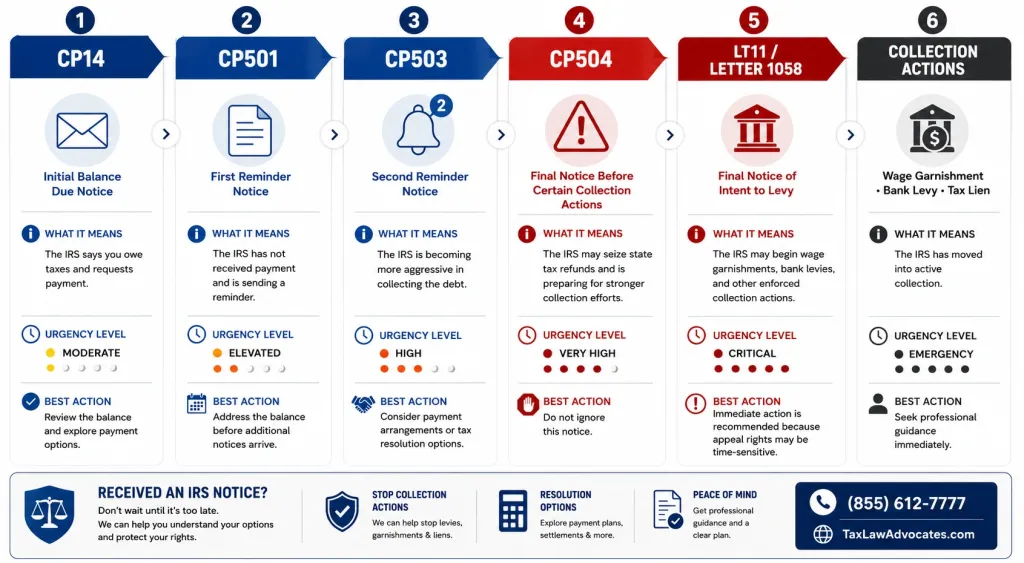
IRS CP Letters: What They Usually Mean
CP notices are among the most common IRS letters taxpayers receive.
“CP” generally refers to “Computer Paragraph” notices generated by the IRS system.
CP14 — Balance Due Notice
This is often one of the first IRS balance notices taxpayers receive.
What This Usually Means
The IRS believes taxes are owed and requests payment or response.
Why Taxpayers Should Not Ignore It
Many people ignore early notices because they assume:
- it is minor,
- they will deal with it later,
- or the IRS will not escalate collections quickly.
CP501 and CP503 — Reminder Notices
These notices generally indicate unresolved balances remain outstanding.
Why These Notices Increase Anxiety
Taxpayers begin realizing:
“The IRS is continuing collections.”
CP504 — Final Notice Before Levy Action
This is one of the most searched IRS notices online.
Why CP504 Creates Panic
The notice may reference:
- levy actions,
- property seizure,
- or escalating collections.
This is often the moment taxpayers begin searching frantically online:
- “Can the IRS take my bank account?”
- “Can the IRS garnish wages?”
- “What happens next?”
IRS LT Letters: Why Taxpayers Fear Them
“LT” notices are another category of IRS collection letters taxpayers commonly search online.
LT11 — Final Notice of Intent to Levy
This is considered a serious IRS collection notice.
Why This Letter Matters
This notice may indicate the IRS is moving closer toward levy enforcement actions if the balance remains unresolved.
Does Every IRS Letter Mean an Audit?
This is one of the most common fears online.
The answer is:
No.
Most IRS letters are not audit notices.
Why Taxpayers Automatically Assume “Audit”
People associate the IRS with:
- investigations,
- audits,
- and punishment.
That emotional fear causes taxpayers to assume the worst immediately.
Can Ignoring IRS Letters Lead to Garnishments or Levies?
Potentially yes, depending on:
- the collection stage,
- unresolved balances,
- and lack of response.
What Usually Happens Before Garnishments
The IRS generally sends:
- multiple notices,
- collection warnings,
- and escalation letters before aggressive collection activity begins.
Why Early Notices Matter More Than People Think
Many taxpayers regret ignoring early notices because earlier action often creates more flexibility.
Why Taxpayers Search IRS Notice Numbers Online
One of the biggest modern taxpayer behaviors is:
Googling the IRS notice number immediately after opening the letter.
People search:
- “What does CP504 mean?”
- “How serious is LT11?”
- “What happens after IRS CP14?”
- “Can I ignore IRS notices?”
Why Taxpayers Trust the Internet First
Many people:
- feel embarrassed,
- fear judgment,
- or panic emotionally before speaking with professionals.
The Biggest IRS Letter Myths Online
Myth #1: “Every IRS Letter Means Immediate Seizure”
False.
Most collection cases involve multiple stages before severe enforcement actions occur.
Myth #2: “Ignoring IRS Letters Makes the Problem Go Away”
False.
Ignoring notices may increase:
- penalties,
- interest,
- and collection pressure.
Myth #3: “The IRS Is About to Arrest Me”
Most IRS collection matters are civil rather than criminal.
How Tax Law Advocates Helps Taxpayers Understand IRS Notices
At Tax Law Advocates, taxpayers often seek guidance after receiving IRS notices because they are unsure:
- how serious the letter is,
- what happens next,
- or whether collections are escalating.
David Cho works on IRS collection and tax resolution matters involving:
Meanwhile, Jamie Roman helps coordinate communication and documentation management throughout IRS resolution matters.
Why Understanding the Notice Matters
IRS notices often contain:
- deadlines,
- rights,
- collection warnings,
- and important procedural information.
What You Should Do After Receiving an IRS Letter
Open the Letter Immediately
Avoidance increases fear and confusion.
Read the Notice Number Carefully
IRS notice numbers often help identify:
- collection stage,
- balance issues,
- or response requirements.
Different IRS letters represent very different levels of urgency.
Do Not Assume the Worst Immediately
Not every IRS notice means:
- audits,
- seizure,
- or garnishments.
Respond Early If the Situation Is Escalating
Earlier action may create:
- more resolution flexibility,
- reduced collection pressure,
- and lower emotional stress.
Final Thoughts on IRS Letters and Collection Notices
IRS letters create enormous fear because taxpayers often associate every notice with financial disaster.
But many taxpayers panic before they even understand what the notice actually means.
Some IRS notices are:
- informational,
- procedural,
- or relatively manageable.
Others may signal escalating collection activity that deserves immediate attention.
At Tax Law Advocates, professionals including Yongho (David) Cho and Jamie Roman help taxpayers understand realistic IRS collection risks and possible next steps after receiving IRS notices.
The most important thing taxpayers can do is stop letting fear control decisions and replace panic with accurate information before IRS problems escalate further.
Frequently Asked Questions
What does CP504 mean from the IRS?
CP504 generally refers to a Final Notice before potential levy enforcement action.
Does every IRS letter mean an audit?
No. Most IRS notices are not audit notices.
What happens if I ignore IRS letters?
Ignoring IRS notices may increase penalties, interest, and collection escalation risks over time.
What is LT11 from the IRS?
LT11 is generally considered a serious collection notice related to levy intent.
Can IRS notices lead to garnishment?
Potentially yes, depending on the collection stage and unresolved tax debt situation.