
S Corp Tax Debt
That Protects Your Business and Your Personal Finances From IRS Collection
$0M+


Discover how much tax debt forgiveness you qualify for.

What Is S Corp Tax Debt?
An S Corporation is a business structure that passes income, losses, and tax obligations through to its shareholders, who report them on their personal tax returns. While this structure offers significant tax advantages, it also creates unique tax obligations that can lead to serious IRS problems when not properly managed.
S Corp tax debt can arise from unpaid payroll taxes, unfiled business returns, shareholder distribution issues, or misclassified income. Because of the pass-through nature of the S Corp structure, tax problems at the business level can quickly become personal tax problems for shareholders and officers.
Why Do People Need S Corp Tax Debt Help?
S Corp owners often discover their tax problems have grown far beyond what they expected, particularly when payroll taxes, estimated payments, and shareholder reporting requirements are not handled correctly from the start.
The IRS has the authority to:
- Assess payroll tax liabilities directly against responsible shareholders
- File federal tax liens against both the business and individual shareholders
- Levy business and personal bank accounts to collect outstanding debt
- Revoke S Corp status for failure to comply with IRS requirements
Professional S Corp tax debt resolution protects both your business structure and your personal finances from IRS enforcement.

Common Problems S Corp Tax Debt Resolution Handles
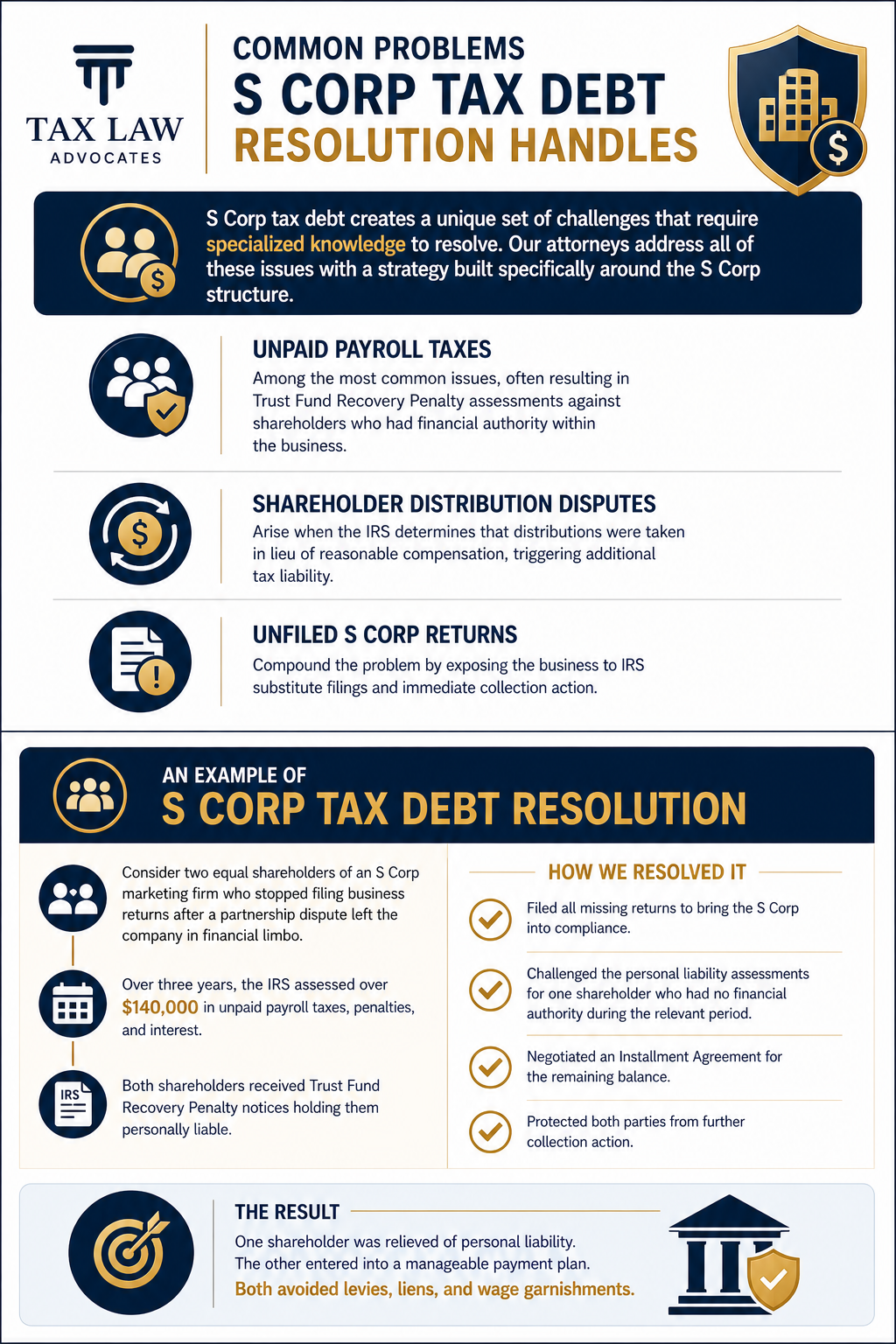
S Corp tax debt creates a unique set of challenges that require specialized knowledge to resolve. Unpaid payroll taxes are among the most common issues, often resulting in Trust Fund Recovery Penalty assessments against shareholders who had financial authority within the business. Shareholder distribution disputes arise when the IRS determines that distributions were taken in lieu of reasonable compensation, triggering additional tax liability. Unfiled S Corp returns compound the problem by exposing the business to IRS substitute filings and immediate collection action. Our attorneys address all of these issues with a strategy built specifically around the S Corp structure.
S Corp Tax Calculator
An S corp tax calculator can give owners a general estimate of their personal tax liability based on salary, distributions, and business profit, but it can’t account for back taxes, penalties, or interest already owed to the IRS. Many S corp owners turn to these tools when they suspect their reasonable salary or distribution split may have caused an underpayment, and that instinct is often worth acting on. If your estimate suggests you owe more than expected, or if you’re already carrying a balance from a prior year, a calculator only tells part of the story. Tax Law Advocates can help you understand your actual liability and what’s driving it, so you’re working with real numbers instead of estimates.
S Corp Payroll Requirements
Eligibility for S Corp tax debt relief depends on the nature of the debt, the current status of the business, and the financial situation of the shareholders involved.
S corp owners who work in the business are generally required to pay themselves a reasonable salary through formal payroll (Forms 940 & 941), with the associated payroll taxes withheld and remitted, before taking any distributions. Skipping payroll altogether, or underpaying salary while taking large distributions, is a common source of IRS problems for S corp owners. If your S corp hasn’t been running payroll correctly, Tax Law Advocates can help you understand your exposure and next steps.
The Truth About S Corp Tax Debt Relief: Pros, Cons & What the IRS Says
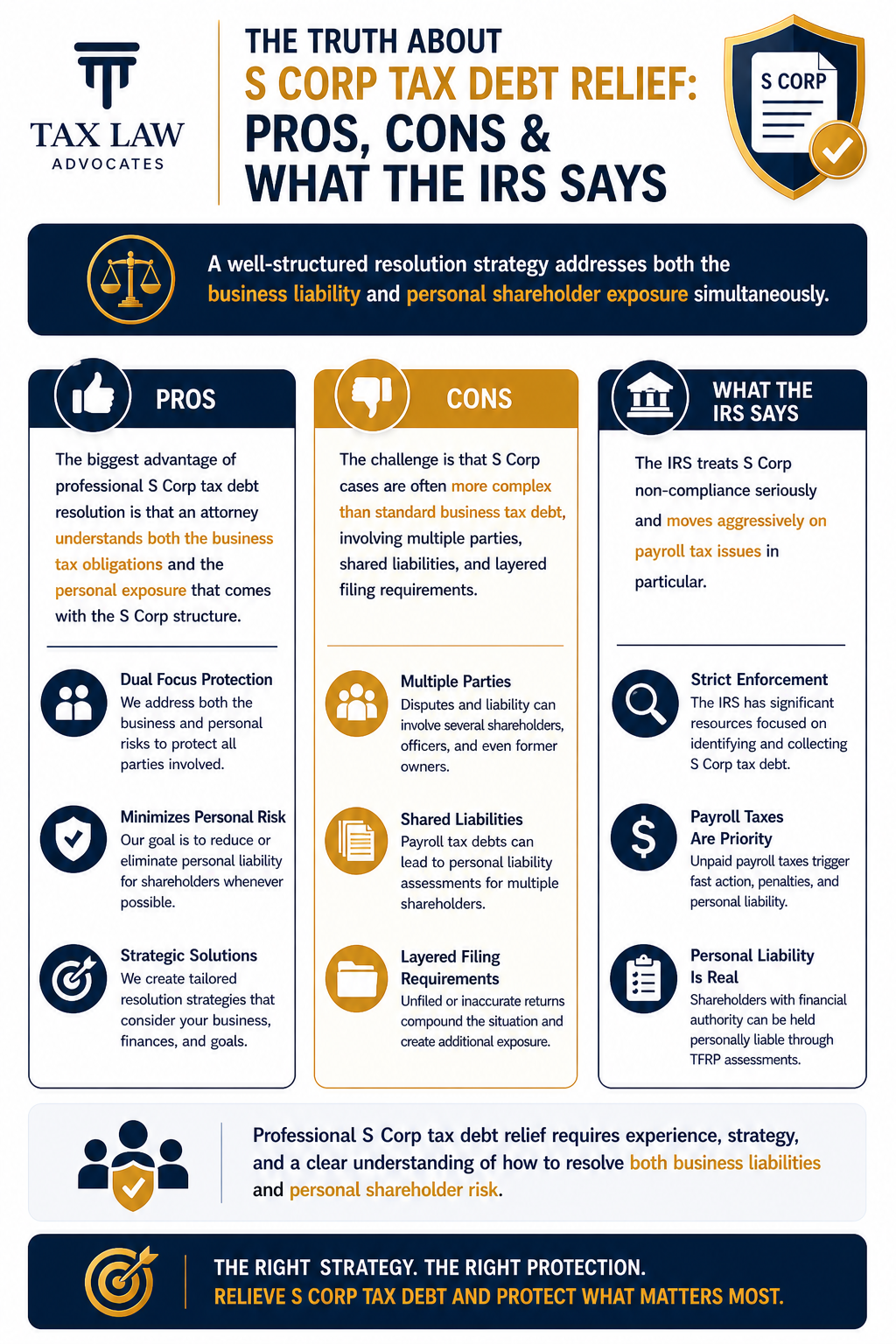
The biggest advantage of professional S Corp tax debt resolution is that an attorney understands both the business tax obligations and the personal exposure that comes with the S Corp structure. This dual focus is critical to protecting all parties involved. The challenge is that S Corp cases are often more complex than standard business tax debt, involving multiple parties, shared liabilities, and layered filing requirements. The IRS treats S Corp non-compliance seriously and moves aggressively on payroll tax issues in particular. A well-structured resolution strategy addresses both the business liability and personal shareholder exposure simultaneously.
What S Corp Tax Debt Relief Options Are Available to Me?
Several IRS-approved resolution programs are available for S Corp tax debt depending on the specifics of your situation.
An Installment Agreement allows the business and or individual shareholders to repay the outstanding balance over time in structured monthly payments. An Offer in Compromise may allow for a settlement of the total debt for less than the full amount owed if financial hardship can be demonstrated. Penalty Abatement can reduce the total balance in cases where reasonable cause for non-compliance exists. Currently Not Collectible status may be available to pause collection activity if neither the business nor the shareholders can make payments at this time.
Tax Deductions for S Corp Owners
S corp owners can deduct legitimate business expenses, such as salaries, benefits, and certain operating costs, before profit passes through to their personal return. Missing eligible deductions can mean overpaying, while overstating them can trigger IRS scrutiny and additional unpaid taxes owed once corrected. If you’re concerned that deductions were handled incorrectly on a prior return, Tax Law Advocates can help you review what happened and address any resulting liability.
S Corp Distributions
S corp distributions are payments made to shareholders from the company’s profits, separate from any salary the owner receives as an employee. Distributions themselves aren’t subject to payroll tax, which is part of what makes the S corp structure appealing, but the IRS requires owners to also pay themselves a reasonable salary first. When salary is set too low relative to distributions, it can raise IRS questions and lead to reclassified income, back payroll taxes, and penalties. Tax Law Advocates can help you assess your exposure and correct course.
How Are S Corp Distributions Taxed
S corp distributions are generally not subject to self-employment or payroll tax, since they’re treated as a return of the shareholder’s investment in the company rather than compensation for work performed. If the IRS determines that distributions were used to avoid payroll tax by paying an artificially low salary, it can reclassify some of those distributions as wages, resulting in back taxes and a possible Trust Fund Recovery Penalty assessment. Tax Law Advocates can help you understand what the IRS is looking at and what your options are.
S Corp Distribution Tax Rate
There isn’t a single flat tax rate on S corp distributions, since they aren’t taxed as wages but instead pass through to the shareholder’s personal return as part of the business’s overall profit. The actual tax impact depends on your total income and your tax bracket, along with whether your salary-to-distribution split holds up under IRS scrutiny. Tax Law Advocates can help you break down what happened and what to do next.
S Corp Tax Benefits
The S corp structure offers real tax advantages, particularly the ability to take distributions that aren’t subject to self-employment tax, which can reduce an owner’s overall tax burden compared to other business structures. These benefits depend on following IRS rules correctly, including paying a reasonable salary and maintaining proper records. When those requirements aren’t met, what should be a tax advantage can instead become a liability, especially if the IRS reclassifies distributions after the fact. If you’re unsure whether your S corp is actually structured to deliver these benefits safely, Tax Law Advocates can help you review your setup and address any risk before it becomes a bigger problem.
Shareholder Distribution S Corp
A shareholder distribution is a payment from the S corp to an owner based on their share of company profit, separate from any wages paid for work performed. The IRS pays close attention to the relationship between shareholder distributions and salary, since disproportionately high distributions relative to a low or nonexistent salary is a recognized red flag. When this pattern draws IRS attention, the result can be reclassified income, back taxes, and penalties that go beyond what was originally owed. If you’re dealing with an IRS inquiry into your shareholder distributions, Tax Law Advocates can help you understand the issue and work toward resolution.
Why Work With a Tax Attorney for S Corp Tax Debt?
S Corp tax debt is not a straightforward resolution case. The overlap between business liability and personal shareholder exposure requires an attorney who understands both sides of the equation. Working with a tax attorney gives you:
- Legal representation for both the business and individual shareholders
- Strategic defense against Trust Fund Recovery Penalty assessments
- Expert negotiation to resolve business and personal tax debt simultaneously
- Full compliance support including all unfiled S Corp returns
Tax Law Advocates brings the legal expertise needed to protect your business structure, your personal finances, and your future. When the IRS comes after your S Corp, you need attorneys who understand every angle of the fight.
Why Tax Law Advocates
Tax Attorney: David Cho
David Cho, Lead Tax Attorney at Tax Law Advocates, brings deep expertise in federal and state tax resolution.
He earned both his J.D. and LL.M. in Taxation from the University of California, Irvine School of Law. His approach focuses on practical, results-driven solutions that help clients regain financial stability.
In one case, he helped a client who was a victim of a tax scam by preparing and submitting a strategic Offer in Compromise—guiding them toward meaningful financial recovery.
Real Client
Scenarios
One client came to us facing wage garnishment while struggling to cover basic living expenses. After reviewing their financials, we positioned their case for hardship status, stopping collections.
Another client believed they had no options. By restructuring their financial presentation, we demonstrated eligibility for relief and prevented enforcement actions.
In a third case, we combined immediate protection with a long-term resolution plan, giving the client both relief and stability.
Meet Your Lead Tax Attorney and Enrolled Agent for IRS Debt Relief & Tax Resolution You Can Trust

David Cho
David Cho
Scott Mullerleile
EA with 12+ years in tax resolution and a background in collections. Scott has successfully handled hundreds of cases, including accepted Offers in Compromise and representation before Revenue Officers, audits, and appeals.

Our IRS Tax Relief Results by the Numbers
Proven results helping clients resolve IRS and state tax debt nationwide.
$0M+
Tax Debt Resolved for Clients
0K+
Clients served
0%
Handled by Tax Attorneys
0%
Cases Successfully Resolved
24hr
Average Case Action Time
0
Years of experience
Tax Law Advocates Client Success Stories
Jonnel Bolotano with Tax Law Advocates was amazing to work with. Even though I didn’t initially start my case with him, he stepped in, took charge, and stayed on top of everything from that point forward.

ItzMiBaebii
If I could give Tax Law Advocates more than 5 stars, I absolutely would. Jamie and Scott were my dream team, steady, sharp, and on top of every detail. I came in with a heavy tax burden that felt like it would follow me forever...

Rebecca Ingram
Jesse Moreno my tax lawyer did a wonderful job on my case. She was very patient kind and professional, and resolution that I received was better than I expected! Thank you Jesse for representing me!

Debbie Kern
FAQ Section
What are tax resolution services?
They are professional services that help resolve tax debt through negotiation and IRS programs.
Can tax resolution reduce my debt?
Yes, in some cases through programs like Offer in Compromise.
How Are Distributions Taxed in an S Corp
Distributions in an S corp pass through to shareholders and are generally taxed as part of the business's overall income on the owner's personal return, rather than being subject to separate payroll taxes. This structure only holds up, however, if the IRS agrees that the owner's salary was reasonable for the work performed before distributions were taken. When that isn't the case, the IRS can reclassify distributions as wages, creating back payroll tax liability plus penalties. If you've received a notice questioning how your distributions were taxed, or you're unsure whether your prior returns handled this correctly, Tax Law Advocates can help you sort through it.
How long does the process take?
It varies from weeks to several months depending on the case.
Will the IRS stop collections immediately?
In some cases, actions can be paused once representation begins.
Do I need a tax attorney?
It’s highly recommended for complex or high-value cases.
Can penalties be removed?
Yes, through penalty abatement if you qualify.
Is this available nationwide?
Yes, services are available in all 50 states.
What if I can’t pay anything?
You may qualify for hardship status.
Is the consultation free?
Yes, initial case reviews are free.