




Discover how much tax debt forgiveness you qualify for.
What Is Payroll Tax 940 & 941?
Form 941 is filed quarterly and covers federal income tax, Social Security, and Medicare taxes withheld from employee wages. Form 940 is filed annually and covers Federal Unemployment Tax (FUTA). Both are mandatory federal obligations for any business with employees.
Falling behind on either form triggers immediate IRS enforcement , including steep penalties, compounding interest, and aggressive collection action. At Tax Law Advocates, we work directly with the IRS to stop collections and resolve your payroll tax debt.
Why Do People Need Payroll Tax 940 & 941 Help?
Most business owners fall behind due to cash flow problems, not negligence. A slow quarter, a late client payment, or an unexpected expense , and suddenly payroll tax deposits get pushed back. The IRS, however, doesn’t consider the reason.
Payroll tax resolution exists to stop these actions and create a plan to resolve your debt before the IRS forces your hand.
Form 940 Instructions
Form 940 is the annual return businesses use to report and pay Federal Unemployment Tax (FUTA), which funds unemployment benefits for workers who lose their jobs. Mistakes on Form 940, like miscalculating the credit or misreporting wages, can lead to IRS notices or an underpayment that grows with penalties and interest over time. If you’re behind on FUTA filings, Tax Law Advocates can help you understand what went wrong and bring your account current.
Form 941 Instructions
Form 941 is the quarterly return employers use to report withheld income tax, Social Security, and Medicare taxes, and the instructions guide you through calculating these amounts accurately for each quarter. Because Form 941 involves money withheld from employees’ paychecks, unpaid amounts can lead to the Trust Fund Recovery Penalty being assessed against responsible individuals personally. Tax Law Advocates can help you understand your current payroll tax standing and the options available to resolve it.
Where to Mail 940 Return
The correct mailing address for Form 940 depends on your business’s location and whether you’re including a payment with your return. Sending your return to the wrong address can delay processing, which matters if penalties are accruing on unpaid FUTA tax in the meantime. If a Form 940 filing has already gone wrong and led to a balance due, Tax Law Advocates can help you sort out the filing and, if needed, discuss an installment agreement for the resulting liability.
Where to Mail Form 941
Form 941, the quarterly payroll tax return, must be mailed to the correct IRS address based on your business’s state and whether a payment is included with the filing. Sending it to the wrong location can cause processing delays, which is especially risky given how quickly payroll tax penalties can accumulate. Tax Law Advocates can help you get current and address any resulting liability.
Where to Send Form 941 Without Payment
When you’re filing Form 941 without an accompanying payment, the IRS designates a specific mailing address that differs from the one used for returns submitted with payment. If you’re catching up on unfiled 941 returns, this often overlaps with broader tax preparation needs. Tax Law Advocates can help you make sure your filings and your standing with the IRS are accurate.
Who Is Eligible for Payroll Tax 940 & 941 Relief in 2026?
Eligibility isn’t based on one single factor, it’s based on your overall financial picture.
You may qualify if:
- You have unfiled Form 940 or 941 returns
- Your business cannot pay the full payroll tax balance
- You are facing IRS levies, liens, or a Trust Fund Recovery Penalty assessment
- You are a business owner being held personally liable for payroll tax debt
The IRS evaluates your income, expenses, and assets to determine which resolution options are available to you. This is precisely why professional representation is so critical.
Federal Unemployment Tax
Federal unemployment tax, commonly known as FUTA, is a tax employers pay to fund unemployment compensation programs, reported annually on Form 940. When state payments are late or a business falls behind on FUTA obligations, the resulting liability can accumulate penalties and interest similarly to back taxes. Tax Law Advocates can help you assess your FUTA tax debt and work toward a resolution.
FUTA 940 Instructions
FUTA, the Federal Unemployment Tax Act, is reported annually on Form 940, and the instructions walk employers through determining which wages are taxable and how much is owed after applicable credits. If you’ve received an unexpected FUTA liability, this is a common source of underpayment that can turn into unpaid taxes if not addressed. Tax Law Advocates can help you review what happened and determine next steps.
Internal Revenue Service Form 940
Form 940 is filed directly with the Internal Revenue Service to report a business’s annual FUTA tax liability, and it exists alongside separate state unemployment tax filing requirements. When FUTA tax goes unpaid or unfiled, penalties and interest accrue similarly to other payroll tax debt, and the IRS can pursue collection. Tax Law Advocates can help you understand your exposure and address it directly.
The Truth About Payroll Tax 940 & 941 Relief: Pros, Cons & What the IRS Says
The biggest advantage of professional resolution is that you stop facing the IRS alone, a tax attorney knows the system, the deadlines, and how to negotiate effectively. However, payroll tax relief is not instant. It requires full financial disclosure and staying current on all future tax obligations. The IRS recognizes Installment Agreements, penalty abatement, and other programs , but only when properly documented and submitted.
What Payroll Tax 940 & 941 Relief Options Are Available to Me?
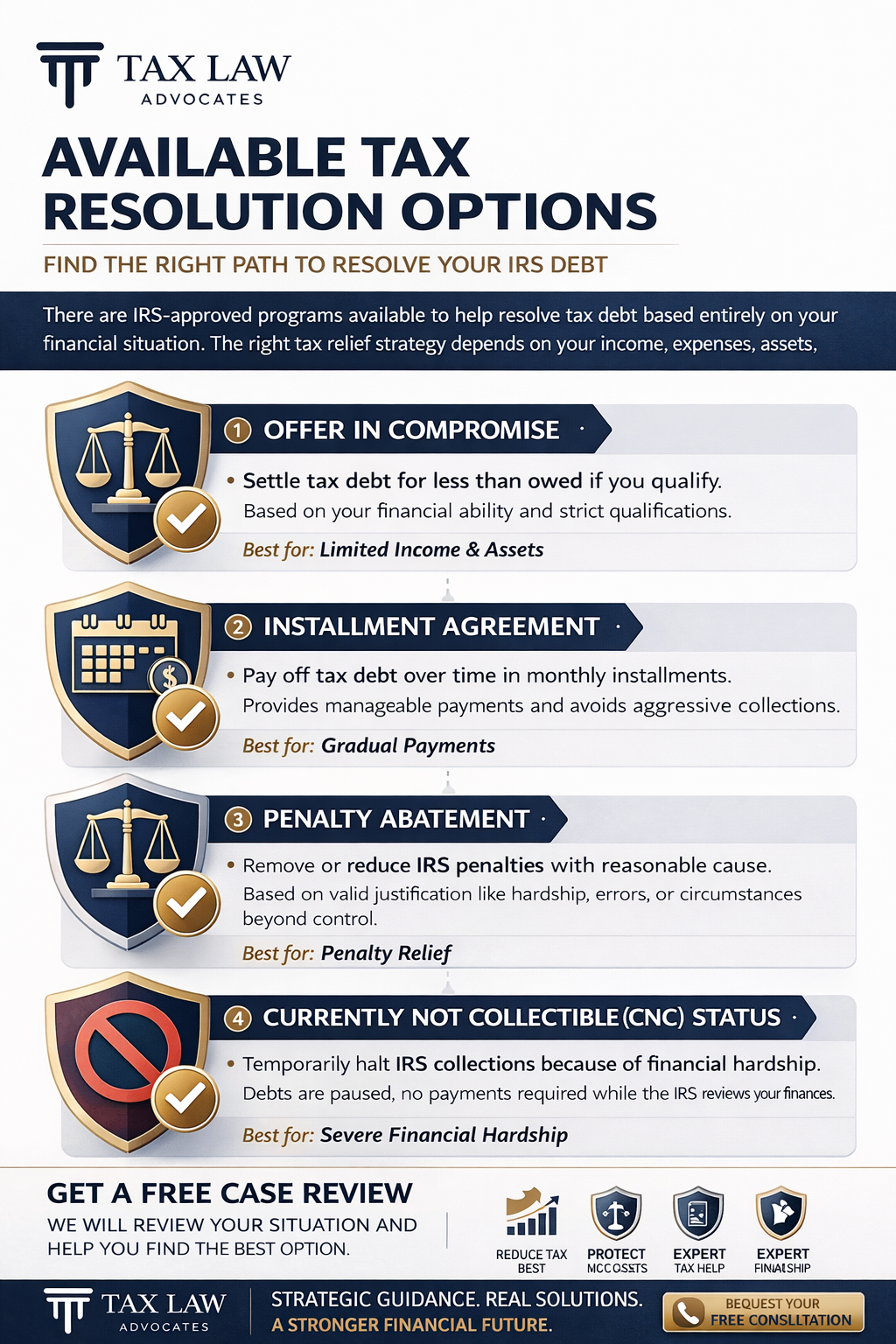
There are several IRS-approved programs available depending on your situation.
An Offer in Compromise may allow you to settle your debt for less than the full amount owed if you qualify. An Installment Agreement lets you pay over time in manageable monthly payments. Penalty Abatement may reduce or eliminate penalties if reasonable cause can be demonstrated. Some cases may also qualify for Currently Not Collectible status, which temporarily pauses all collection actions.
The right solution depends entirely on your financial circumstances.
How to Apply for Payroll Tax 940 & 941 Relief in 2026?
Applying for payroll tax resolution is more than just filling out a form. You will need to:
- Gather detailed financial records
- File all missing 940 and 941 returns
- Complete IRS financial disclosure forms
- Submit a properly documented resolution proposal
Having a tax attorney represent you is critical, errors or incomplete disclosures can result in a rejected application and accelerated IRS collection.
Why Work With a Tax Attorney for Payroll Tax 940 & 941?
Tax resolution is not a do-it-yourself legal strategy. Working with a tax attorney gives you:
- Legal representation before the IRS
- Protection of your personal assets from Trust Fund liability
- Expert negotiation to reduce penalties and secure repayment terms
- Full compliance support for all unfiled returns
- Unlike tax relief companies, Tax Law Advocates puts licensed attorneys on your case from day one. The IRS has attorneys working for them, you should too.
Why Tax Law Advocates
Tax Attorney: David Cho
Real Client
Scenarios
One client came to us facing wage garnishment while struggling to cover basic living expenses. After reviewing their financials, we positioned their case for hardship status, stopping collections.
Another client believed they had no options. By restructuring their financial presentation, we demonstrated eligibility for relief and prevented enforcement actions.
In a third case, we combined immediate protection with a long-term resolution plan, giving the client both relief and stability.
Meet Your Lead Tax Attorney and Enrolled Agent for IRS Debt Relief & Tax Resolution You Can Trust
David Cho
David Cho
Scott Mullerleile
EA with 12+ years in tax resolution and a background in collections. Scott has successfully handled hundreds of cases, including accepted Offers in Compromise and representation before Revenue Officers, audits, and appeals.
Our IRS Tax Relief Results by the Numbers
Proven results helping clients resolve IRS and state tax debt nationwide.
$0M+
Tax Debt Resolved for Clients
0K+
Clients served
0%
Handled by Tax Attorneys
0%
Cases Successfully Resolved
24hr
Average Case Action Time
0
Years of experience
Tax Law Advocates Client Success Stories
Jonnel Bolotano with Tax Law Advocates was amazing to work with. Even though I didn’t initially start my case with him, he stepped in, took charge, and stayed on top of everything from that point forward.
ItzMiBaebii
If I could give Tax Law Advocates more than 5 stars, I absolutely would. Jamie and Scott were my dream team, steady, sharp, and on top of every detail. I came in with a heavy tax burden that felt like it would follow me forever...
Rebecca Ingram
Jesse Moreno my tax lawyer did a wonderful job on my case. She was very patient kind and professional, and resolution that I received was better than I expected! Thank you Jesse for representing me!
Debbie Kern
FAQ
What are tax resolution services?
They are professional services that help resolve tax debt through negotiation and IRS programs.
Can tax resolution reduce my debt?
Yes, in some cases through programs like Offer in Compromise.
Do I qualify for tax relief?
It depends on your income, assets, and financial hardship.
How long does the process take?
It varies from weeks to several months depending on the case.
Will the IRS stop collections immediately?
In some cases, actions can be paused once representation begins.
Do I need a tax attorney?
It’s highly recommended for complex or high-value cases.
Can penalties be removed?
Yes, through penalty abatement if you qualify.
Is this available nationwide?
Yes, services are available in all 50 states.
What if I can’t pay anything?
You may qualify for hardship status.
Is the consultation free?
Yes, initial case reviews are free.
