



IRS Business Installment Agreement

That Puts You Back in Control and Keeps Your Business Running

$0M+

Tax Debt Resolved

Discover how much tax debt forgiveness you qualify for.

This field is for validation purposes and should be left unchanged.
Your Name(Required)
TLA-webimage-25

What Is an IRS Business Installment Agreement?

An IRS Business Installment Agreement is a formal payment arrangement that allows businesses to pay off outstanding federal tax debt over time in structured monthly payments. Instead of facing immediate collection action, your business gets a manageable path to full compliance.

This agreement is one of the most widely used tax resolution options available to businesses. It stops collection activity, prevents asset seizures, and gives you the breathing room needed to get back on track financially.

Why Do People Need an IRS Business Installment Agreement?

Most businesses that pursue an Installment Agreement are fully operational and generating revenue but simply cannot pay their entire tax debt in one lump sum. The balance may have grown due to penalties and interest, or a difficult period left the business financially stretched.

The IRS has the authority to:

  • Seize business assets and equipment
  • Levy business bank accounts without warning
  • File federal tax liens that damage your business credit
  • Garnish incoming receivables and revenue
  • An IRS Business Installment Agreement stops these actions in their tracks and replaces enforcement with a structured repayment plan.
tax-law-advocates (4)

Common Problems IRS Business Installment Agreement Resolution Handles

Businesses pursuing installment agreements face a range of challenges beyond just the tax balance itself. Unfiled returns must be brought current before the IRS will consider any agreement, which many businesses struggle to navigate alone. Penalty and interest accumulation can make the total balance feel impossible to repay, requiring a strategic approach to negotiate realistic payment terms. Existing federal tax liens can complicate business operations and financing, and need to be addressed as part of the resolution process. Our attorneys manage every step to make sure the agreement is structured in a way that works for your business.

IRS Installment Agreement Form

The IRS installment agreement form is the document businesses use to formally request a monthly payment plan for tax debt instead of paying the full balance at once. Depending on your situation, this may be Form 9465 or an application submitted through the IRS’s online system. The right form and process depend on how much you owe, the type of tax involved, and whether you’re applying as a business or an individual. Tax Law Advocates can help you determine which installment agreement option applies to your case and make sure it’s completed accurately the first time.

Installment Agreement Request Form 9465

Form 9465 is the IRS’s standard form for requesting a monthly payment plan for unpaid taxes. While it’s commonly associated with individual tax debt, businesses may also use it in certain circumstances, depending on the type of tax owed and the amount. The form asks for financial details that the IRS uses to evaluate your proposed payment amount, so accuracy is important. An incomplete or inconsistent submission can lead to processing delays or a counteroffer from the IRS that doesn’t reflect what your business can actually afford. Tax Law Advocates can help prepare and review Form 9465 so your request is presented clearly and accurately from the start.

Where to Mail Form 9465

The correct mailing address for Form 9465 depends on where you live or where your business is located, as the IRS assigns different processing centers by region. Using the wrong address can delay processing by weeks, which matters if penalties and interest are accruing on an unpaid tax balance in the meantime. If you’re unsure which address applies, Tax Law Advocates can help you confirm the right path so your request doesn’t get delayed unnecessarily.

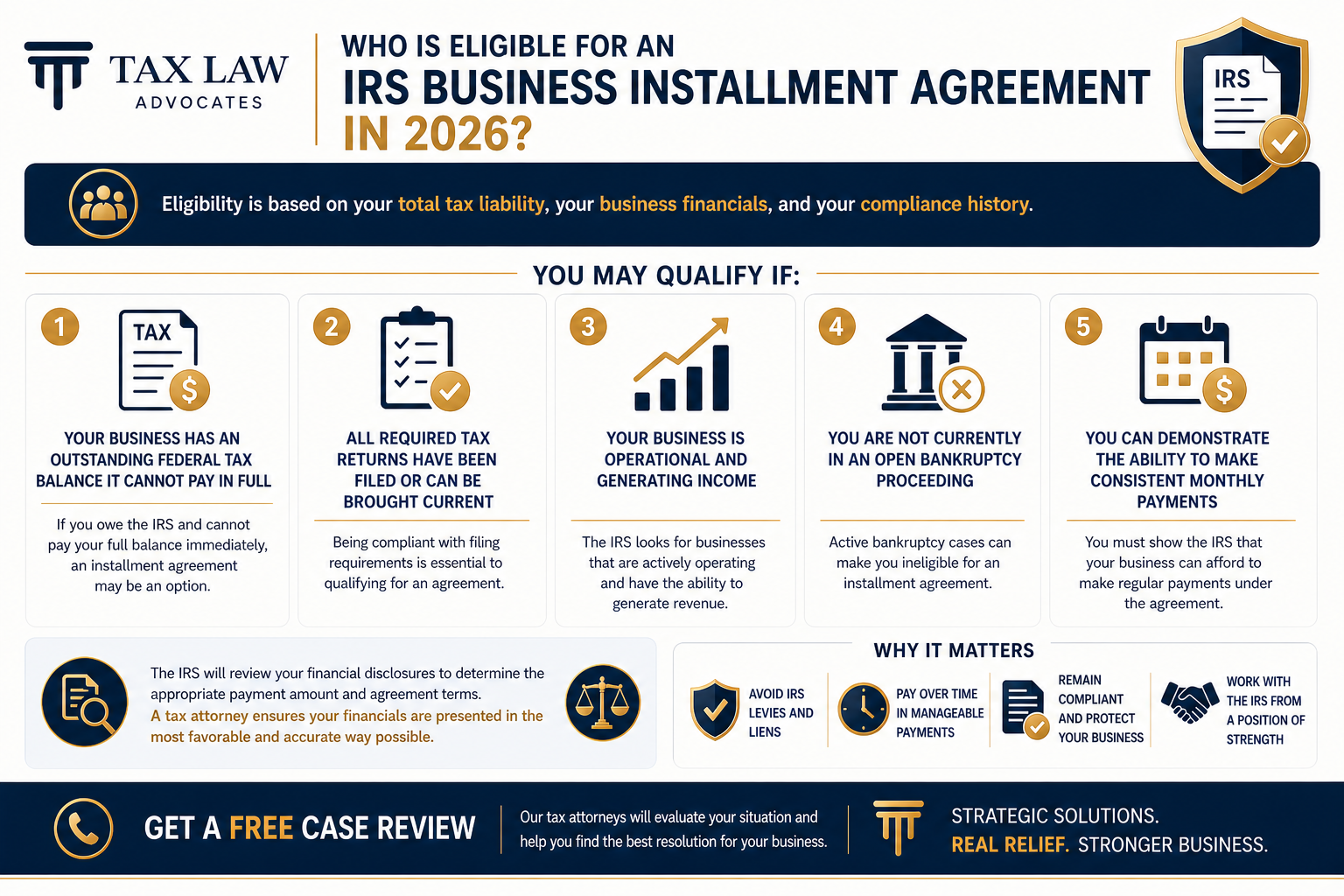
Who Is Eligible for an IRS Business Installment Agreement in 2026?

Eligibility is based on your total tax liability, your business financials, and your compliance history.

You may qualify if:

  • Your business has an outstanding federal tax balance it cannot pay in full
  • All required tax returns have been filed or can be brought current
  • Your business is operational and generating income
  • You are not currently in an open bankruptcy proceeding
  • You can demonstrate the ability to make consistent monthly payments
  • The IRS will review your financial disclosures to determine the appropriate payment amount and agreement terms. A tax attorney ensures your financials are presented in the most favorable and accurate way possible.

The Truth About IRS Business Installment Agreements: Pros, Cons & What the IRS Says

The biggest advantage of an Installment Agreement is immediate relief from IRS collection activity. Once accepted, levies stop, and your business can operate without the constant threat of enforcement. Penalties and interest do continue to accrue on the remaining balance during the repayment period, which is an important factor to account for when structuring your agreement. The IRS supports Installment Agreements as a preferred resolution tool, but requires strict compliance with all future tax obligations. Falling behind on a new tax liability while under an agreement can cause it to default.

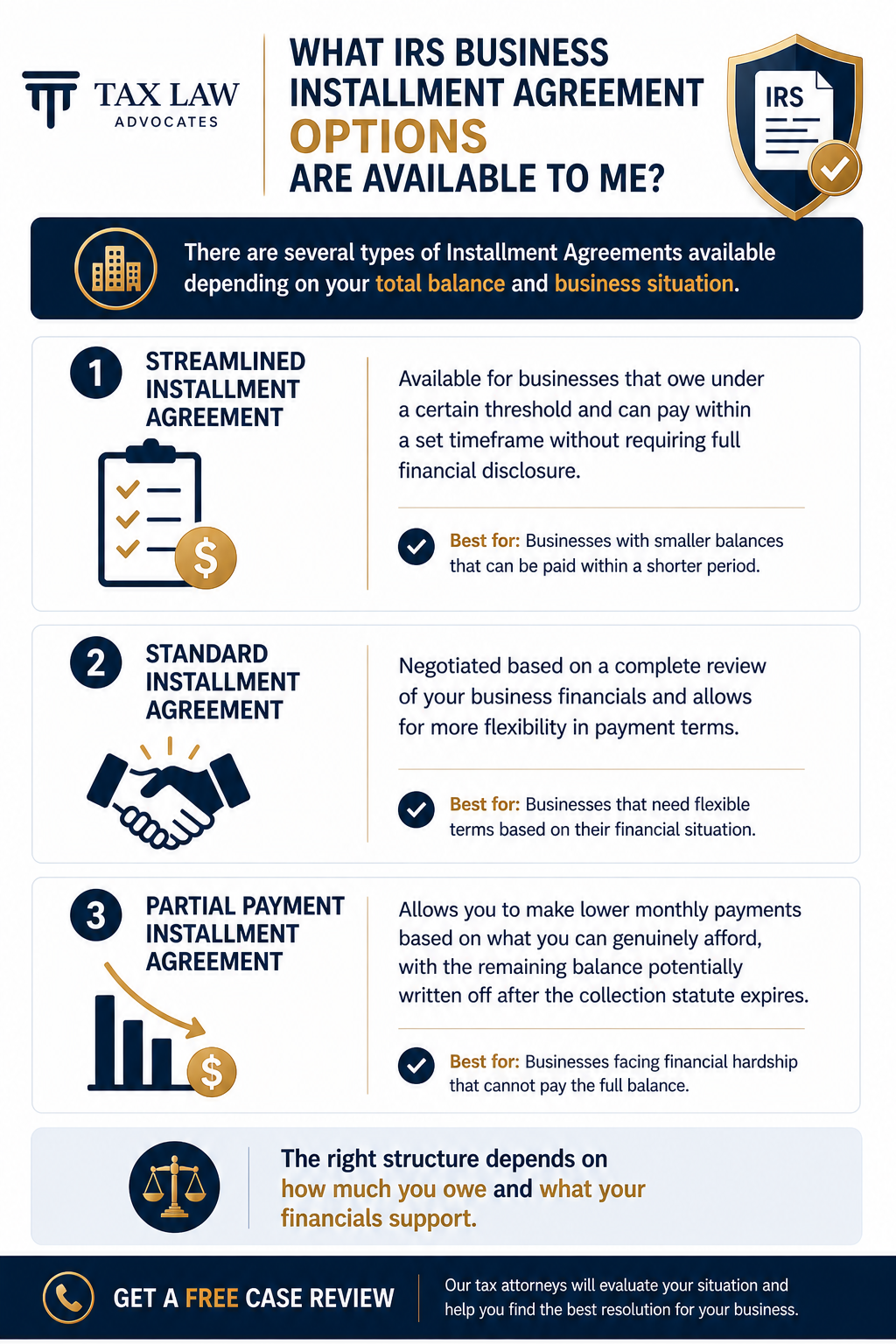
What IRS Business Installment Agreement Options Are Available to Me?

There are several types of Installment Agreements available depending on your total balance and business situation.

A Streamlined Installment Agreement is available for businesses that owe under a certain threshold and can pay within a set timeframe without requiring full financial disclosure. A Standard Installment Agreement is negotiated based on a complete review of your business financials and allows for more flexibility in payment terms. A Partial Payment Installment Agreement allows you to make lower monthly payments based on what you can genuinely afford, with the remaining balance potentially written off after the collection statute expires. The right structure depends on how much you owe and what your financials support.

Can You Pay Taxes in Installments?

Yes, the IRS allows both individuals and businesses to pay tax debt over time through an installment agreement, rather than in one lump sum. This option exists because the IRS generally prefers a manageable, ongoing payment to unpaid taxes that go unpaid entirely. Setting up a payment plan is often a real solution, but the terms matter as much as the approval itself. Tax Law Advocates can help you understand what a realistic, sustainable installment agreement looks like for your business before you commit to one.

Can You Have 2 Installment Agreements With the IRS?

Generally, the IRS does not allow two separate active installment agreements at the same time. If a business already has a payment plan in place and incurs a new tax liability, the existing agreement typically needs to be modified to include the new debt, rather than starting a second, separate agreement. Tax Law Advocates can help you determine how to properly incorporate new tax debt into an existing installment agreement, or restructure it, so your standing with the IRS stays intact.

Installment Agreement for Payroll Taxes

Payroll tax debt is treated more seriously by the IRS than most other business tax liabilities, since a portion of payroll tax (Forms 940 & 941) represents money withheld from employees’ wages. Falling behind on these payments can lead to significant penalties, and in some cases, the Trust Fund Recovery Penalty against business owners or responsible parties personally. Tax Law Advocates has experience navigating payroll tax cases specifically and can help you understand your exposure and your options.

Online Payment Plan

The IRS offers an online payment plan application that allows many individuals and some businesses to set up an installment agreement without mailing in paperwork. This option can be faster than a paper request and, for qualifying balances, may provide an immediate response. However, not every business or every type of tax debt is eligible to apply online, and the terms offered through the automated system aren’t always the most favorable option available. Before applying, it’s worth understanding whether the online plan is actually the best fit for your situation or whether a different approach could serve you better. Tax Law Advocates can help you evaluate your options before you commit to a plan through the IRS’s online system.

Streamlined Installment Agreement

A streamlined installment agreement is a type of payment plan with simplified approval requirements, generally available to taxpayers who owe under a certain threshold and can pay off the balance within a set number of years. If you’re not sure whether your business qualifies for this simplified option, Tax Law Advocates can review your balance and help determine the most efficient path to an approved agreement, or whether the IRS Fresh Start Program offers a better fit.

IRS Form for Payment Arrangement

The specific IRS form needed to request a payment arrangement depends on your circumstances, including how much your business owes, whether the debt involves payroll taxes or other business taxes, and whether you’re applying online or by mail. Getting this right from the outset saves time and reduces the risk of default down the line. Tax Law Advocates can help you identify the correct form for your situation and guide you through submitting a request built around your business’s actual financial picture.

Why Work With a Tax Attorney for an IRS Business Installment Agreement?

Negotiating directly with the IRS without representation puts you at a significant disadvantage. Working with a tax attorney gives you:

  • Legal representation throughout the entire negotiation process
  • Accurate financial disclosure that presents your situation favorably
  • Strategic structuring of payment terms to protect your cash flow
  • Ongoing compliance support to keep your agreement in good standing

Tax Law Advocates fights to get your business the most favorable agreement terms possible. We handle the IRS so you can focus on running your business.

Why Tax Law Advocates

At Tax Law Advocates, everything we do is focused on results, transparency, and client protection. We bring over 16 years of experience in handling IRS cases across the country. Our team uses proprietary analysis tools and proven negotiation strategies to create tailored solutions. You’re not treated like a case number—you’re treated like a client with a real financial future at stake.

Tax Attorney: David Cho

David Cho, Lead Tax Attorney at Tax Law Advocates, brings deep expertise in federal and state tax resolution.
He earned both his J.D. and LL.M. in Taxation from the University of California, Irvine School of Law. His approach focuses on practical, results-driven solutions that help clients regain financial stability.
In one case, he helped a client who was a victim of a tax scam by preparing and submitting a strategic Offer in Compromise—guiding them toward meaningful financial recovery.

Real Client
Scenarios

One client came to us facing wage garnishment while struggling to cover basic living expenses. After reviewing their financials, we positioned their case for hardship status, stopping collections.
Another client believed they had no options. By restructuring their financial presentation, we demonstrated eligibility for relief and prevented enforcement actions.
In a third case, we combined immediate protection with a long-term resolution plan, giving the client both relief and stability.

Meet Your Lead Tax Attorney and Enrolled Agent for IRS Debt Relief & Tax Resolution You Can Trust

David Cho

Tax attorney with a J.D. and LL.M. in Taxation from UCI Law. David focuses on practical tax resolution strategies, helping clients navigate IRS and state issues with clear, solution-driven guidance.

David Cho

Tax attorney with a J.D. and LL.M. in Taxation from UCI Law. David focuses on practical tax resolution strategies, helping clients navigate IRS and state issues with clear, solution-driven guidance.

Scott Mullerleile

EA with 12+ years in tax resolution and a background in collections. Scott has successfully handled hundreds of cases, including accepted Offers in Compromise and representation before Revenue Officers, audits, and appeals.

Scott Mullerleile

EA with 12+ years in tax resolution and a background in collections. Scott has successfully handled hundreds of cases, including accepted Offers in Compromise and representation before Revenue Officers, audits, and appeals.

Our IRS Tax Relief Results by the Numbers

Proven results helping clients resolve IRS and state tax debt nationwide.

$0M+

Tax Debt Resolved for Clients

0K+

Clients served

0%

Handled by Tax Attorneys

0%

Cases Successfully Resolved

24hr

Average Case Action Time

0

Years of experience

Tax Law Advocates Client Success Stories

Jonnel Bolotano with Tax Law Advocates was amazing to work with. Even though I didn’t initially start my case with him, he stepped in, took charge, and stayed on top of everything from that point forward.

ItzMiBaebii

If I could give Tax Law Advocates more than 5 stars, I absolutely would. Jamie and Scott were my dream team, steady, sharp, and on top of every detail. I came in with a heavy tax burden that felt like it would follow me forever...

Rebecca Ingram

Jesse Moreno my tax lawyer did a wonderful job on my case. She was very patient kind and professional, and resolution that I received was better than I expected! Thank you Jesse for representing me!

Debbie Kern

FAQ

They are professional services that help resolve tax debt through negotiation and IRS programs.

Yes, in some cases through programs like Offer in Compromise.

It depends on your income, assets, and financial hardship.

It varies from weeks to several months depending on the case.

In some cases, actions can be paused once representation begins.

It’s highly recommended for complex or high-value cases.

Yes, through penalty abatement if you qualify.

Yes, services are available in all 50 states.

You may qualify for hardship status.

Yes, initial case reviews are free.

Speak directly with a tax attorney. No obligation. Just real answers.