
IRS Installment Agreement
A Smarter Way to Pay Your Tax Debt Without the Pressure
$0M+


Discover how much tax debt forgiveness you qualify for.
If you’re dealing with IRS debt and can’t pay everything upfront, you’re not alone, and more importantly, you’re not out of options. The Internal Revenue Service actually offers structured payment plans called IRS installment agreements, designed to give you breathing room while staying compliant. But here’s what most people don’t realize… Not all payment plans are created equal, and choosing the wrong one could mean paying more than you need to, for longer than necessary.

What is an Installment Agreement (Form 9465)?
An IRS installment agreement is essentially a payment plan that allows you to pay off your tax debt over time instead of all at once.
Most people request it using Form 9465, although it can also be set up online or negotiated directly depending on your situation. At a basic level, it sounds simple, you owe taxes, and the IRS lets you pay monthly. But in reality, there’s more happening behind the scenes.
The IRS evaluates your financial situation, determines what they believe you can afford, and structures a plan accordingly. Without the right approach, that number can end up being higher than it should be.
Different Types of Installment Agreements
This is where things start to matter more than most people think.
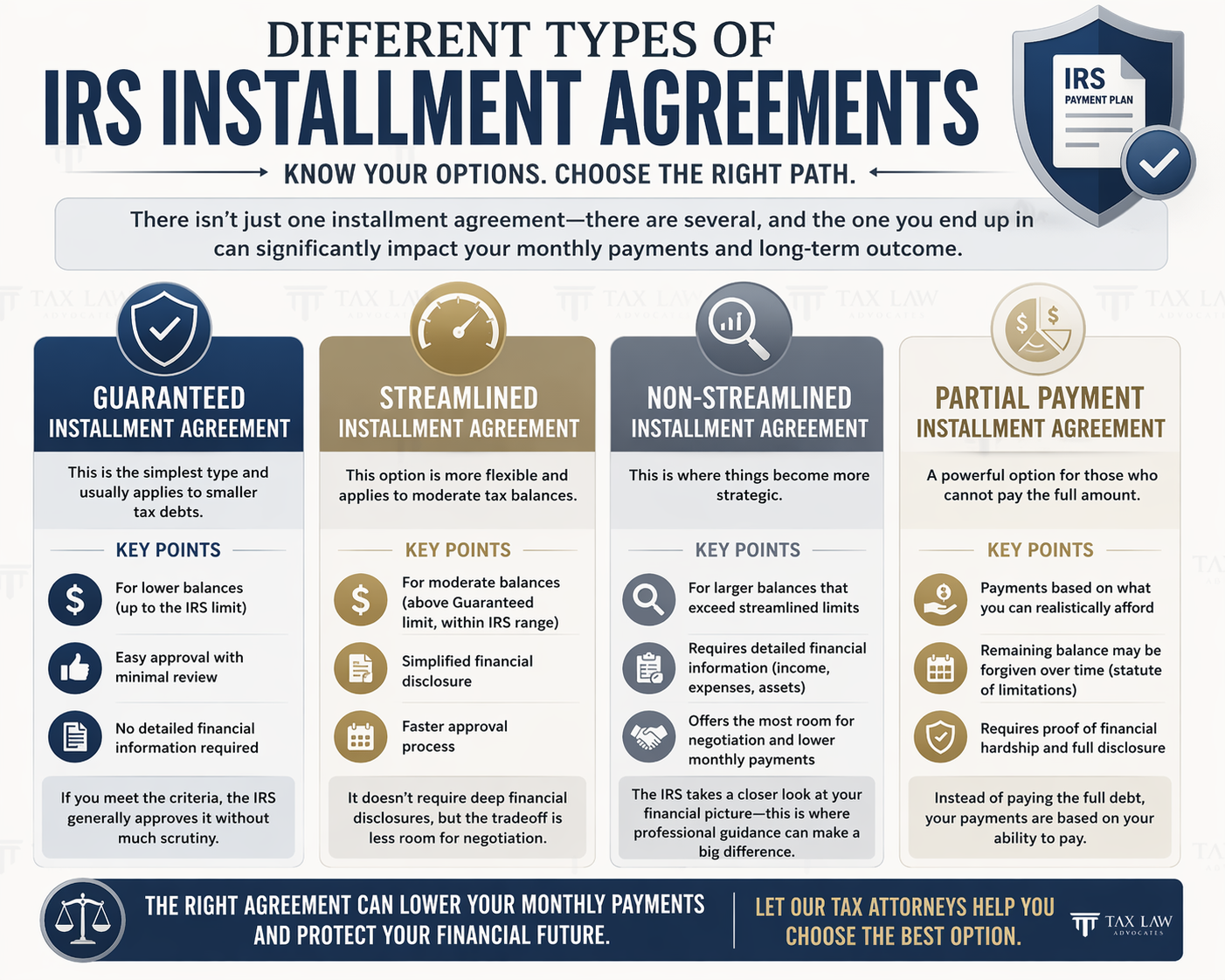
There isn’t just one installment agreement, there are several, and the one you end up in can significantly impact your monthly payments and long-term outcome.
Guaranteed Installment Agreement
This is the simplest type and usually applies to smaller tax debts. If you meet the criteria, the IRS generally approves it without much scrutiny.
Streamlined Installment Agreement
This option is more flexible and applies to moderate tax balances. It doesn’t require deep financial disclosures, but the tradeoff is less room for negotiation.
Non-Streamlined Installment Agreement
This is where things become more strategic. The IRS takes a closer look at your income, expenses, and assets, and this is exactly where professional guidance can make a big difference in lowering your monthly obligation.
Partial Payment Installment Agreement
This is one of the most powerful options available. Instead of paying the full debt, your payments are based on what you can realistically afford, and in some cases, a portion of the debt may never be collected. But getting into this type of agreement requires careful positioning.
How an IRS Installment Agreement Works
Once your agreement is approved, it becomes your structured path forward. You make monthly payments based on the agreed terms, and in most cases, the IRS pauses aggressive collection actions like levies or garnishments.
However, penalties and interest may still continue unless addressed strategically. That’s why this isn’t just about setting up payments, it’s about setting them up the right way. Because the IRS isn’t trying to minimize your payments, you are.
Payment arrangement with the IRS
Establishing a payment arrangement with the IRS requires selecting the correct agreement type based on total liability, taxpayer compliance status, and whether the taxpayer is an individual, self-employed, or business entity, the latter of which is addressed in more depth on our IRS Business Installment Agreement page. Agreements can be requested online, by phone, or via Form 9465, though online applications are limited to specific balance thresholds and compliance conditions. Tax Law Advocates determines the most advantageous application channel and agreement structure for each taxpayer’s circumstances.
Can you pay taxes in installments
The IRS permits taxpayers to pay outstanding liabilities through structured installment agreements rather than requiring immediate full payment, provided the taxpayer remains compliant with current filing and estimated tax obligations. Failure to maintain compliance during an active agreement, such as missing a new year’s filing, can result in default and reinstatement of full collection activity, including a tax lien or wage garnishment. Tax Law Advocates monitors ongoing compliance requirements to help taxpayers avoid installment agreement default.
Address to mail IRS installment payments
The correct mailing address for IRS installment agreement payments depends on the taxpayer’s state of residence and the specific IRS form used to establish the agreement, as published in the IRS Form 9465 instructions and taxpayer’s agreement confirmation notice. Sending payments to an incorrect address can delay processing and create the false appearance of a missed payment. Tax Law Advocates confirms correct payment routing, including electronic options through the Electronic Federal Tax Payment System, to prevent processing errors.
How to Apply for an Installment Plan
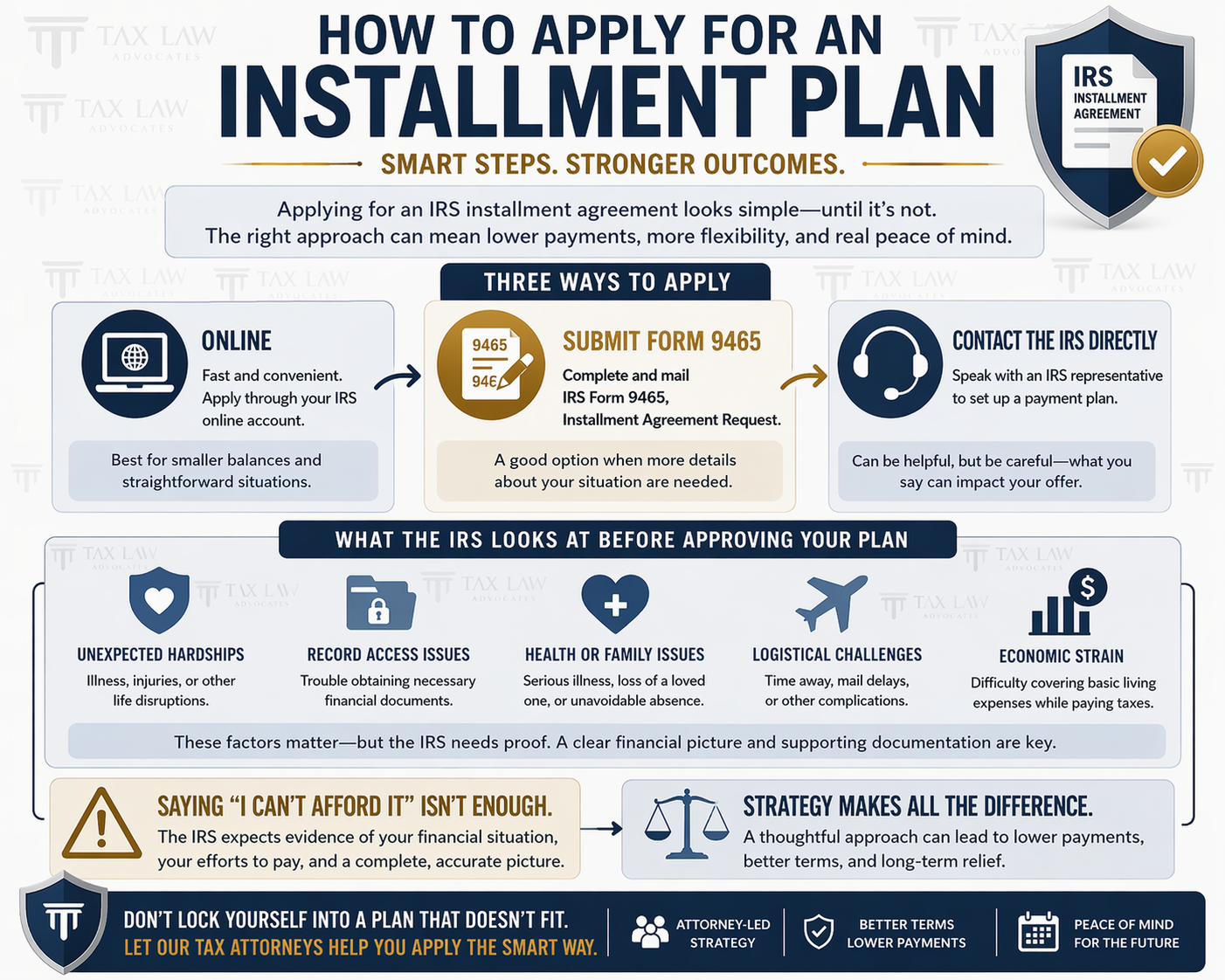
On the surface, applying looks straightforward. You can go online, submit Form 9465, or contact the IRS directly. But here’s where many people unknowingly put themselves at a disadvantage. They apply quickly, accept the IRS’s terms, and lock themselves into a plan that doesn’t reflect their true financial situation. In reality, the IRS looks at a range of factors before approving a plan. They consider situations like unexpected hardships, health issues, difficulty accessing financial records, or economic strain that affects your ability to cover basic living expenses. At the same time, it’s important to understand that simply saying “I can’t afford it” isn’t enough. The IRS expects to see effort, documentation, and a clear financial picture. That’s where strategy, and sometimes legal representation, comes into play.
IRS installment agreement attorney
An IRS installment agreement attorney evaluates a taxpayer’s full liability, current compliance status, and cash flow to determine which agreement type, streamlined, non-streamlined, or partial-pay, best fits the case before submission. Attorney involvement is particularly valuable when the liability exceeds $50,000 or spans multiple business tax periods, where non-streamlined agreements require additional financial disclosure, sometimes overlapping with a Trust Fund Recovery Penalty exposure. Tax Law Advocates’ attorneys, including Scott Mullerleile and David Cho, negotiate installment terms directly with IRS Collection to secure agreements that reflect the taxpayer’s actual ability to pay.
Monthly payment plan
An IRS monthly payment plan allows taxpayers to satisfy a tax liability over time rather than in a single lump sum, with terms determined by the balance owed, the taxpayer’s compliance history, and the applicable Collection Statute Expiration Date. Streamlined agreements for balances under $50,000 generally avoid full financial disclosure, while larger balances require a Collection Information Statement, similar to what’s evaluated under the IRS Hardship Program. Tax Law Advocates structures monthly payment plans to remain sustainable against the taxpayer’s documented monthly budget.
Can you have 2 installment agreements with the IRS ?
The IRS generally does not permit two separate active installment agreements; instead, a new tax liability is typically consolidated into the taxpayer’s existing agreement through a reinstatement or modification process. Attempting to establish a second independent agreement without proper consolidation can trigger default of the original agreement. Tax Law Advocates manages agreement modifications when new liabilities arise, whether individual or business tax debt, to keep the taxpayer in continuous compliance.
Can you have multiple IRS payment plans?
Multiple simultaneous IRS payment plans are not standard practice; new liabilities are generally required to be consolidated into an existing agreement rather than maintained as separate concurrent plans. The IRS may reassess the taxpayer’s full financial picture when consolidating agreements, potentially altering the original payment amount, or in some cases prompting consideration of an Offer in Compromise instead. Tax Law Advocates handles agreement consolidation to ensure new liabilities are properly integrated without jeopardizing existing agreement standing.
Fee for IRS installment agreement
IRS installment agreement setup fees vary by application method and income level, with reduced fees available for online applications and low-income taxpayers who qualify for fee waivers under current IRS guidelines. Direct debit agreements generally carry lower setup fees than agreements paid by check or online payment. Tax Law Advocates identifies fee reduction eligibility for qualifying taxpayers before agreement submission.
Missed payment IRS installment agreement
A missed payment under an active IRS installment agreement can result in default, though the IRS generally issues a CP523 notice providing an opportunity to cure the default before terminating the agreement and resuming collection action. Response timing to this notice is critical, as the cure period is limited and non-response results in full agreement termination, potentially leading to notices like a CP504 or LT11. Tax Law Advocates responds to default notices promptly to reinstate agreements before collection activity resumes.
How to set up a payment plan?
Setting up an IRS payment plan begins with confirming the exact balance owed through an account transcript, then selecting an agreement type based on balance size, compliance status, and ability to pay under IRS Collection Financial Standards. Taxpayers who file Form 9465 without first verifying transcript-confirmed balances risk proposing agreements based on inaccurate figures tied to unpaid taxes. Tax Law Advocates verifies transcript data before structuring and submitting a payment plan.
Installment agreement pros and cons
Installment agreements halt active IRS enforcement, such as levies and garnishment, but do not stop interest and reduced-rate penalty accrual on the outstanding balance for the agreement’s duration. Longer-term agreements lower monthly payments but increase total interest paid over the life of the arrangement compared to more aggressive resolution options. Tax Law Advocates evaluates whether an installment agreement or an alternative resolution, such as an Offer in Compromise or penalty abatement, better serves the taxpayer’s total financial outcome.
Intent to terminate installment agreement
An IRS Notice of Intent to Terminate Installment Agreement (CP523) is issued when the taxpayer defaults on agreement terms, such as missing a payment or failing to file a subsequent return, and provides a limited window to respond before the IRS resumes full collection activity, including levy action. Ignoring this notice allows the IRS to terminate the agreement and pursue enforced collection without further installment negotiation. Tax Law Advocates responds to termination notices immediately to preserve the agreement or negotiate reinstatement terms — contact us right away if you’ve received a CP523.
Why Tax Law Advocates
At Tax Law Advocates, every IRS Installment Agreement case is built around strategy, not volume. With over 16 years of experience handling tax resolution matters, we create customized payment solutions based on each client’s financial situation and long-term goals. You won’t be passed around or treated like just another case file. Our team works directly with the IRS to negotiate installment agreements designed to reduce financial pressure while helping you stay compliant and protected. Through clear communication, transparency, and experienced guidance, we make sure you understand every step of the process and the options available to you.
Real Client Scenarios
One client came to us facing a monthly payment they simply couldn’t sustain. After reviewing their financials, we restructured their agreement and reduced the burden significantly. Another client assumed they had to pay their full balance. With the right strategy, we positioned them into a partial payment agreement that changed their long-term outlook completely.
In another case, we stepped in just before enforcement action and secured an agreement that stopped collections immediately. These aren’t unusual situations—they’re just situations handled correctly.
Meet Your Lead Tax Attorney and Enrolled Agent for IRS Debt Relief & Tax Resolution You Can Trust

David Cho
David Cho
Scott Mullerleile
EA with 12+ years in tax resolution and a background in collections. Scott has successfully handled hundreds of cases, including accepted Offers in Compromise and representation before Revenue Officers, audits, and appeals.

Our IRS Tax Relief Results by the Numbers
Proven results helping clients resolve IRS and state tax debt nationwide.
$0M+
Tax Debt Resolved for Clients
0K+
Clients served
0%
Handled by Tax Attorneys
0%
Cases Successfully Resolved
24hr
Average Case Action Time
0
Years of experience
Tax Law Advocates Client Success Stories
Jonnel Bolotano with Tax Law Advocates was amazing to work with. Even though I didn’t initially start my case with him, he stepped in, took charge, and stayed on top of everything from that point forward.

ItzMiBaebii
If I could give Tax Law Advocates more than 5 stars, I absolutely would. Jamie and Scott were my dream team, steady, sharp, and on top of every detail. I came in with a heavy tax burden that felt like it would follow me forever...

Rebecca Ingram
Jesse Moreno my tax lawyer did a wonderful job on my case. She was very patient kind and professional, and resolution that I received was better than I expected! Thank you Jesse for representing me!

Debbie Kern
FAQ
What is an IRS installment agreement?
It’s a payment plan that allows you to pay your tax debt over time instead of all at once.
How do I request an IRS installment agreement?
You can apply online, submit Form 9465, or work with a tax professional.
Will the IRS stop collections once I’m approved?
In most cases, yes. Approval typically pauses aggressive actions.
Can my monthly payment be negotiated?
Yes, especially in more complex agreements where financial review is involved.
Does interest continue during the plan?
Yes, although strategies may reduce the overall impact.
What happens if I miss a payment?
Your agreement could default, and IRS enforcement may resume.
Can I qualify if I owe a large amount?
Yes, but it may require more detailed financial documentation.
What is Form 9465?
It’s the official IRS form used to request a payment plan.
Can I pay off my plan early?
Yes, and doing so can reduce interest costs.
Do I really need a tax attorney?
Not required—but often the difference between a basic plan and a strategic one.