
Unpaid Taxes
That Stop IRS Collections and Get You Back on Solid Financial Ground
$0M+


Discover how much tax debt forgiveness you qualify for.

What Is Unpaid Taxes?
Unpaid taxes are any federal or state tax obligations that were not paid by the required due date. They can result from an inability to pay at the time of filing, a missed filing altogether, an IRS adjustment to a previously filed return, or simply a balance that was ignored and allowed to grow over time.
Unpaid taxes do not go away on their own. The IRS and state tax agencies actively pursue collection on all outstanding balances, and every month a balance remains unpaid, penalties and interest are added, making the total amount owed larger and the resolution more complex.
Why Do People Need Unpaid Taxes Help?
Most people with unpaid taxes are not trying to evade the system. A job loss, a medical emergency, a difficult business period, or simply not having the funds available at the time of filing are the real reasons most unpaid tax situations develop. The problem is the IRS does not factor in circumstances when it begins collection.
The IRS has the authority to:
- File federal tax liens against your property and personal assets
- Levy your bank accounts and garnish your wages without further warning
- Seize personal and business property to satisfy the outstanding balance
- Revoke your passport if your unpaid tax debt exceeds the federal threshold
Unpaid tax resolution exists to stop these actions and negotiate a path forward that works for your actual financial situation.

Common Problems Unpaid Taxes Resolution Handles
Unpaid tax situations involve a wide range of challenges that grow more serious the longer they go unaddressed. Compounding penalties and interest are among the most damaging aspects of unpaid taxes, often causing the balance to grow far beyond the original amount owed. Active IRS collection actions including bank levies and wage garnishments create immediate financial hardship that requires urgent intervention. Federal tax liens filed against personal property can damage credit and complicate real estate transactions for years. Unfiled returns tied to unpaid balances create additional penalties on top of the existing debt. Our attorneys address every aspect of the unpaid tax situation with a resolution strategy built around your specific financial circumstances.
How Long Can Taxes Go Unpaid
There’s no set expiration date that simply erases unpaid taxes, but the IRS does operate under a general 10-year statute of limitations on collection from the date a tax is assessed, after which the debt is typically no longer collectible. That said, this timeline can be extended by certain actions, like filing for bankruptcy, submitting an Offer in Compromise, or leaving the country for an extended period, so it’s not a simple countdown you can wait out. In the meantime, unpaid taxes continue accruing penalties and interest, which means the balance typically grows substantially over those years rather than staying static. If you’re hoping unpaid taxes will simply go away with time, it’s worth understanding your actual timeline rather than assuming. Tax Law Advocates can help you determine where your specific debt stands and what realistic options exist.
Unpaid State Income Tax
Unpaid state income tax is handled separately from federal tax debt, since each state has its own tax agency, collection rules, and enforcement timeline. Depending on the state, unpaid income tax can lead to penalties, interest, and eventually a state tax levy on wages or bank accounts if it goes unresolved. Because state and federal tax debt are tracked independently, it’s possible to be current with the IRS while still owing a state, or vice versa. If you’re unsure where you stand with your state, reviewing your account directly with the state tax agency is the clearest way to confirm. Tax Law Advocates can help you address unpaid state income tax alongside any federal tax issues you may be facing.
How to Find Unpaid Property Taxes
Unpaid property taxes are typically tracked by the county tax assessor or treasurer’s office where the property is located, not by the IRS, since property tax is a local government matter. Most counties offer an online portal where you can search by property address or parcel number to see whether taxes are current or delinquent. This is a useful step if you’re buying property, managing an inherited property, or simply want to confirm your own account is up to date. Property tax delinquency can eventually lead to a lien or, in more serious cases, a tax sale of the property, so catching an unpaid balance early matters. Tax Law Advocates primarily focuses on federal and state income tax matters, but can help you understand how unpaid property taxes may intersect with broader tax debt you’re facing.
What Is the IRS Interest Rate on Unpaid Taxes?
The IRS interest rate on unpaid taxes is set quarterly and is based on the federal short-term rate plus 3 percentage points for individual taxpayers, which means it can fluctuate from year to year based on broader interest rate conditions. This interest compounds daily, so even a relatively modest balance can grow meaningfully over time if it isn’t addressed. Interest is separate from any penalties assessed for late filing or late payment, which means both can apply to the same balance simultaneously. If you’re trying to understand why your tax debt has grown since you first received a notice, this compounding interest is often the reason. Tax Law Advocates can help you get an accurate, current picture of what you actually owe.
How Much Interest Does the IRS Charge on Unpaid Taxes?
The exact amount of interest the IRS charges depends on the current quarterly rate, how large the original balance is, and how long it has gone unpaid, since interest accrues daily on the outstanding amount. Because this interest compounds, a balance that was manageable when it was first assessed can become significantly larger the longer it sits unresolved. This is one of the main reasons the total owed on an old notice, like a CP504 notice, can look very different from the balance shown on an earlier one. Understanding how interest is calculated on your specific balance can help you see the real cost of delaying resolution. Tax Law Advocates can help you calculate your actual balance and evaluate options like penalty abatement that may reduce what you owe.
Unpaid Property Taxes
Unpaid property taxes are a local tax matter, separate from federal or state income tax debt, but the consequences can still be significant, ranging from penalties and interest to a lien against the property or, in extended cases of nonpayment, a tax sale. Because property tax rules and enforcement timelines vary by county, the process and urgency can differ significantly depending on where the property is located. Unpaid property taxes don’t typically show up on federal IRS records, which means they need to be addressed directly with the local tax authority rather than through IRS channels. If you’re dealing with unpaid property taxes alongside other tax debt, it’s worth understanding which agency handles which balance. Tax Law Advocates can help you understand how your overall tax situation fits together, including where property taxes sit relative to any federal or state tax debt.
Penalty for Late Tax Return
The IRS charges a failure-to-file penalty for returns submitted after the deadline without an approved extension, typically calculated as a percentage of the unpaid tax owed for each month the return is late, up to a set maximum. This penalty is generally more significant than the failure-to-pay penalty, which is one reason the IRS often encourages taxpayers to file on time even if they can’t pay in full immediately. Both penalties can apply simultaneously if a return is both late and unpaid, along with accruing interest on top. If you have a late return you haven’t filed yet, filing as soon as possible can limit how much the failure-to-file penalty continues to grow. Tax Law Advocates can help you file overdue returns and explore penalty abatement if you qualify for relief.
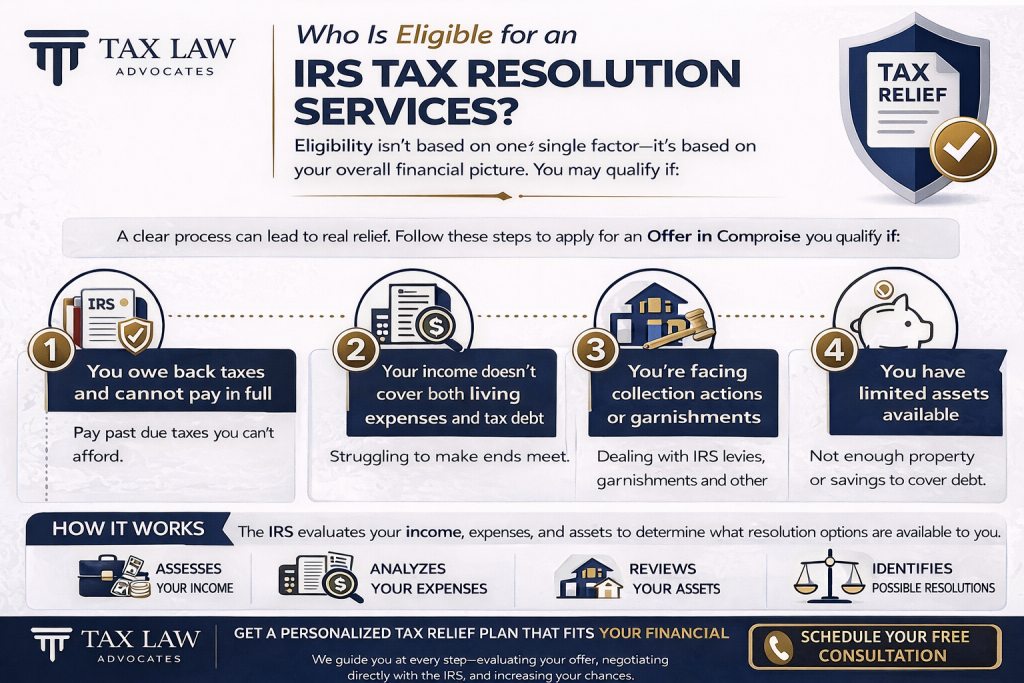
Who Is Eligible for Unpaid Taxes Relief in 2026?
Eligibility for unpaid tax relief is based on your total outstanding balance, your current financial situation, and your filing history. You may qualify if:
- You have an outstanding federal or state tax balance you cannot pay in full
- You are currently facing IRS collection action including levies, liens, or garnishments
- Your unpaid balance has grown significantly due to penalties and interest
- You have unfiled returns connected to unpaid tax balances
- Your financial situation has changed since the original tax obligation was incurred
The IRS evaluates your complete financial picture to determine which resolution programs you qualify for. The right option depends entirely on your specific circumstances.
The Truth About Unpaid Taxes Relief: Pros, Cons & What the IRS Says
The greatest advantage of professional unpaid tax resolution is that it stops collection action and replaces it with a structured path forward. An attorney builds a case based on your actual financial data and presents it to the IRS in a way that maximizes your chances of the most favorable resolution available. The challenge is that resolving unpaid taxes requires full financial disclosure and a commitment to staying compliant with all future tax obligations. The IRS will not negotiate with taxpayers who continue to accrue new debt during the resolution process. Acting quickly preserves more options and prevents further financial damage.
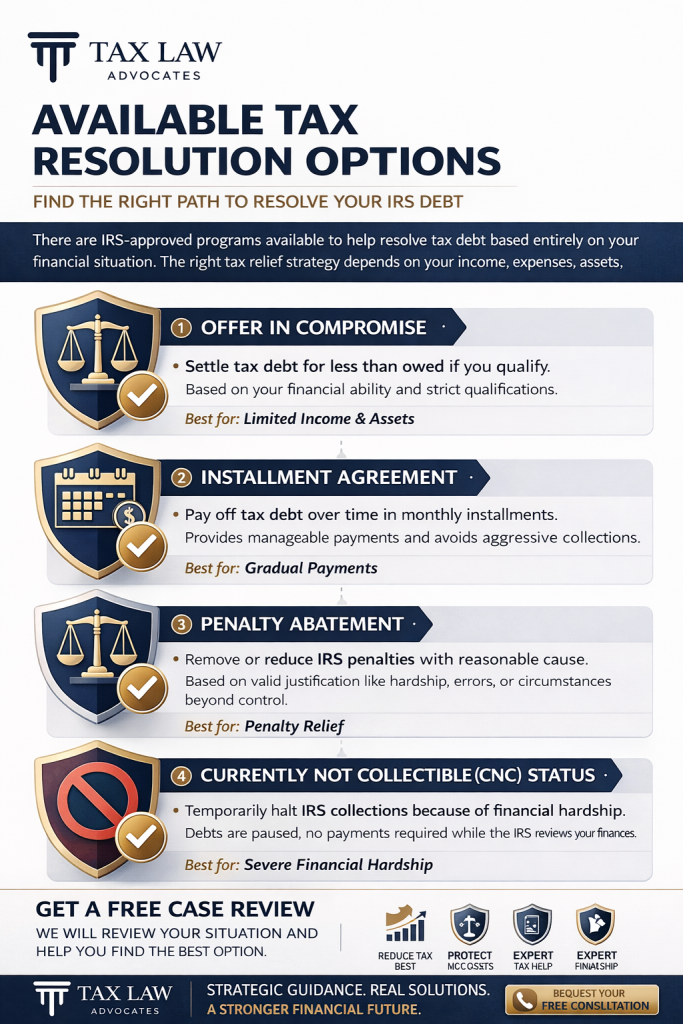
What Unpaid Taxes Relief Options Are Available to Me?
Several IRS approved resolution programs are available depending on your financial situation and total liability.
An Installment Agreement allows you to repay your unpaid tax balance over time in manageable monthly payments based on your current income and expenses. An Offer in Compromise may allow you to settle your total liability for less than the full amount owed if your financial situation demonstrates that full collection is not feasible. Penalty Abatement can reduce the total balance by eliminating penalties assessed for failure to file or failure to pay where reasonable cause exists. Currently Not Collectible status temporarily halts all IRS collection activity if your financial situation makes any payment impossible at this time.
How Do I Know If I Owe Back Taxes?
Owing back taxes, whether to the IRS or a state, usually becomes clear through written notices, like a CP14 notice at the federal level, rather than a phone call or email. If you suspect you may owe but haven’t received anything recently, you can request an account transcript from the IRS, or contact your state tax agency directly, to confirm your actual balance and filing status. It’s also worth checking both federal and state accounts separately, since owing one doesn’t necessarily mean you owe the other. If you’re unsure where you stand, our back taxes help page walks through this in more detail. Tax Law Advocates can help you get a clear, complete picture of any unpaid taxes across every agency involved.
What Happens if Taxes Are Late?
When taxes are filed or paid late, the IRS typically assesses penalties for both late filing and late payment, along with interest that accrues on the unpaid balance until it’s paid in full. If the debt continues to go unaddressed, the IRS can escalate collection efforts, moving from notices to more serious enforcement actions like a tax lien, wage garnishment, or bank levy. The consequences generally build in stages rather than happening all at once, which means there’s usually a window to address the issue before it becomes more serious. If your taxes are already late, taking action now, even if you can’t pay in full, is almost always better than waiting. Tax Law Advocates can help you understand exactly where your case stands and what to do next.
IRS Penalties and Interest Calculator
An IRS penalties and interest calculator can give you a general estimate of how much your tax debt has grown due to failure-to-file penalties, failure-to-pay penalties, and daily compounding interest. These tools can be a helpful starting point for understanding the scope of your balance, but they don’t account for factors like penalty abatement eligibility, prior payments already applied, or errors in the IRS’s original assessment. If your estimated balance feels overwhelming, it’s worth remembering that the number a calculator produces isn’t necessarily the final amount you’ll have to pay. Tax Law Advocates can review your actual IRS account and identify whether penalty abatement or another resolution option could reduce what you owe.
How Long Do You Have to Pay Your Taxes?
Taxes are generally due by the standard federal filing deadline each year, and payment in full by that date avoids failure-to-pay penalties and minimizes interest, even if you file for an extension on the paperwork itself. If you can’t pay in full by the deadline, the IRS offers alternatives, including an installment agreement or, in qualifying cases, an Offer in Compromise, rather than leaving the balance to accrue penalties indefinitely. Waiting to address a balance you can’t pay in full often makes the situation more expensive over time, not less. If you’re trying to figure out how to handle taxes you can’t pay right now, Tax Law Advocates can help you understand and pursue the option that fits your situation, following our process for resolution.
How to Apply for Unpaid Taxes Relief in 2026?
Resolving unpaid taxes requires a structured approach that begins with a full review of your outstanding obligations. You will need to:
- File all missing tax returns to bring your account into full compliance
- Gather complete financial records including income, expenses, assets, and liabilities
- Identify the total outstanding balance across all tax years and types
- Submit a properly documented resolution application to the IRS or state tax agency
No resolution program is available until all outstanding returns are filed. Getting compliant is always the essential first step in the process.
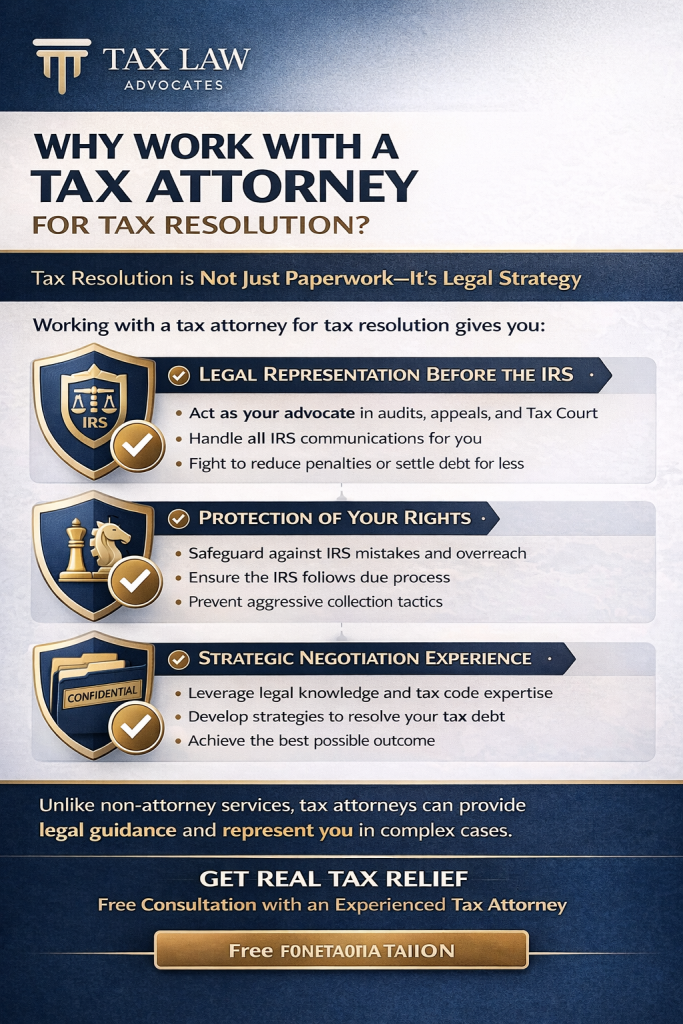
Why Work With a Tax Attorney for Unpaid Taxes?
Unpaid taxes left unresolved become a long term financial burden that affects every area of your life. Working with a tax attorney gives you:
- Legal representation in all dealings with the IRS and state tax agencies
- Strategic resolution planning based on your actual financial situation
- Protection from collection action while your case is actively being worked
- Full compliance support from the first unfiled return through final resolution
Tax Law Advocates handles unpaid tax cases from start to finish. We make sure the IRS sees your complete and accurate financial picture and that every available resolution option is pursued aggressively on your behalf.
Why Tax Law Advocates
Tax Attorney: David Cho
Real Client
Scenarios
One client came to us facing wage garnishment while struggling to cover basic living expenses. After reviewing their financials, we positioned their case for hardship status, stopping collections.
Another client believed they had no options. By restructuring their financial presentation, we demonstrated eligibility for relief and prevented enforcement actions.
In a third case, we combined immediate protection with a long-term resolution plan, giving the client both relief and stability.
Meet Your Lead Tax Attorney and Enrolled Agent for IRS Debt Relief & Tax Resolution You Can Trust

David Cho
David Cho
Scott Mullerleile
EA with 12+ years in tax resolution and a background in collections. Scott has successfully handled hundreds of cases, including accepted Offers in Compromise and representation before Revenue Officers, audits, and appeals.

Our IRS Tax Relief Results by the Numbers
Proven results helping clients resolve IRS and state tax debt nationwide.
$0M+
Tax Debt Resolved for Clients
0K+
Clients served
0%
Handled by Tax Attorneys
0%
Cases Successfully Resolved
24hr
Average Case Action Time
0
Years of experience
Tax Law Advocates Client Success Stories
Jonnel Bolotano with Tax Law Advocates was amazing to work with. Even though I didn’t initially start my case with him, he stepped in, took charge, and stayed on top of everything from that point forward.

ItzMiBaebii
If I could give Tax Law Advocates more than 5 stars, I absolutely would. Jamie and Scott were my dream team, steady, sharp, and on top of every detail. I came in with a heavy tax burden that felt like it would follow me forever...

Rebecca Ingram
Jesse Moreno my tax lawyer did a wonderful job on my case. She was very patient kind and professional, and resolution that I received was better than I expected! Thank you Jesse for representing me!

Debbie Kern
FAQ
What are tax resolution services?
They are professional services that help resolve tax debt through negotiation and IRS programs.
Can tax resolution reduce my debt?
Yes, in some cases through programs like Offer in Compromise.
Do I qualify for tax relief?
It depends on your income, assets, and financial hardship.
How long does the process take?
It varies from weeks to several months depending on the case.
Will the IRS stop collections immediately?
In some cases, actions can be paused once representation begins.
Do I need a tax attorney?
It’s highly recommended for complex or high-value cases.
Can penalties be removed?
Yes, through penalty abatement if you qualify.
Is this available nationwide?
Yes, services are available in all 50 states.
What if I can’t pay anything?
You may qualify for hardship status.
Is the consultation free?
Yes, initial case reviews are free.