

Tax Resolution Services

That Stop IRS Pressure and Get You Back in Control

$0M+

Tax Debt Resolved

Discover how much tax debt forgiveness you qualify for.

This field is for validation purposes and should be left unchanged.
Your Name(Required)

Get Back in Control With Realistic Solutions Tailored to Your Finances

Tax Law Advocates provides immediate and strategic tax resolution solutions to help taxpayers explore their options and find a path forward to resolve tax debt with the IRS. Our experienced tax attorneys will analyze your circumstances, work to protect your income and assets, and build a tailored strategy to resolve your tax problems as quickly as possible.

TLA-webimage-18

How We Help Resolve Your Unpaid Taxes

If you’re facing challenges like unpaid back taxes, tax liens, levies, wage garnishments and IRS audits, the tax resolution services from Tax Law Advocates can help reduce the impact and put you back in control.

Our attorney-led solutions include:

  • Case evaluation: Your attorney consultation begins with an account transcript pull and a financial questionnaire to determine which resolution pathway, such as an installment agreement or Offer in Compromise (OIC), is procedurally viable.
  • Immediate action: Our tax attorneys take action right away to protect you from collection. When possible, we stop levies and protect your accounts and assets from being frozen or withdrawn.
  • Strategic negotiation: We serve as your legal representation before the IRS. We’ll engage directly with IRS Revenue Officers and the Automated Collection Service to pursue resolution programs to potentially protect your assets and reduce liability.
  • Confidential communication: Conversations with your attorney are legally protected by attorney-client privilege, so they’ll remain confidential and cannot be used against you in most cases.

Who Is Eligible for Resolution Programs?

The IRS evaluates your income, expenses and assets to determine what resolution options are available to you. You may qualify if:

  • You owe back taxes and cannot pay in full.

  • Your income doesn’t cover both living expenses and unpaid taxes.

  • You’re facing collection actions like levies or garnishments.

  • You have limited assets available.

Tax Law Advocates provides professional representation and clarity throughout the process. Our team of tax professionals will analyze your financial documentation and debt to help determine your eligibility and give you a clear strategy based on your situation.

How We Decide Which Resolution Path Is Right for You

As we analyze your documentation, our team will investigate the actions the IRS has already taken and your tax history to understand your case and determine the best path forward.

1. Evaluate the IRS's Transactional History in Your Case

The IRS may send automated notices about owed taxes and levying your assets. Our tax attorneys will review the notices you’ve received and your account records to understand where you are in the collection process.

2. Investigate Your Tax History

We’ll review your tax history to determine:

  • If you are compliant with making estimated payments and filing your tax returns.

  • The Collection Statute Expiration Dates (CSED) to determine the enforcement timeline for collecting the amount owed.

  • If the IRS has filed a Substitute for Return for you.

3. Determine Your Reasonable Collection Potential

Tax Law Advocates will look at your complete and verifiable financial record to determine your reasonable collection potential (RCP) — your ability to pay back your tax balance. We’ll review your assets, liabilities, expenses and income.

IRS-Approved Tax Resolution Options

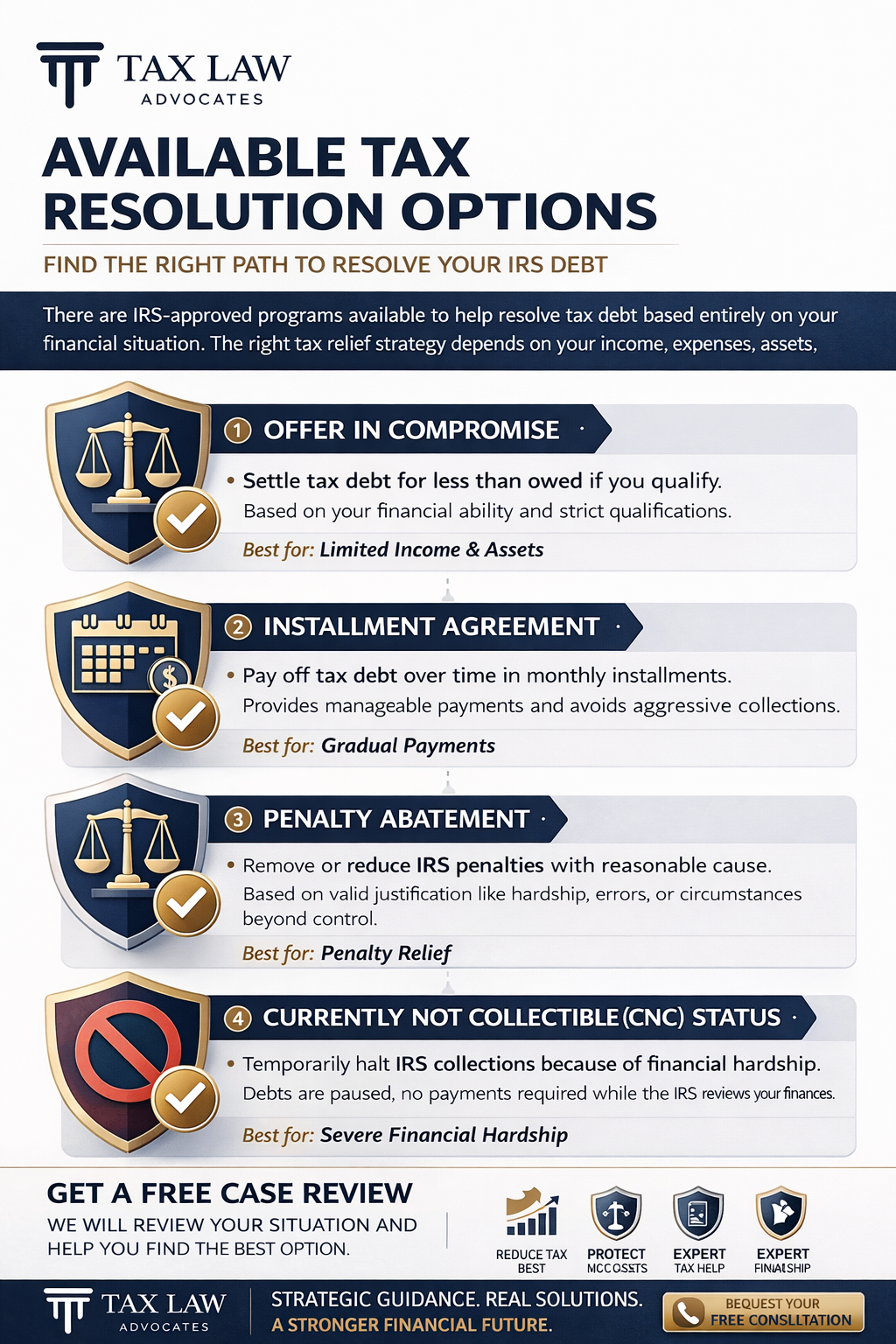
Our tax professionals will help you identify the right option for you based on our investigation into your tax history and metrics like your CSED and RCP. These programs include:

  • OIC: With an OIC, you settle your taxes for a lower amount than what you owe based on your RCP. This program is recommended for taxpayers who cannot pay the full balance before the CSED expires.
  • Installment agreement: An installment agreement lets you pay your taxes over time in manageable monthly payments. Installment agreements are best for taxpayers who have the cash flow to make payments until the CSED runs out.
  • Penalty abatement: A penalty abatement may remove or reduce penalties if you have reasonable cause, including circumstances beyond your control, errors and hardship. While this program provides penalty relief, it will not remove your tax liability.

  • Currently Not Collectible (CNC): In some cases, taxpayers experiencing severe financial hardship may qualify for CNC status, which pauses most collections for a time. However, this option doesn’t erase your tax debt or prevent interest and penalties from accumulating.

Why Choose Tax Law Advocates?

Tax Law Advocates is a licensed tax resolution company that is committed to helping taxpayers find relief from their unpaid taxes. We offer:

  • Attorney-led service: Our team of tax professionals includes tax attorneys, enrolled agents and certified public accountants (CPAs). We provide proven negotiation strategies and tailored solutions to help you decide which option applies best to your liability before you commit.
  • Proprietary analysis tools: We have a suite of tools to help you understand your RCP with the IRS, such as our OIC estimator.
  • Extensive experience: We bring over 16 years of experience in handling tax relief cases across the country.

Meet Your Lead Tax Attorney and Enrolled Agent for IRS Debt Relief & Tax Resolution You Can Trust

David Cho

Tax attorney with a J.D. and LL.M. in Taxation from UCI Law. David focuses on practical tax resolution strategies, helping clients navigate IRS and state issues with clear, solution-driven guidance.

David Cho

Tax attorney with a J.D. and LL.M. in Taxation from UCI Law. David focuses on practical tax resolution strategies, helping clients navigate IRS and state issues with clear, solution-driven guidance.

Scott Mullerleile

EA with 12+ years in tax resolution and a background in collections. Scott has successfully handled hundreds of cases, including accepted Offers in Compromise and representation before Revenue Officers, audits, and appeals.

Scott Mullerleile

EA with 12+ years in tax resolution and a background in collections. Scott has successfully handled hundreds of cases, including accepted Offers in Compromise and representation before Revenue Officers, audits, and appeals.

Our IRS Tax Relief Results by the Numbers

Proven results helping clients resolve IRS and state tax debt nationwide.

$0M+

Tax Debt Resolved for Clients

0K+

Clients served

0%

Handled by Tax Attorneys

0%

Cases Successfully Resolved

24hr

Average Case Action Time

0

Years of experience

Tax Law Advocates Client Success Stories

Jonnel Bolotano with Tax Law Advocates was amazing to work with. Even though I didn’t initially start my case with him, he stepped in, took charge, and stayed on top of everything from that point forward.

ItzMiBaebii

If I could give Tax Law Advocates more than 5 stars, I absolutely would. Jamie and Scott were my dream team, steady, sharp, and on top of every detail. I came in with a heavy tax burden that felt like it would follow me forever...

Rebecca Ingram

Jesse Moreno my tax lawyer did a wonderful job on my case. She was very patient kind and professional, and resolution that I received was better than I expected! Thank you Jesse for representing me!

Debbie Kern

FAQ

Review these common questions to learn more about our tax resolution services.

The length of the tax relief process varies from a few months to a few years, depending on the complexity of your case. After assembling and submitting the required documents to Tax Law Advocates, we'll submit your application for the resolution path you're pursuing. The IRS may take several months to process your application and assign someone to your case.

The resolution option also influences the timeline. While installment agreements are generally more streamlined and easier to process, programs like OIC that require documentation can take longer to approve.

The IRS will typically pause collection actions only after you have submitted your application for a resolution program. The resolution path you choose determines when collections stop. While CNC status stops certain collection efforts for a period of time, an OIC typically suspends most collection activities only once an offer is pending or accepted for processing.

If you are experiencing financial hardship, you may qualify for hardship status through the CNC program. CNC temporarily  pauses collection efforts like wage garnishment, asset seizures and levies to help taxpayers cover basic living expenses. Tax Law Advocates will review your case to decide if the CNC pathway is right for you.


Request Your Free Case Review Today

Gain control of your tax debt with expert assistance from the trusted tax relief company, Tax Law Advocates. Request a no-obligation case review to talk to our tax attorneys about your case today.