

Discover how much tax debt forgiveness you qualify for.
Back Taxes Meaning
Back taxes are taxes that were owed in a prior year but weren’t paid in full by the original deadline, whether because a return went unfiled, a payment was missed, or an audit resulted in additional tax assessed after the fact. Once a balance becomes back taxes, it begins accruing penalties and interest, which means waiting to address it typically makes the total owed larger over time, not smaller. The IRS also has escalating collection tools for unresolved back taxes, from notices to a tax lien, bank levy, or wage garnishment. Understanding that back taxes are a solvable problem, not a permanent one, is often the first step. Tax Law Advocates works directly with clients to assess back tax balances and identify a realistic path to resolution.
How Do I Know If I Have Back Taxes
The clearest sign of back taxes is an IRS notice, since the IRS typically sends written correspondence, like a CP14 notice or CP501/CP503 notice, once a balance is due or a return appears unfiled. Some people also become aware of back taxes when a tax refund is unexpectedly withheld, or when they simply realize a past year’s return was never filed. If you’re not sure whether you owe, you can request your account transcript directly from the IRS, which will show filed returns, assessed balances, and any pending notices. If you suspect you may have back taxes but haven’t confirmed it, Tax Law Advocates can help you get a clear, accurate picture of where you stand before the balance grows further.
How Much Money Will I Get Back Taxes
This phrase often comes from confusion between two very different situations: owing back taxes versus expecting a tax refund. If you’re asking how much you might get back, and you don’t currently have unfiled returns or a known balance due, that’s a refund question best answered with a tax balance/refund calculator. But if you’re asking because you’re unsure whether the IRS owes you money or you owe the IRS, back taxes and refunds are handled very differently, and the IRS can apply an expected refund toward an existing balance rather than issuing it to you. If you’re uncertain which situation applies to you, Tax Law Advocates can help you sort out your actual standing with the IRS.
What Is Back Taxes with an example
Back taxes are unpaid tax obligations from a previous tax year, and they can originate from several different sources: a return that was filed but not fully paid, a return that was never filed at all, or additional tax assessed after an IRS audit. Regardless of how the debt originated, back taxes are treated the same way by the IRS in terms of collection, with penalties and interest accruing until the balance is resolved. Many people delay addressing back taxes out of uncertainty or anxiety about the process, but options like an installment agreement, Offer in Compromise, or penalty abatement may all be available depending on your circumstances. Tax Law Advocates can help you understand which of these options fits your situation and guide you through resolving it.
Who Is Eligible for Back Taxes Help in 2026?
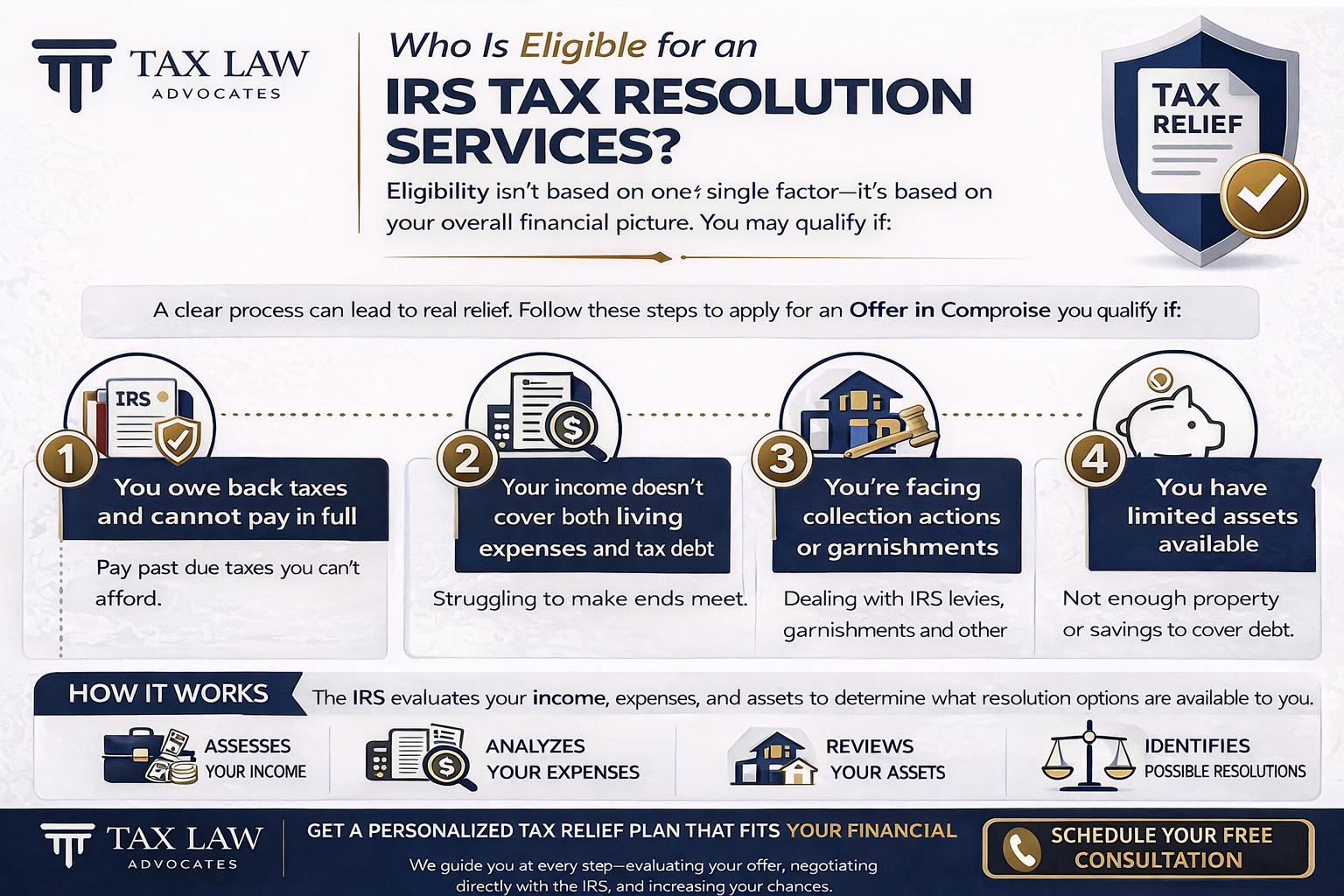
Anyone with outstanding federal or state tax debt or unfiled returns is eligible for professional back taxes help. You may qualify for resolution programs if:
- You have one or more years of unfiled federal or state tax returns
- You owe back taxes that you cannot pay in full
- The IRS has filed Substitute for Returns on your behalf
- You are currently facing collection action such as levies, liens, or garnishments
- Your back tax balance has grown significantly due to penalties and interest
- The IRS and most state tax agencies have resolution programs available for taxpayers who come forward and engage in the process. Acting sooner rather than later preserves more options.
What Back Taxes Help Options Are Available to Me?
Several IRS and state-approved resolution programs are available depending on your total liability and financial situation.
An Installment Agreement allows you to repay your back tax balance over time in structured monthly payments based on what you can afford. An Offer in Compromise may allow you to settle your total back tax liability for less than the full amount owed if financial hardship can be demonstrated. Penalty Abatement can significantly reduce the total balance by eliminating penalties assessed for failure to file or failure to pay. Currently Not Collectible status temporarily halts all IRS collection activity if your current financial situation makes any payment impossible.
How to Apply for Back Taxes Help in 2026?
Resolving back taxes requires a step by step approach that starts with getting fully compliant. You will need to:
- File all missing federal and state tax returns with accurate income and deductions
- Gather complete financial records including income, expenses, assets, and liabilities
- Identify all outstanding balances across every year and tax type
- Submit a resolution application with full financial disclosure to the IRS or state agency
Getting compliant by filing all missing returns is always the first step. No resolution program is available to a taxpayer with outstanding unfiled returns.
Why Tax Law Advocates
At Tax Law Advocates, everything we do is focused on results, transparency, and client protection.
We bring over 16 years of experience in handling IRS cases across the country. Our team uses proprietary analysis tools and proven negotiation strategies to create tailored solutions.
You’re not treated like a case number—you’re treated like a client with a real financial future at stake.
Tax Attorney: David Cho
Real Client
Scenarios
One client came to us facing wage garnishment while struggling to cover basic living expenses. After reviewing their financials, we positioned their case for hardship status, stopping collections.
Another client believed they had no options. By restructuring their financial presentation, we demonstrated eligibility for relief and prevented enforcement actions.
In a third case, we combined immediate protection with a long-term resolution plan, giving the client both relief and stability.
Meet Your Lead Tax Attorney and Enrolled Agent for IRS Debt Relief & Tax Resolution You Can Trust
David Cho
David Cho
Scott Mullerleile
EA with 12+ years in tax resolution and a background in collections. Scott has successfully handled hundreds of cases, including accepted Offers in Compromise and representation before Revenue Officers, audits, and appeals.
Our IRS Tax Relief Results by the Numbers
Proven results helping clients resolve IRS and state tax debt nationwide.
$0M+
Tax Debt Resolved for Clients
0K+
Clients served
0%
Handled by Tax Attorneys
0%
Cases Successfully Resolved
24hr
Average Case Action Time
0
Years of experience
Tax Law Advocates Client Success Stories
Jonnel Bolotano with Tax Law Advocates was amazing to work with. Even though I didn’t initially start my case with him, he stepped in, took charge, and stayed on top of everything from that point forward.
ItzMiBaebii
If I could give Tax Law Advocates more than 5 stars, I absolutely would. Jamie and Scott were my dream team, steady, sharp, and on top of every detail. I came in with a heavy tax burden that felt like it would follow me forever...
Rebecca Ingram
Jesse Moreno my tax lawyer did a wonderful job on my case. She was very patient kind and professional, and resolution that I received was better than I expected! Thank you Jesse for representing me!
Debbie Kern
FAQ
What are tax resolution services?
They are professional services that help resolve tax debt through negotiation and IRS programs.
Can tax resolution reduce my debt?
Yes, in some cases through programs like Offer in Compromise.
Do I qualify for tax relief?
It depends on your income, assets, and financial hardship.
How long does the process take?
It varies from weeks to several months depending on the case.
Will the IRS stop collections immediately?
In some cases, actions can be paused once representation begins.
Do I need a tax attorney?
It’s highly recommended for complex or high-value cases.
Can penalties be removed?
Yes, through penalty abatement if you qualify.
Is this available nationwide?
Yes, services are available in all 50 states.
What if I can’t pay anything?
You may qualify for hardship status.
Is the consultation free?
Yes, initial case reviews are free.
