For many taxpayers, opening a letter from the Internal Revenue Service can be stressful. Over the past several years, however, millions of taxpayers became accustomed to receiving fewer collection notices as the IRS temporarily scaled back certain enforcement activities during and immediately following the COVID-19 pandemic.
That period has ended.
Today, the IRS has resumed many traditional collection programs, and taxpayers across the United States are once again seeing a significant increase in IRS collection notices. Individuals and businesses with unpaid tax liabilities are receiving balance due notices, levy warnings, and collection correspondence at levels not seen in years.
If you recently received a notice from the IRS, you are not alone.
More importantly, receiving an IRS notice does not necessarily mean that the IRS will immediately seize your bank account or garnish your wages. In many situations, taxpayers still have options available to resolve their tax debt and protect their rights. The key is understanding what the notice means and responding before collection actions escalate.
At Tax Law Advocates, our tax attorneys regularly represent individuals and businesses facing IRS collection matters nationwide. Based on our experience, one of the most common and costly mistakes taxpayers make is ignoring IRS correspondence because they feel overwhelmed, afraid, or uncertain about what to do next.
This guide explains why IRS collection notices are increasing in 2026, what the most common notices mean, the potential consequences of ignoring them, and the tax resolution options that may be available.
Why Are More Taxpayers Receiving IRS Collection Notices?
Many taxpayers are surprised by the sudden increase in IRS correspondence. The primary reason is straightforward: the IRS has largely returned to pre-pandemic collection activity.
During the pandemic, the IRS paused or limited certain automated collection programs while addressing staffing shortages, processing delays, and unprecedented operational challenges. As those challenges subsided, the agency resumed collection efforts and restarted many automated notice programs.
At the same time, the IRS has received additional funding to modernize its operations, improve technology, and increase enforcement efficiency.
Today, the IRS uses sophisticated systems to:
- Match income reported by employers, banks, and financial institutions.
- Identify unpaid tax liabilities more quickly.
- Generate automated collection notices.
- Prioritize cases for enforcement action.
- Monitor payment compliance.
As a result, taxpayers with unresolved tax debt may receive notices sooner and move through the collection process faster than in previous years.
The increase in IRS collection notices does not necessarily indicate that the IRS is targeting taxpayers more aggressively than before. Rather, it reflects a return to standard collection procedures that had been temporarily disrupted.
Understanding the IRS Collection Process
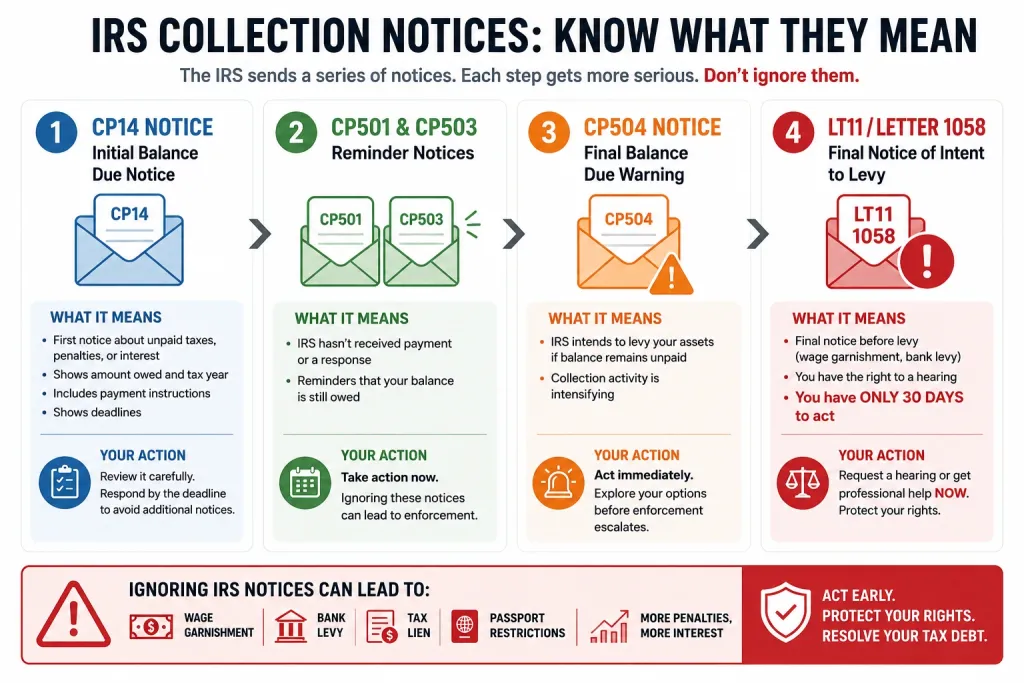
The IRS collection process generally follows a series of escalating notices. Each notice provides information regarding the amount owed and may explain the taxpayer’s rights and available response options.
Although every case is unique, the process often progresses through several stages.
CP14 Notice: Initial Balance Due Notice
The CP14 notice is usually the first notice taxpayers receive after the IRS determines that taxes, penalties, or interest remain unpaid.
The notice explains:
- The amount owed.
- The tax year involved.
- Applicable penalties and interest.
- Payment instructions.
- Deadlines for response.
Many taxpayers mistakenly assume that receiving a CP14 notice is not serious because it appears informational. However, failure to respond may trigger additional collection activity.
Taxpayers who disagree with the amount owed should carefully review the notice, compare it to their filed returns, and seek professional advice if necessary.
CP501 and CP503 Notices: Reminder Notices
If the balance remains unpaid, the IRS may issue CP501 and CP503 notices.
These letters serve as reminders that the tax debt remains outstanding.
Receiving multiple reminder notices generally indicates that the IRS has not received payment or a response regarding available resolution options.
Ignoring these notices can significantly increase the likelihood of future enforcement action.
CP504 Notice: Final Balance Due Warning
A CP504 notice is substantially more serious.
This notice informs taxpayers that the IRS intends to levy certain assets if the balance remains unresolved.
While the CP504 is not always the final levy notice required by law, it signals that collection activity is intensifying.
Taxpayers who receive a CP504 notice should act promptly to evaluate available options before collection enforcement escalates.
LT11 and Letter 1058: Final Notice of Intent to Levy
Among all IRS collection notices, LT11 and Letter 1058 are often the most critical.
These notices constitute a Final Notice of Intent to Levy and Notice of Your Right to a Hearing.
Generally, taxpayers have only 30 days from the notice date to request a Collection Due Process hearing.
Failing to act within this period may significantly limit appeal rights and permit the IRS to begin enforced collection action.
Because these notices involve important legal rights, taxpayers should carefully evaluate their circumstances and consider obtaining professional representation before deadlines expire.
What Happens If You Ignore IRS Collection Notices?
Many taxpayers avoid opening IRS mail because they fear bad news or believe they cannot afford to pay the debt.
Unfortunately, ignoring IRS collection notices rarely improves the situation.
In many cases, the opposite occurs.
As unpaid balances continue to accrue penalties and interest, the IRS may eventually initiate enforcement actions designed to collect the debt.
Frequently Asked Questions About IRS Collection Notices
Why am I suddenly receiving IRS collection notices in 2026?
Many taxpayers are receiving more IRS collection notices because the IRS has resumed normal collection activities after pandemic-related slowdowns. The agency has also improved its technology and automated systems, allowing it to identify unpaid tax liabilities and send notices more efficiently.
What should I do if I receive an IRS collection notice?
First, do not ignore the notice. Carefully review the notice number, tax year, amount owed, and response deadline. Verify that the information is accurate and determine whether you agree with the balance. If you owe a substantial amount or have received a levy notice, consulting a qualified tax attorney may help protect your rights.
Does receiving an IRS notice mean I am being audited?
No. Most IRS collection notices are not audits. Collection notices generally relate to unpaid tax balances, penalties, or interest. Audit notices typically state that the IRS is reviewing specific items on your tax return.
What happens if I ignore IRS collection notices?
Ignoring IRS collection notices can lead to increasingly serious enforcement actions, including federal tax liens, wage garnishments, bank levies, passport restrictions, and other collection measures. Penalties and interest will also continue to accrue.
How long do I have to respond to an LT11 or Letter 1058?
In most cases, taxpayers have 30 days from the date of the LT11 or Letter 1058 notice to request a Collection Due Process (CDP) hearing. Missing this deadline may significantly reduce your appeal rights.
Can the IRS garnish my wages without warning?
Generally, no. Before garnishing wages, the IRS is typically required to issue several notices, including a Final Notice of Intent to Levy, and provide the taxpayer with an opportunity to request a hearing.
Can the IRS take money directly from my bank account?
Yes. If certain legal requirements are met and the taxpayer fails to respond to collection notices, the IRS may issue a bank levy that freezes and eventually seizes funds from a bank account.
Can IRS collection actions be stopped?
In many situations, yes. Depending on your financial circumstances, available options may include an Installment Agreement, Offer in Compromise, Currently Not Collectible status, Collection Appeals, or other tax resolution strategies.
Will penalties and interest continue to increase if I do not pay?
Yes. In most situations, penalties and interest continue to accrue until the tax debt is fully paid, becomes legally unenforceable, or another resolution is reached.
Should I hire a tax attorney after receiving an IRS collection notice?
Not every taxpayer requires legal representation. However, if you owe a substantial amount, have received an LT11 or levy notice, are facing wage garnishment, or disagree with the IRS, speaking with an experienced tax attorney may help you understand your rights and evaluate available options.