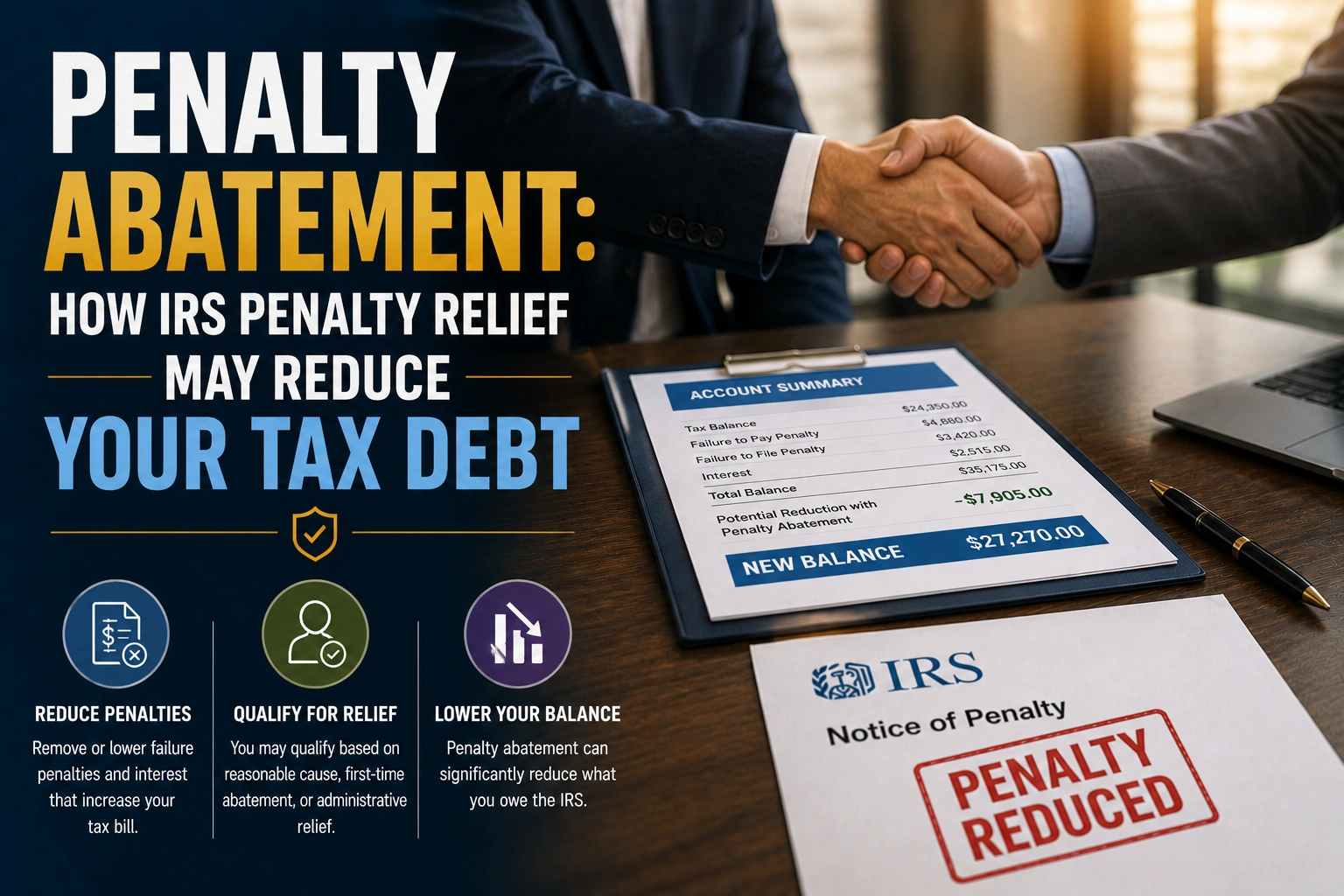
Penalty abatement can help taxpayers reduce or remove certain IRS penalties that continue increasing tax debt over time. Many individuals and business owners are surprised to discover that IRS penalties sometimes become larger than the original tax balance itself. Understanding how penalty abatement works may help taxpayers legally reduce unnecessary financial pressure and improve their overall tax resolution strategy.
At Tax Law Advocates, tax attorneys and enrolled agents regularly assist taxpayers with first time penalty abatement requests, IRS negotiations, and complex tax penalty abatement matters involving both individuals and businesses.
What Is Penalty Abatement?
The penalty abatement definition refers to the reduction or removal of IRS penalties under specific IRS rules and administrative policies. The penalty abatement meaning generally involves asking the IRS to forgive penalties when a taxpayer qualifies for relief.
Penalty abatement does not usually remove the original taxes owed. Instead, it focuses on reducing additional charges added by the IRS because of filing or payment issues.
Common penalties that may qualify for penalty removal include:
- Failure-to-file penalties
- Failure-to-pay penalties
- Payroll tax penalties
- Accuracy-related penalties
- Estimated tax penalties
Many taxpayers do not realize they may qualify for a penalty abatement program until they speak with an experienced tax professional.
Why IRS Penalties Become So Expensive
IRS penalties often continue growing monthly until the balance is resolved. In some situations, taxpayers ignore notices for several years and discover that penalties and interest have dramatically increased the debt.
For example, a taxpayer who originally owed $15,000 may later owe substantially more after years of accumulating penalties and interest.
This is why many taxpayers explore tax penalty abatement options before collections become more aggressive.
Penalty removal can sometimes reduce thousands of dollars from a taxpayer’s balance.
What Is First Time Penalty Abatement?
First time penalty abatement is one of the most common IRS administrative relief options available to taxpayers with a strong compliance history.
This program allows qualifying taxpayers to request removal of certain penalties if they previously filed and paid taxes properly for multiple years.
Many taxpayers also refer to this option as:
- First time abatement
- One time tax forgiveness
- Administrative waiver
Although the phrase one time tax forgiveness is commonly used online, the IRS officially refers to the process as first time penalty abatement.
How First Time Abatement Works
The IRS generally reviews the taxpayer’s compliance history before approving first time abatement requests. Taxpayers may qualify if they:
- Filed required returns in prior years
- Had no major penalties during the previous three years
- Paid taxes properly or maintained approved payment arrangements
For example, a business owner who filed taxes correctly for years but missed one filing deadline during a serious family emergency may qualify for first time penalty abatement if prior compliance standards were maintained.
This form of penalty abatement can sometimes produce substantial savings.
What Types of IRS Penalties May Qualify for Relief?
Not every IRS penalty automatically qualifies for relief. The IRS reviews each penalty abatement request individually based on compliance history, supporting documentation, and circumstances.
IRS penalty cases can vary significantly depending on the amount owed and the taxpayer’s overall compliance history. Smaller penalties between $500 and $2,000 are often resolved through the IRS First Time Abatement (FTA) program if the taxpayer qualifies based on prior compliance. Mid-range penalties between $5,000 and $15,000 may require a more detailed review of IRS transcripts, filing history, and payment status before relief is approved. Larger penalty balances exceeding $20,000 typically involve more advanced negotiation strategies, additional documentation, and sometimes attorney-led representation to pursue meaningful tax penalty relief or reduction options.
Understanding which penalties may qualify for penalty removal is an important part of strategic tax resolution planning.
What Is Considered Reasonable Cause?
Taxpayers who do not qualify for first time abatement may still qualify for penalty abatement through reasonable cause relief.
The IRS may consider whether circumstances outside the taxpayer’s control prevented proper compliance.
Serious Medical Emergencies
Hospitalization, severe illness, or major medical conditions sometimes support reasonable cause arguments for penalty abatement requests.
Natural Disasters
Wildfires, hurricanes, floods, and other disasters may affect filing or payment obligations and support penalty removal requests.
Death in the Family
The IRS sometimes considers major family emergencies when evaluating tax penalty abatement requests.
Incorrect Professional Advice
In certain situations, reliance on incorrect advice from a qualified tax professional may support reasonable cause relief.
Financial Hardship Alone Usually Does Not Qualify
Many taxpayers assume inability to pay automatically qualifies them for penalty abatement. In reality, the IRS generally expects additional supporting factors beyond financial hardship alone.
How to Submit a Penalty Abatement Request
A proper penalty abatement request should clearly explain why the taxpayer qualifies for relief and include supporting documentation whenever possible.
Taxpayers may request penalty relief through:
- IRS phone requests
- Formal written letters
- IRS forms in certain situations
- Attorney or enrolled agent representation
The strongest requests usually include detailed timelines, supporting evidence, compliance history, and clear explanations of the circumstances involved.
Weak or incomplete requests are often denied even when taxpayers may technically qualify for relief.
Penalty Abatement vs Offer in Compromise
Many taxpayers confuse penalty abatement with IRS settlement programs such as Offer in Compromise.
IRS tax relief programs serve different purposes depending on the taxpayer’s financial situation and compliance status. Penalty abatement focuses specifically on removing IRS penalties that have been added to a tax balance. Offer in Compromise is a separate program that may allow qualifying taxpayers to settle their overall tax debt for less than the full amount owed. An installment agreement helps taxpayers manage debt through structured monthly payments over time. Currently Not Collectible status does not erase tax debt, but it may temporarily pause IRS collection actions when taxpayers are experiencing significant financial hardship.
These programs are entirely different.Understanding the difference between these programs is important because online misinformation often creates confusion about IRS relief options.
How Penalty Removal May Improve Tax Resolution Options
Reducing penalties may improve a taxpayer’s overall financial position and sometimes affect eligibility for broader IRS resolution programs.
Lower balances may:
- Reduce monthly payment obligations
- Improve Offer in Compromise calculations
- Reduce IRS collection pressure
- Prevent balances from escalating further
In many cases, successful tax penalty abatement becomes an important first step before negotiating broader IRS resolutions.
Common Mistakes Taxpayers Make
Ignoring IRS Notices
Delaying action often allows penalties and interest to continue increasing unnecessarily.
Submitting Weak Documentation
The IRS expects detailed explanations and supporting evidence for many reasonable cause requests.
Assuming Approval Is Automatic
Even valid first time penalty abatement cases may require proper presentation and communication.
Failing to Stay Compliant
The IRS usually expects taxpayers to remain current with required filings before considering penalty removal requests.
When Professional Representation May Help
Complex IRS cases involving multiple years, payroll tax penalties, or aggressive collections often require more advanced negotiation strategies.
At Tax Law Advocates, tax attorneys and enrolled agents analyze IRS transcripts, compliance history, and financial circumstances to determine whether taxpayers may qualify for first time penalty abatement, reasonable cause relief, or broader tax resolution strategies.
Professional guidance may become especially important when:
- Business payroll taxes are involved
- Multiple years remain unfiled
- IRS collections are escalating
- Bank levies or wage garnishments exist
- Large balances continue growing rapidly
Frequently Asked Questions
What is penalty abatement?
Penalty abatement is the reduction or removal of IRS penalties when taxpayers qualify under IRS guidelines.
What is first time penalty abatement?
First time penalty abatement is an IRS administrative waiver for taxpayers with strong prior compliance histories.
Does penalty abatement remove taxes owed?
No. Penalty abatement generally removes penalties, not the original tax balance.
Is one time tax forgiveness real?
The phrase usually refers to first time abatement, which is a legitimate IRS administrative relief option.
Can businesses qualify for tax penalty abatement?
Yes. Businesses may qualify depending on the type of penalty and their compliance history.
Does the IRS automatically approve penalty abatement requests?
No. Taxpayers must generally request relief and demonstrate eligibility.