
If you owe the IRS more than you can realistically pay, you may have heard about the IRS Offer in Compromise (OIC) program. An Offer in Compromise allows qualifying taxpayers to potentially settle their tax debt for less than the full amount owed. However, the process is highly detailed, heavily documented, and frequently misunderstood.
This is why many taxpayers search for a tax attorney offer in compromise solution before submitting an application to the IRS.
At Tax Law Advocates, tax professionals like David Cho and Jamie Roman help taxpayers evaluate whether an Offer in Compromise is truly the right strategy based on their financial situation, assets, income, and IRS collection exposure.
What Is an IRS Offer in Compromise?
An Offer in Compromise is an IRS settlement program that allows certain taxpayers to resolve outstanding tax debt for less than the total balance owed.
The IRS only approves an Offer in Compromise when it believes:
- The taxpayer cannot reasonably pay the full debt
- Collection would create financial hardship
- There is doubt as to collectibility
- Special circumstances justify relief
An OIC is not automatic forgiveness. The IRS performs a deep financial review before approving any settlement.
This is why many people seek guidance from an experienced offer in compromise attorney or offer in compromise lawyer before filing.
How Does a Tax Attorney Offer in Compromise Work?
A tax attorney handling an Offer in Compromise typically begins by reviewing:
- IRS account transcripts
- Tax filing compliance
- Monthly income and expenses
- Equity in assets
- Bank accounts
- Real estate holdings
- Business ownership
- Wage garnishment or levy exposure
The IRS calculates something called “Reasonable Collection Potential” (RCP). This calculation determines whether the agency believes it can collect the debt in full over time.
If the IRS believes collection is unlikely, an Offer in Compromise may be considered.
The IRS Closely Reviews Financial Information
When submitting an OIC application, taxpayers often must provide:
- Bank statements
- Pay stubs
- Tax returns
- Mortgage statements
- Vehicle information
- Retirement account balances
- Monthly expense documentation
Any inconsistency or missing information can delay or damage the case.
Do I Need a Tax Attorney for Offer in Compromise?
One of the most common questions taxpayers ask is: “Do I need a tax attorney for offer in compromise?”
Technically, no. The IRS allows taxpayers to apply on their own.
However, many taxpayers underestimate:
- The level of financial analysis involved
- IRS scrutiny during the review process
- Documentation requirements
- Strategic timing issues
- Collection risks during review
- The possibility of rejection
A qualified OIC attorney can help evaluate whether:
- An Offer in Compromise is realistic
- Another IRS program may be better
- Certain assets could complicate the case
- Filing now could increase collection risk
At Tax Law Advocates, David Cho and Jamie Roman often review cases where taxpayers previously submitted unsuccessful DIY Offers in Compromise that could potentially have been structured differently.
Common Reasons the IRS Rejects Offers in Compromise
Many Offer in Compromise applications are denied each year.
Common Rejection Reasons Include:
- Missing tax returns
- Incomplete financial documentation
- Unrealistic expense claims
- Undisclosed assets
- Incorrect valuation of property
- High disposable income
- Failure to remain compliant during review
The IRS also reviews future earning potential, not just current hardship.
This is why working with an experienced offer in compromise attorney may help avoid preventable filing mistakes.
What Happens After You Submit an Offer in Compromise?
Once submitted, the IRS may:
- Request additional documentation
- Pause certain collection activity
- Continue reviewing financial records
- Verify asset ownership
- Conduct detailed income analysis
The review process may take several months or longer depending on IRS workload and case complexity.
During the Review Process
Taxpayers generally must:
- Stay current on tax filings
- Continue making required estimated tax payments
- Respond quickly to IRS requests
- Avoid new tax debt
Failure to remain compliant can result in immediate rejection.
Offer in Compromise vs Other IRS Relief Programs
An Offer in Compromise is not always the best solution.
In some cases, alternative IRS resolution programs may provide more practical relief.
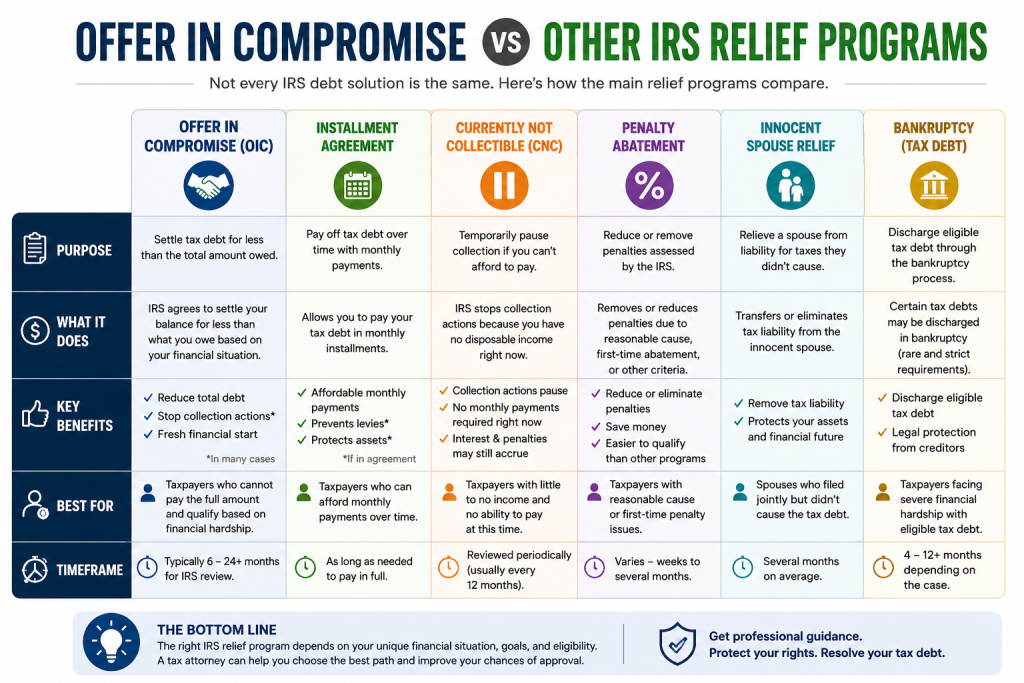
An experienced OIC attorney can help determine which option best matches your financial situation.
Offer in Compromise Los Angeles Cases
Taxpayers searching for “Offer in Compromise Los Angeles” often face:
- High living expenses
- Self-employment tax debt
- Payroll tax problems
- Real estate equity concerns
- Business-related IRS liabilities
In large metro areas like Los Angeles, IRS collection cases can become especially complex due to property values and income analysis.
Tax attorneys familiar with California IRS collection issues may help taxpayers better understand how local financial conditions impact OIC evaluations.
How an OIC Attorney Evaluates IRS Settlement Eligibility
An experienced tax attorney Offer in Compromise review often focuses on:
- Ability to pay
- Future income potential
- Asset liquidation risk
- Collection statute timelines
- IRS enforcement exposure
- Compliance history
The goal is not simply submitting paperwork — it is strategically evaluating whether the IRS is realistically likely to approve the settlement.
Not Every Taxpayer Qualifies
The IRS generally does not approve Offers in Compromise for taxpayers who:
- Have substantial disposable income
- Own high-equity assets
- Can fully pay through installments
- Are not compliant with tax filings
Proper case analysis is critical before applying.
Risks of Filing an Offer in Compromise Incorrectly
Submitting an Offer in Compromise without proper preparation can sometimes create additional problems.
Potential risks include:
- IRS collection delays turning into enforcement
- Financial disclosures exposing collectible assets
- Rejection after months of review
- Increased scrutiny of finances
- Continued penalty and interest accrual
This is why many taxpayers choose to consult with an offer in compromise lawyer before proceeding.
Why Taxpayers Work With Tax Law Advocates
At Tax Law Advocates, tax professionals including David Cho and Jamie Roman help taxpayers evaluate complex IRS settlement and collection situations.
The firm assists with:
- Offer in Compromise analysis
- IRS hardship evaluations
- Wage garnishment cases
- Bank levy issues
- Penalty abatement requests
- Installment agreements
- IRS appeals and compliance planning
Every IRS case is different, and the right solution depends on the taxpayer’s overall financial picture.
Final Thoughts on Tax Attorney Offer in Compromise Cases
An IRS Offer in Compromise can provide meaningful relief for qualifying taxpayers, but approval is far from guaranteed.
The IRS carefully analyzes:
- Income
- Expenses
- Assets
- Equity
- Future earning potential
- Compliance history
For taxpayers facing serious IRS debt, consulting with an experienced tax attorney Offer in Compromise professional may help clarify whether an OIC is realistic or whether another IRS resolution strategy may be more effective.
When handled strategically, the right resolution plan can help taxpayers stabilize their finances and reduce long-term IRS collection pressure.
Frequently Asked Questions
What does an offer in compromise attorney do?
An offer in compromise attorney evaluates your financial condition, prepares IRS documentation, negotiates with the IRS, and determines whether an OIC is the best resolution strategy.
Do I need a tax attorney for offer in compromise?
You are not legally required to hire a tax attorney, but many taxpayers seek professional guidance because IRS OIC cases involve complex financial analysis and strict documentation rules.
How long does an IRS Offer in Compromise take?
The process can take several months or longer depending on case complexity, IRS workload, and whether additional documentation is requested.
Can an Offer in Compromise stop IRS collections?
In some situations, certain collection actions may pause during review, but this depends on the specific case and IRS procedures.
What is the difference between an OIC attorney and a CPA?
An OIC attorney focuses on legal tax resolution strategy, IRS negotiations, appeals, and enforcement defense, while a CPA primarily handles accounting and tax preparation.
Does the IRS accept most Offers in Compromise?
No. Many applications are rejected because taxpayers fail to meet IRS qualification standards or submit incomplete financial information.
Can self-employed taxpayers qualify for an Offer in Compromise?
Yes. Self-employed individuals may qualify, but the IRS will closely examine business income, expenses, and assets.
Is an Offer in Compromise available in Los Angeles?
Yes. Taxpayers in Los Angeles and throughout California may apply for an Offer in Compromise if they meet IRS eligibility requirements.