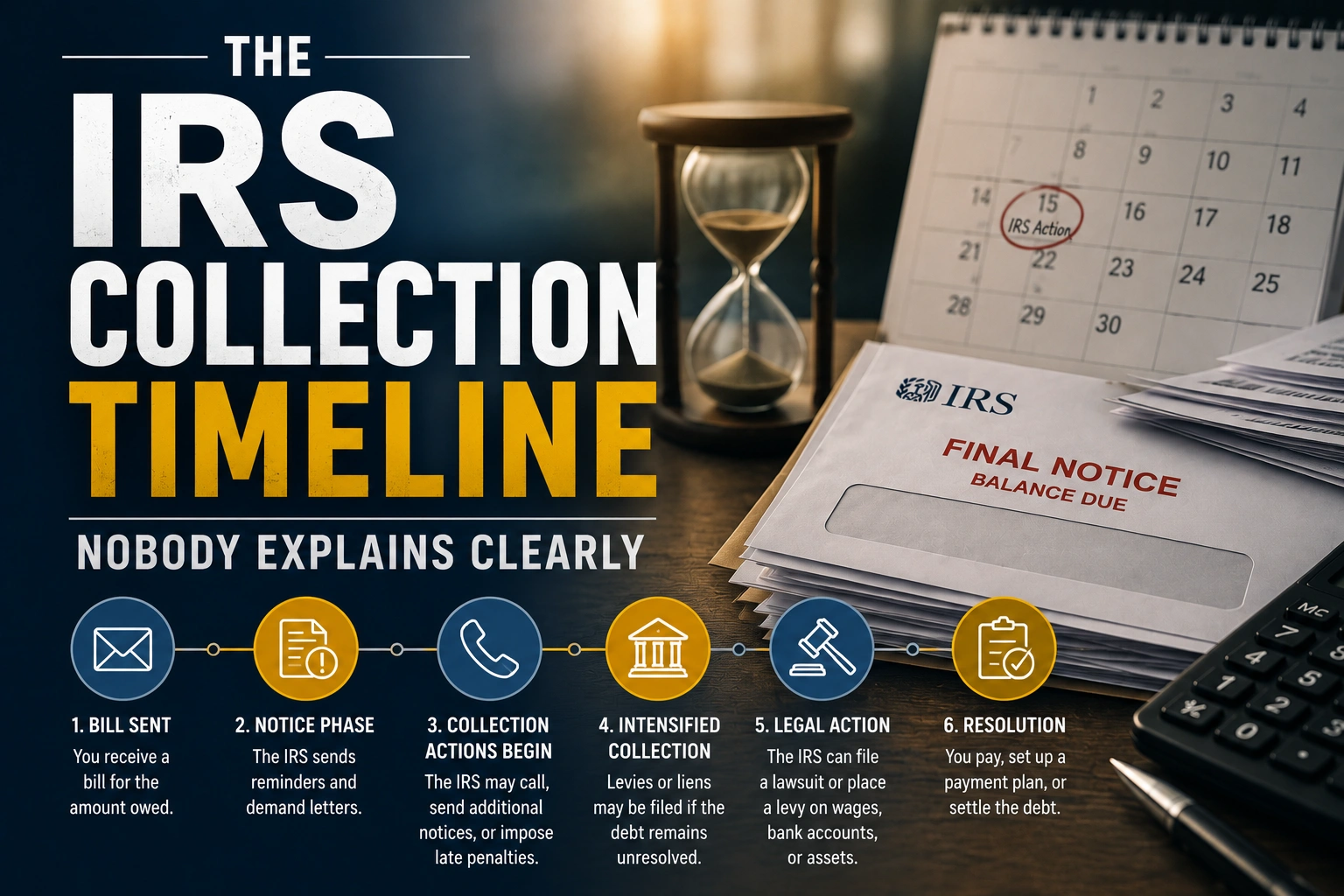
One of the biggest reasons taxpayers panic is because they do not understand how IRS collections actually work.
Most people think IRS enforcement happens instantly.
They imagine:
- surprise bank freezes,
- agents appearing suddenly,
- immediate garnishments,
- or losing everything overnight.
Social media often makes the IRS sound immediate and unstoppable.
At the same time, other internet sources dangerously claim:
- “The IRS won’t do anything.”
- “Just ignore the notices.”
- “They’re too understaffed to come after you.”
Both extremes are misleading.
The truth is that the IRS collection timeline is usually gradual, procedural, and emotionally exhausting for taxpayers who do not understand what is happening.
Across Reddit, TikTok, Quora, and financial forums, taxpayers constantly search:
- “How long before the IRS garnishes wages?”
- “What happens after IRS notices?”
- “Can the IRS freeze my bank account suddenly?”
- “How serious is a CP504 notice?”
- “Did I wait too long?”
- “What stage am I in?”
At Tax Law Advocates, many taxpayers seek help only after years of confusion and emotional avoidance because nobody clearly explained how IRS collections typically escalate over time. Professionals including Yongho (David) Cho and Jamie Roman help taxpayers understand the IRS collection process, what collection stages may mean, and why earlier action often creates more flexibility.
This guide explains the IRS collection timeline step by step using realistic taxpayer examples that make the process easier to understand emotionally and financially.
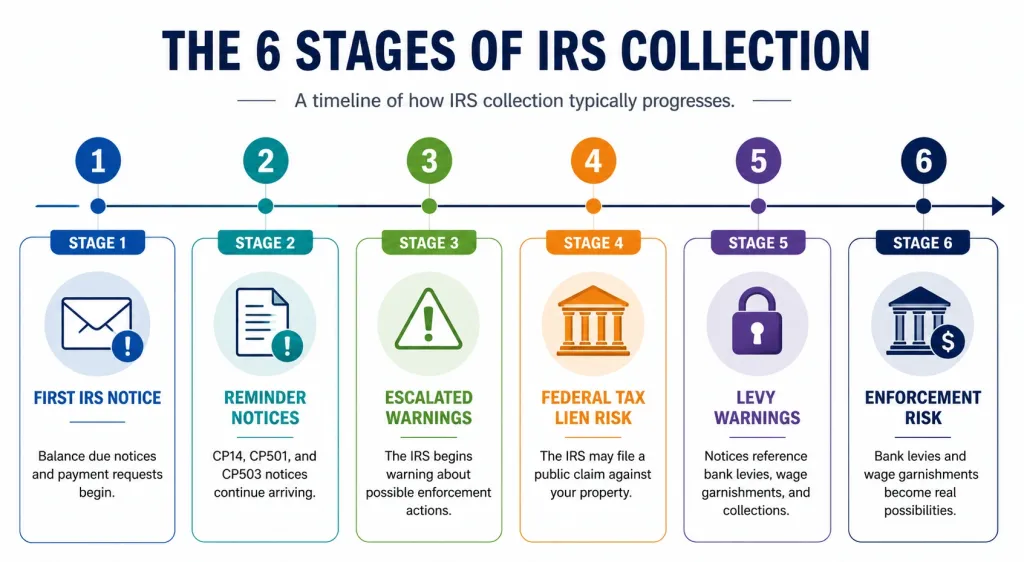
Stage 1: The IRS Sends the First Notice
For many taxpayers, IRS problems begin quietly.
At first, the IRS usually sends:
- balance due notices,
- filing reminders,
- or payment requests.
Many taxpayers panic immediately.
Others completely ignore the letters.
What Taxpayers Usually Think at This Stage
People often tell themselves:
- “I’ll deal with it next month.”
- “I can’t afford this right now.”
- “Maybe it’s a mistake.”
- “It’s probably not serious yet.”
Example: Michael the Restaurant Owner
Michael owned a small restaurant and owed roughly $18,000 after struggling during a slow business year.
When the first IRS notices arrived, he told himself:
“I just need business to improve first.”
He stopped opening IRS mail because every letter increased his anxiety.
Six months later, penalties and interest had grown significantly.
Stage 2: Reminder Notices Continue Arriving
If balances remain unresolved, the IRS usually sends additional notices.
This is where taxpayers often begin feeling emotionally overwhelmed.
Common IRS Notices During This Stage
Taxpayers may receive:
- CP14 notices,
- CP501 notices,
- CP503 notices,
- or escalating payment reminders.
Example: Sarah the Freelancer
Sarah worked as a freelance designer and fell behind on estimated taxes after inconsistent income.
When the IRS notices started arriving, she became embarrassed and stopped opening them entirely.
She later explained:
“I knew it was getting worse, but emotionally I couldn’t deal with it.”
By the time she finally reviewed the notices, the balance had nearly doubled from penalties and interest.
Stage 3: The IRS Becomes More Aggressive
At this point, IRS notices may begin sounding significantly more serious.
This is often when taxpayers start searching online frantically at night.
What Taxpayers Usually Search During This Stage
People commonly search:
- “Can the IRS garnish wages?”
- “Can the IRS take my bank account?”
- “How serious is a CP504?”
- “Can the IRS take my house?”
Example: David the Contractor
David ignored IRS notices for nearly two years after struggling with self-employment taxes.
When he received a Final Notice mentioning levy action, he panicked because he thought:
“They’re taking everything tomorrow.”
In reality, the IRS collection process had been escalating gradually for months before that point.
Stage 4: Federal Tax Lien Risks Increase
At this stage, taxpayers may begin encountering federal tax lien issues.
This is one of the most misunderstood IRS collection stages online.
What an IRS Tax Lien Actually Means
A federal tax lien is the government’s legal claim connected to unpaid tax debt.
It does not automatically mean:
- immediate seizure,
- eviction,
- or business shutdown.
Example: Jennifer the Realtor
Jennifer discovered the IRS filed a tax lien after years of avoiding unresolved tax balances.
She immediately feared:
“I’m losing my home.”
But after finally understanding the situation, she realized the lien was serious but not the same as immediate property seizure.
Stage 5: Levy Warnings Begin
This is one of the most emotionally intense stages.
Taxpayers begin receiving notices referencing:
- levy action,
- garnishments,
- or asset collection.
Why This Stage Feels So Terrifying
At this point, many taxpayers finally understand:
- the IRS can legally enforce collections,
- and avoidance is no longer emotionally sustainable.
Example: Carlos the Small Business Owner
Carlos delayed dealing with payroll tax debt because his business cash flow kept fluctuating.
When levy warnings arrived, he panicked because:
- payroll was due,
- vendors needed payment,
- and he feared losing the business entirely.
He later admitted:
“I thought if I just worked harder, I could eventually fix it.”
Stage 6: Wage Garnishment or Bank Levy Risks Increase
This is often the stage taxpayers fear most online.
What Happens Before IRS Enforcement Escalates
One major misconception online is:
“The IRS freezes accounts instantly.”
In reality, collection situations generally escalate through multiple notice stages first.
Example: Emily the Nurse
Emily ignored IRS notices for several years after a divorce and financial hardship.
When her paycheck was finally affected, she felt completely blindsided.
But after reviewing the timeline, she realized:
the IRS had sent multiple notices and warnings for a long time beforehand.
Why the IRS Collection Timeline Feels Emotionally Different From Other Debt
IRS debt affects people psychologically in unique ways.
Unlike credit cards, taxpayers often feel:
- fear of government authority,
- embarrassment,
- panic,
- and uncertainty.
The Biggest IRS Collection Myths Online
Myth #1: “The IRS Will Forget About Me”
This is one of the most dangerous myths online. People desperately want emotional relief when financially overwhelmed.
Myth #2: “The IRS Immediately Takes Everything”
Also false.
Most collection cases involve gradual escalation and multiple notices.
Myth #3: “I Should Wait Until I Can Pay Everything”
Many taxpayers believe they should avoid communication until they can fully pay the balance.
Why Earlier Action Usually Creates More Options
One of the most common taxpayer regrets is:
“I should’ve dealt with this sooner.”
At Tax Law Advocates, many taxpayers seek guidance only after years of emotional avoidance and escalating IRS pressure.
Why Every IRS Case Is Different
IRS outcomes depend heavily on:
- compliance,
- income,
- assets,
- business operations,
- and collection stage.
How Tax Law Advocates Helps Taxpayers Understand IRS Collections
At Tax Law Advocates, taxpayers often seek guidance because they:
- do not understand the collection timeline,
- panic after levy notices,
- or fear escalating IRS enforcement.
Yongho (David) Cho works on IRS collection and tax resolution matters involving:
- levies,
- tax liens,
- wage garnishments,
- payroll tax issues,
- and compliance strategies.
Meanwhile, Jamie Roman helps coordinate communication and documentation management throughout IRS collection resolution matters.
Why Organization Matters During IRS Cases
IRS matters often involve:
- deadlines,
- notices,
- financial records,
- and ongoing documentation requirements.
Final Thoughts: The IRS Collection Timeline Is Usually Slower — and More Emotional — Than People Realize
The internet often presents the IRS in extremes:
either:
- “They’ll destroy your life tomorrow”
or: - “They’ll never actually do anything.”
The reality is more nuanced.
Most IRS collection matters escalate gradually over time through:
- notices,
- warnings,
- liens,
- levy risks,
- and collection procedures.
But emotional avoidance often causes taxpayers to panic too late because they never fully understood the process earlier.
At Tax Law Advocates, professionals including David Cho and Jamie Roman help taxpayers understand realistic IRS collection risks and possible resolution strategies before situations become even more financially and emotionally overwhelming.
The most important thing taxpayers can do is replace fear and avoidance with accurate information and early action.
Frequently Asked Questions
How long does the IRS collection process usually take?
IRS collection matters often escalate gradually over time through notices, warnings, liens, and possible enforcement actions depending on the situation.
What happens after IRS notices are ignored?
Ignoring notices may increase penalties, interest, and collection escalation risks.
Does the IRS garnish wages immediately?
Most IRS collection situations involve multiple notice stages before garnishment risks escalate further.
What is the difference between an IRS lien and levy?
A lien is a legal claim connected to unpaid tax debt, while a levy involves actual collection enforcement actions.