Can the IRS Garnish Your Wages?
Yes. The Internal Revenue Service (IRS) has the legal authority to garnish wages for unpaid tax debt through an IRS Wage Garnishment, also known as an IRS wage levy. Unlike many private creditors, the IRS does not need to obtain a court judgment before issuing a wage levy. Once the required notices have been sent and the taxpayer fails to resolve the debt, the IRS can instruct an employer to withhold a portion of the employee’s paycheck and send those funds directly to the government until the tax liability is satisfied or alternative arrangements are made.
An IRS wage levy allows the government to require your employer to send a portion of your paycheck directly to the IRS until the tax debt is resolved or the levy is released. For many taxpayers, this can create immediate financial hardship and emotional stress. However, there are legal options available to stop or reduce IRS wage garnishment in certain situations.
At Tax Law Advocates, our tax attorneys and enrolled agents help individuals and business owners nationwide understand their rights and pursue lawful tax resolution strategies.
Understanding a Tax Levy on Paycheck
A tax levy on paycheck is one of the IRS’s most aggressive collection actions. Before garnishing wages, the IRS typically sends several written notices informing the taxpayer about the balance owed and the possibility of enforcement action.
Common IRS collection notices may include:
If these notices are ignored, the IRS may proceed with wage garnishment, bank levies, or other collection activity.
A tax levy on paycheck can continue for an extended period unless action is taken to resolve the underlying tax issue.
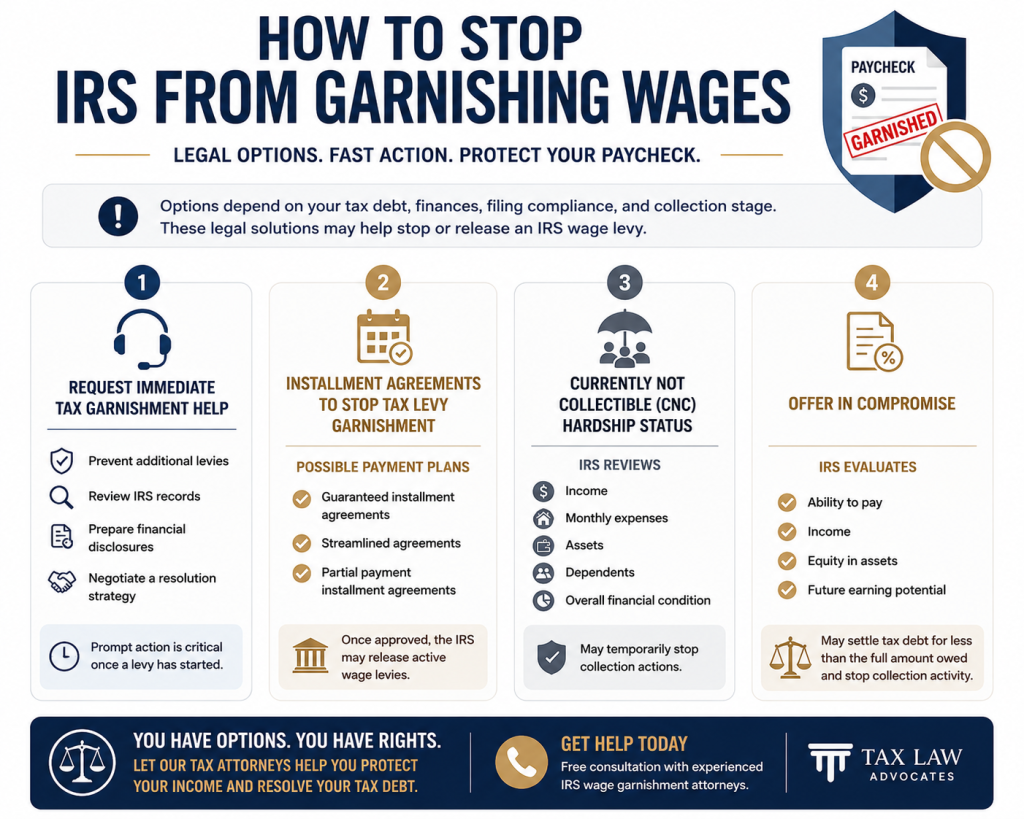
How to Stop IRS From Garnishing Wages
Many taxpayers ask: “How to stop IRS from garnishing wages?”
The answer depends on the facts of the case, including the amount owed, financial condition, filing compliance, and collection stage. Several legal options may be available.
Request Immediate Tax Garnishment Help
In some situations, an experienced representative may contact the IRS and request a temporary hold on collection activity while financial documentation and resolution options are reviewed.
This may provide valuable time to:
- Prevent additional levies
- Review IRS records
- Prepare financial disclosures
- Negotiate a resolution strategy
Prompt action is often critical once a levy has started.
Installment Agreements to Stop Tax Levy Garnishment
An IRS installment agreement may help stop tax levy garnishment when approved by the IRS.
Possible payment plan options include:
- Guaranteed installment agreements
- Streamlined agreements
- Partial payment installment agreements
Once accepted into a qualifying agreement, the IRS may release active wage levies in many cases.
Currently Not Collectible (CNC) Hardship Status
Taxpayers experiencing serious financial hardship may qualify for Currently Not Collectible status.
This option may temporarily stop collection actions if the IRS determines the taxpayer cannot reasonably pay while covering necessary living expenses.
The IRS reviews:
- Income
- Monthly expenses
- Assets
- Dependents
- Overall financial condition
For some individuals, hardship status can provide temporary relief from wage garnishment.
Offer in Compromise
An Offer in Compromise may allow eligible taxpayers to settle tax debt for less than the full balance owed.
This program is not available to everyone, and qualification depends on multiple financial factors.
The IRS carefully evaluates:
- Ability to pay
- Income
- Equity in assets
- Future earning potential
When appropriate, an Offer in Compromise may help resolve tax debt and stop ongoing collection activity.
How to Stop State Tax Levy on Wages
Federal IRS garnishments are not the only concern for taxpayers. Many states also have authority to issue wage levies for unpaid state tax liabilities.
Taxpayers often ask how to stop state tax levy on wages after receiving notices from state agencies such as:
- California Franchise Tax Board (FTB)
- New York Department of Taxation and Finance
- Illinois Department of Revenue
- Other state tax agencies
State tax agencies may have different procedures and deadlines than the IRS. However, options may include:
- Payment arrangements
- Hardship claims
- Penalty relief requests
- Administrative appeals
- Settlement negotiations
Acting quickly after receiving state tax notices is extremely important.
How to Stop Tax Garnishment Before It Gets Worse
The earlier taxpayers respond, the more options may be available.
Ignoring tax notices often leads to:
- Larger penalties and interest
- Wage garnishment
- Bank account levies
- Federal tax liens
- Increased enforcement activity
If you are trying to determine how to stop tax garnishment, it is important to:
- Review all IRS or state notices carefully
- Avoid ignoring certified mail
- Gather financial documentation
- Speak with a qualified tax professional
Every tax situation is different, and resolution strategies should be based on the taxpayer’s individual financial condition and compliance history.
IRS Wage Garnishment Attorneys Can Help Review Your Options
IRS wage garnishment attorneys may help taxpayers understand:
- Collection rights
- Appeal opportunities
- Payment options
- Hardship programs
- Levy release procedures
- Tax resolution strategies
Professional representation may also help reduce communication stress by allowing representatives to communicate directly with the IRS on the taxpayer’s behalf.
At Tax Law Advocates, our team works with taxpayers nationwide to evaluate collection cases and explain available options under federal tax law.
What Does “Issue Levy Check” Mean?
Some taxpayers searching IRS records or payroll notices may see references to “issue levy check.”
Generally, this refers to funds being processed or sent pursuant to an active levy order.
This may involve:
- Wage garnishment payments
- Bank levy transfers
- Employer remittances to tax authorities
If you receive notices containing levy language, immediate review is recommended to understand whether active collection enforcement has started.
Tax Garnishment Help for Individuals and Businesses
Wage garnishment can affect:
- Employees
- Independent contractors
- Self-employed individuals
- Business owners
In many cases, taxpayers still have options available even after garnishment has started.
Understanding your rights early may help reduce financial disruption and create a path toward long-term tax resolution.
Speak With Experienced Tax Professionals
If you are dealing with:
- IRS wage garnishment
- Tax levy on paycheck
- State tax wage levies
- Bank levies
- IRS collection notices
The team at Tax Law Advocates can help review your situation and explain potential resolution options.
A timely review may help prevent additional enforcement action and provide clarity during a stressful financial situation.
Frequently Asked Questions
Can the IRS garnish your wages without going to court?
Yes. Federal tax law gives the IRS authority to issue wage levies administratively without first obtaining a court judgment.
How much can the IRS take from my paycheck?
The IRS generally leaves an exempt amount based on filing status and dependents, but the remaining portion may still create substantial hardship.
Can wage garnishment be reversed?
In some situations, levies may be released if taxpayers qualify for hardship relief, payment arrangements, or other resolution programs.
Does the IRS notify employers?
Yes. Employers are legally required to comply once they receive an IRS levy notice.
Can state tax agencies garnish wages too?
Yes. Many state tax agencies have authority to levy wages for unpaid state tax liabilities.
This article is for educational purposes only and does not constitute legal or tax advice. Viewing this page does not create an attorney-client relationship. IRS outcomes depend on your specific financial situation, documentation, compliance status, and procedural posture. If you have received time-sensitive IRS notices, seek qualified professional advice promptly.