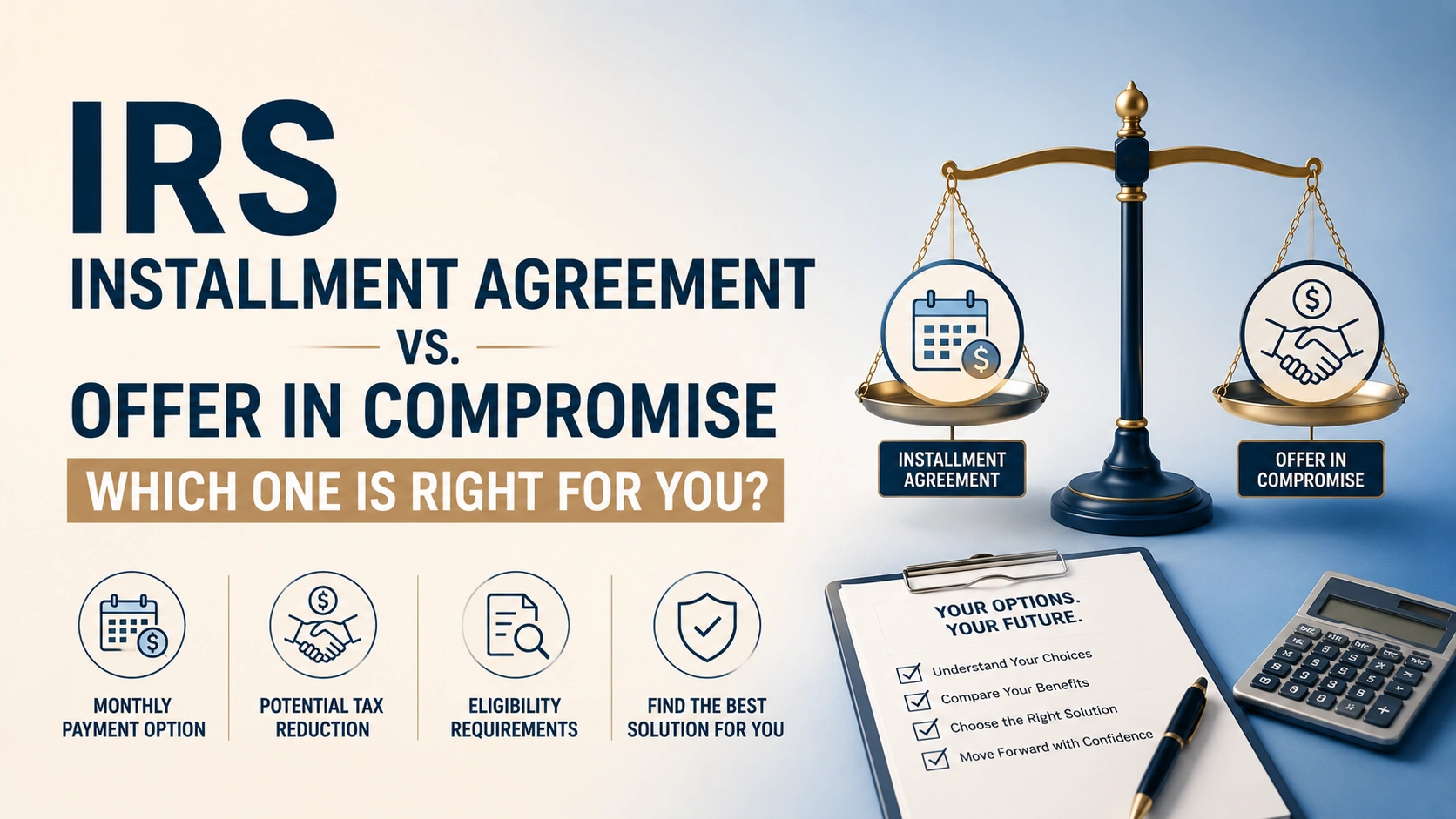
If you owe the IRS and cannot pay the full balance right now, two options come up more than any other: the installment agreement and the Offer in Compromise. Both are legitimate IRS programs. Both can stop collection actions and give you a path to resolution. But they work in very different ways, serve very different financial situations, and have very different outcomes in terms of how much you will ultimately pay.
The choice between them is not about which one sounds better. It is about which one you actually qualify for and which one makes the most financial sense given your specific income, expenses, and assets.
This guide breaks down exactly how each option works, who qualifies, what the application process looks like, and how to make the right decision for your situation.
What Is an IRS Installment Agreement?
An IRS installment agreement is a payment plan that allows you to pay your full tax balance over time through structured monthly payments rather than all at once. You are not reducing the amount you owe. You are spreading it out into manageable payments.
There are several types of installment agreements depending on your balance and circumstances:
Streamlined Installment Agreement. If you owe $50,000 or less in combined tax, penalties, and interest, and have filed all required returns, you may qualify for a streamlined agreement. This option does not require a detailed financial disclosure and is typically the fastest to set up.
Non-Streamlined Installment Agreement. For balances above $50,000, the IRS requires a more detailed review of your financial situation, including income, expenses, and assets, before approving a payment plan.
Partial Payment Installment Agreement. If you cannot afford monthly payments large enough to pay off the full balance before the IRS’s 10-year collection window expires, you may qualify for a Partial Payment Installment Agreement. Under this arrangement, your payments are based on what you can actually afford, and any remaining balance at the end of the collection period may expire uncollected.
Short-Term Payment Plan. If you can pay the full balance within 180 days, you may qualify for a short-term plan with no setup fee.
Once an approved installment agreement is in place, the IRS generally suspends active enforcement actions such as levies and garnishments as long as you remain current on payments. Penalties and interest, however, continue to accrue on your unpaid balance until it is paid in full.
What Is an Offer in Compromise?
An Offer in Compromise is an agreement between you and the IRS that settles your full tax liability for less than the total amount owed. If accepted, you pay a negotiated settlement amount and the remaining balance is forgiven.
The OIC is often referenced in advertisements promising to settle tax debt for “pennies on the dollar.” That outcome is real, but it is also the exception rather than the rule. The IRS accepts an OIC only when it determines that the amount you are offering represents the most it can reasonably expect to collect from you given your financial situation. That figure is called your Reasonable Collection Potential (RCP).
The IRS calculates your RCP based on:
Your monthly disposable income after allowable living expenses, multiplied over a period of time. The net equity in your assets, including home equity, vehicle equity, bank balances, and retirement accounts.
If the total of those two figures is less than what you owe, you may qualify for an OIC. If the IRS determines you could fully pay through an installment agreement, your OIC application will generally be rejected.
There are three grounds on which the IRS may accept an OIC:
Doubt as to collectibility. This is the most common. You agree you owe the tax but cannot pay the full amount based on your financial situation. This is the basis for most consumer OIC cases.
Doubt as to liability. You dispute whether you actually owe the tax or whether the amount assessed is correct. This is a separate process from the standard financial hardship OIC.
Effective tax administration. You can technically pay in full, but doing so would create severe economic hardship or would be inequitable under exceptional circumstances.
Key Differences at a Glance
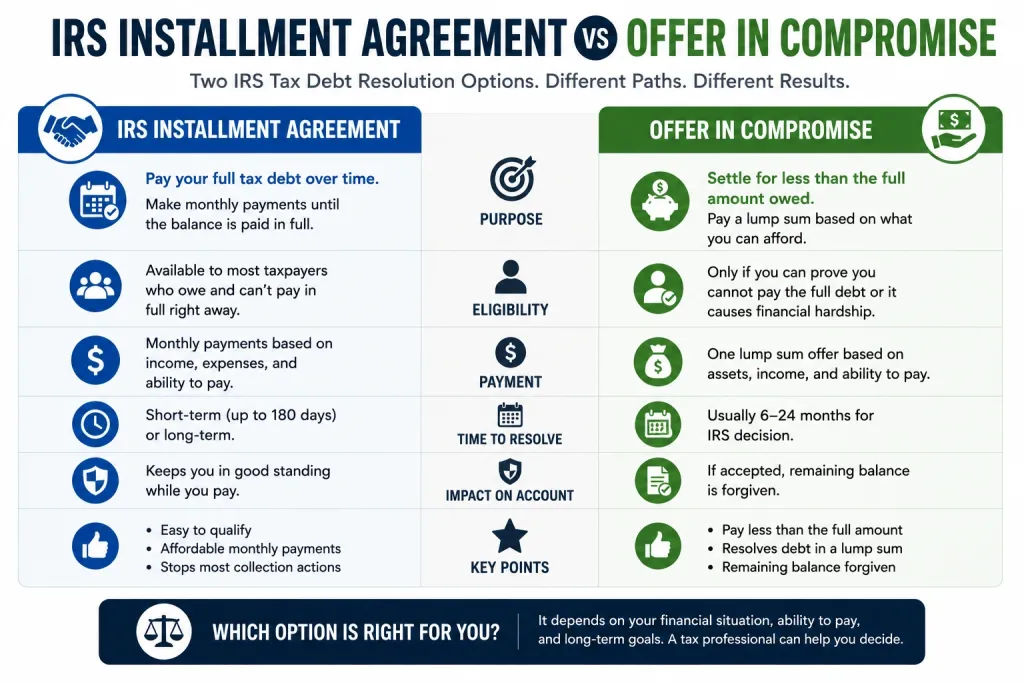
Total amount paid. With an installment agreement, you pay the full balance plus accruing interest and penalties. With a successful OIC, you pay a negotiated settlement that is often significantly less than the full amount owed.
Eligibility bar. Installment agreements have a high approval rate and are available to most taxpayers who are current on their filings. OICs have a lower approval rate because the IRS only accepts them when it genuinely cannot collect more through other means.
Financial disclosure. Streamlined installment agreements require minimal documentation for balances under $50,000. OIC applications require a complete and detailed financial disclosure, including income, expenses, assets, debts, and equity calculations across everything you own.
Processing time. An installment agreement can often be set up within days through the IRS Online Payment Agreement tool. An OIC typically takes anywhere from 6 to 12 months or longer for the IRS to review and process.
Effect on enforcement. Both options generally suspend active collection actions once approved. During an OIC review, the IRS also suspends the 10-year statute of limitations for collections, so the clock stops while your offer is being evaluated.
Compliance requirements. With either option, you must be current on all tax return filings before the IRS will consider your application. During an active installment agreement, you must continue to file and pay current taxes on time. Under an accepted OIC, you must remain compliant for five years following acceptance or the agreement can default and the original liability is reinstated.
Which Option Are You More Likely to Qualify For?
The honest answer is that most people who reach out for tax relief qualify for an installment agreement. It is the default resolution tool for taxpayers who owe money and need more time to pay.
The Offer in Compromise is not for everyone who owes the IRS. It is specifically for taxpayers whose financial situation makes full repayment genuinely unrealistic. The IRS looks at what you own and what you earn, not just what you owe.
You are more likely to qualify for an OIC if:
Your income is low relative to your tax debt. You have little equity in assets. Your debt is significantly higher than what the IRS could realistically collect from you over the remaining collection period. You are facing long-term financial hardship that is unlikely to improve.
You have steady income that can support monthly payments. Your balance is under $50,000. You can pay the full amount over time even if not immediately. You need to stop enforcement actions quickly and get into compliance.
A Common Misconception Worth Addressing
Many taxpayers assume that applying for an OIC is always worth trying because the worst that can happen is it gets rejected. That is not entirely accurate.
An OIC application requires a nonrefundable application fee of $205 as of 2026, which is waived for low-income applicants. It also requires an upfront payment at the time of submission, either 20% of the offer amount for a lump sum offer, or the first monthly installment for a periodic payment offer. These payments are nonrefundable even if the IRS rejects the application.
More significantly, the time spent pursuing an OIC that was never going to be approved is time during which penalties and interest continue to compound on your unpaid balance. A qualified tax professional can evaluate your Reasonable Collection Potential before you apply and give you a realistic assessment of whether your OIC has a genuine chance of being accepted.
The Role of the IRS Fresh Start Program
Both installment agreements and Offers in Compromise are core components of the IRS Fresh Start Program, which expanded access to these relief options and loosened some of the qualifying thresholds for both.
Under Fresh Start provisions:
The threshold for streamlined installment agreements was raised to $50,000, making it easier for more taxpayers to set up a payment plan without detailed financial disclosure. OIC eligibility was broadened by adjusting how the IRS calculates allowable living expenses and by extending the multiplier used to calculate future income in the RCP formula. Lien thresholds were raised, reducing the number of cases in which the IRS files a public Notice of Federal Tax Lien.
If you are evaluating your options, understanding how Fresh Start provisions affect your specific situation is an important part of the analysis.
What If Neither Option Fully Works for You?
For some taxpayers, neither a standard installment agreement nor an OIC is the right fit, at least not immediately. In those cases, other options may bridge the gap:
Currently Not Collectible Status. If you genuinely cannot afford any payments without creating financial hardship, the IRS may place your account in Currently Not Collectible status, temporarily suspending all collection activity. This is not a permanent solution, but it buys time while your situation stabilizes.
Partial Payment Installment Agreement. As noted above, if your budget allows you to pay something but not enough to pay in full before the collection period ends, a PPIA may be the most realistic path.
Penalty Abatement. If penalties represent a significant portion of your balance, reducing or eliminating them through first-time abatement or reasonable cause relief can change the financial picture enough to make a full payment plan or OIC more viable.
What You Should Do Before Applying for Either Option
Get current on your tax filings. The IRS will not consider an installment agreement or an OIC if you have unfiled returns. This is a non-negotiable prerequisite for both programs.
Pull your IRS account transcripts. Before you can choose the right resolution path, you need to understand your complete tax picture, what years are affected, what the exact balances are, and what collection stage your account has reached.
Calculate your actual Reasonable Collection Potential. For an OIC evaluation, knowing your RCP before you apply is critical. A professional can run these numbers using the same methodology the IRS uses, so you are not guessing.
Don’t apply for an OIC just because you saw it advertised. The OIC is a powerful tool for the right situation, but it is not the right tool for everyone. Getting an honest evaluation from a qualified tax professional before submitting an application can save you time, money, and months of waiting.
We Can Help You Decide
At Tax Law Advocates, we evaluate each client’s situation individually before recommending a path forward. Our team of federally licensed enrolled agents and tax attorneys reviews your full financial picture, runs the IRS’s own collection potential calculations, and gives you a straightforward recommendation on whether an installment agreement, an Offer in Compromise, or another resolution option best fits your situation.
We don’t push one option over another. We find the one that actually works for you.
Call us at 855-612-7777 or request your free case review today.
Frequently Asked Questions
Can I switch from an installment agreement to an Offer in Compromise?
Yes. If your financial situation changes and you believe you now qualify for an OIC, you can apply while an installment agreement is in place. You do not need to make installment payments while your OIC is being reviewed, and if the OIC is rejected, your installment agreement can typically be reinstated without an additional setup fee.
How long does the IRS have to accept or reject an OIC?
The IRS has two years from the date it receives your OIC application to make a determination. If it does not respond within that window, your offer is automatically accepted. In practice, most OIC reviews are completed within 6 to 12 months.
Will an installment agreement show up on my credit report?
An installment agreement itself is not reported to credit bureaus. However, a Notice of Federal Tax Lien, which the IRS may file for balances above certain thresholds, is a public record and can appear on your credit report.
Can I apply for an OIC if I am self-employed?
Yes. Self-employed taxpayers can apply for an OIC. However, if you have employees, you must be current on all required federal tax deposits for the current and prior two quarters before the IRS will consider your application.
What happens if I default on an accepted Offer in Compromise?
If you fail to meet the terms of an accepted OIC, including remaining compliant with all tax filings and payments for five years after acceptance, the IRS can reinstate the original full tax liability, minus any payments already made. Defaulting on an OIC can put you in a worse position than if you had never filed one.
This article is for informational purposes only and does not constitute legal or tax advice. Results vary based on individual circumstances. Tax Law Advocates is an independent tax resolution firm and is not affiliated with the IRS.