
IRS Bank Levy Help
Stop Account Seizures Fast
$0M+


Discover how much tax debt forgiveness you qualify for.
What Is a Levy?
A tax levy is the legal seizure of your property or assets by the IRS or a state tax agency to satisfy an unpaid tax debt. It’s different from a tax lien, which is simply a legal claim against your property as security for the debt; a levy is the actual taking of that property, whether it’s the money in your bank account, a portion of your paycheck, or in rarer cases, physical property like a vehicle. A levy is not usually the government’s first move. It typically comes after several unanswered notices, such as a CP504 or LT11 notice, and taxpayers generally have rights and options along the way, including the right to request a hearing before certain levies take effect. Understanding where you are in this process is the first step toward resolving it, and an experienced tax attorney like David Cho at Tax Law Advocates can review your notices and explain exactly what’s happening and what can still be done.
Unlike a tax lien, which is a claim, a levy is actual enforcement, meaning the IRS is actively collecting.
Simple Breakdown:
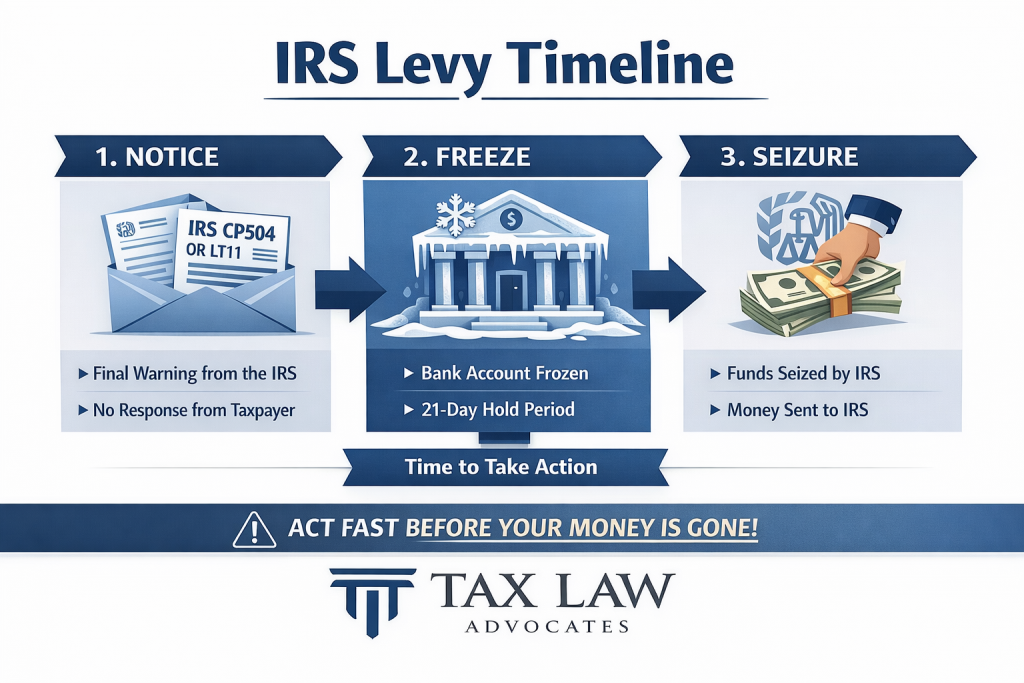
- IRS sends notices (CP504, LT11)
- You don’t respond or resolve
- IRS issues levy to your bank
- Funds are frozen and later withdrawn
How Much Can a Bank Levy Take?
In most cases, an IRS bank levy can take all funds available in your account at the time of the levy. However:
- It does NOT continuously drain your account (that’s wage garnishment)
- It only applies to funds present on the day of the levy
- Future deposits are not automatically taken (unless additional levies are issued)
Important:
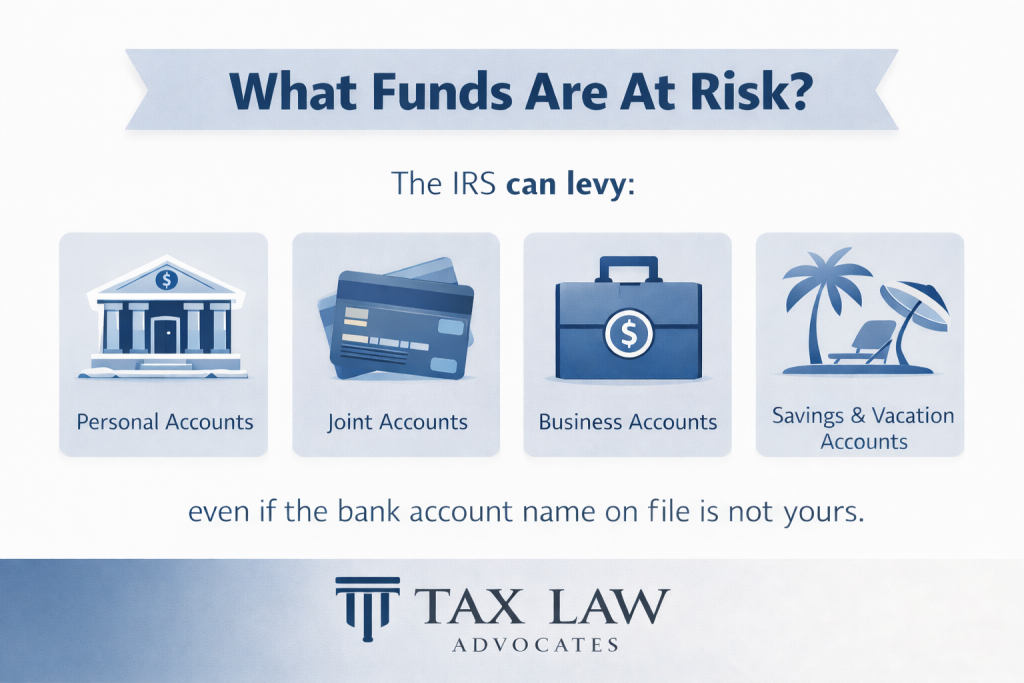
- Joint accounts may also be affected
- Business accounts can be levied
- Multiple accounts can be targeted

Can a Bank Levy Take All Your Money?
Yes, a bank levy can take your entire account balance, leaving you with zero access to funds. But there are important exceptions and opportunities:
Possible Protections:
- You may qualify for hardship relief
- Certain funds (like Social Security) may have partial protection
- Legal intervention can stop or reverse the levy
What Happens Next:
- Bank holds funds for 21 days
- This is your window to act
- After that, funds are sent to the IRS
If you do nothing, the money will be gone.
Can the IRS Take Your House?
In rare and extreme cases, yes, the IRS has the legal authority to seize a primary residence to satisfy unpaid tax debt. However, this is one of the most restricted collection actions available to the IRS. Seizing a personal residence generally requires approval from a federal district court judge or magistrate, and the IRS reserves this step as a last resort after other collection efforts and communication attempts have failed. In practice, most tax debts are resolved through less severe means, such as an installment agreement or Offer in Compromise, long before a home is ever at risk. If you’re worried about losing your house over back taxes, the priority is to respond to IRS notices and open communication as early as possible. The tax attorneys at Tax Law Advocates can assess your specific situation, explain how close (or far) your case is from this outcome, and help you pursue options designed to protect your property.
Why Is There a Tax Levy on My Paycheck?
Finding a tax levy on your paycheck is alarming, but it’s rarely a surprise the IRS springs without warning, it’s almost always the final step in a formal notice sequence that began months earlier. Typically, the process starts with a bill for unpaid taxes, like a CP14 notice (a Notice and Demand for Payment). If that balance goes unpaid and unaddressed, the IRS follows up with additional notices, such as a CP501 or CP503 notice, eventually culminating in a Final Notice of Intent to Levy and Notice of Your Right to a Hearing, like a CP90 or LT11 notice, usually sent at least 30 days before enforcement begins. If that final notice goes unanswered, whether because it was missed, misunderstood, or simply put off during a stressful time, the IRS moves forward with issuing the levy directly to your employer.
The good news is that a wage levy is very often reversible. The IRS has established, well-defined paths to release a levy, including setting up an installment agreement, demonstrating financial hardship through the IRS Hardship Program, disputing the underlying debt, or requesting a Collection Due Process hearing if your rights weren’t properly honored.
What Is a Levy on a Bank Account?
A bank levy is the IRS’s or a state agency’s legal seizure of funds directly from your checking or savings account to satisfy a tax debt. Unlike a wage garnishment, a bank levy is generally a one-time action tied to the account balance at the moment the levy is received by your bank, it captures whatever funds are available up to the amount owed, rather than continuing indefinitely. Your bank is legally obligated to comply once it receives the levy notice, freezing the specified funds and, after a required holding period, forwarding them to the IRS unless the levy is released first. For many people, seeing a frozen or depleted account is one of the most stressful parts of dealing with back taxes, since it can disrupt rent, utilities, and everyday expenses. Because timing is critical with bank levies, reaching out to a tax professional as soon as you’re notified can make a real difference in whether the funds can still be protected.
Can a Bank Levy Take All Your Money?
A bank levy can reach the full balance in your account at the time the levy is processed, up to the total amount you owe, there generally isn’t a built-in exempt amount the way there is with wage garnishments. That said, certain federal benefit payments, such as Social Security or VA benefits, may carry specific protections from levy under federal law, particularly if they were directly deposited within a protected look-back period, so not every dollar in an account is automatically fair game. Because the rules around what is and isn’t protected can be technical and fact-specific, it’s worth having those details reviewed rather than assuming the worst. If a levy has already hit your account, or you’re worried one is coming, Tax Law Advocates can evaluate what funds may be eligible for protection and what steps can be taken to limit the damage.
How to Stop a State Tax Levy
State tax levies work similarly to IRS levies in concept but follow the specific procedures of each state’s tax agency, which can differ from federal rules in timing, notice requirements, and available relief options. Generally, stopping a state levy involves responding promptly to the agency, providing requested financial documentation, and pursuing an available resolution such as a payment plan, a hardship-based hold, or, where applicable, an appeal of the underlying assessment. Because state agencies don’t always follow the same procedural safeguards as the IRS, deadlines can move quickly, and it’s easy to lose track of what’s required. If you’re facing a state tax levy, Tax Law Advocates can help identify which state agency issued it, what your rights and deadlines are, and what realistic paths exist to get it released.
What to Do When You Get a Notice of Levy
The most important thing to do when you receive a notice of levy is not ignore it, even if you’re not sure what it means or feel overwhelmed by it. Start by reading the notice carefully to identify which agency sent it, what type of notice it is, and whether a response deadline is listed; many levy notices, including a CP504, LT11, or LT1058 notice, come with a limited window to request a hearing or otherwise respond before enforcement begins. Gather your recent tax filings, IRS correspondence, and basic financial information, since you’ll likely need them regardless of which resolution path you pursue. From there, reaching out to a qualified tax professional quickly matters more than almost anything else, since levy timelines move fast and options tend to narrow the longer a notice goes unanswered. Tax Law Advocates offers a case review with a licensed tax attorney to help you understand exactly what the notice means for your situation and what steps make sense next.
Who Do I Call About a Tax Levy?
When you’re facing a levy, who you call matters. Many companies that advertise “tax relief” are call centers or sales-driven operations without licensed attorneys actually handling your case. Tax Law Advocates are built differently; your case is reviewed and handled by licensed tax attorneys like Scott Mullerleile, David Cho, and Jamie Roman, not a sales team reading from a script, which matters when you’re dealing with something as serious and legally technical as an IRS or state levy. Whether you’re dealing with a frozen bank account, a wage garnishment, or a notice warning that one is coming, the right first call is to someone who can actually read your IRS transcripts, understand your rights, and act on your behalf. Tax Law Advocates offers a confidential case review to help you understand where you stand and what options may be available before deciding on next steps — contact us to get started.
How We Help Stop a Bank Levy
When you contact us, we act fast.
01
Immediate Case Review
We analyze:
- IRS notices
- Account status
- Financial hardship
02
Emergency IRS Intervention
We contact the IRS directly to:
- Request levy release
- Place collection holds
- Prevent further seizures
03
Resolution Strategy
Benefits of Bank Levy Help
Working with a tax attorney can:
- Stop or reverse bank levies quickly
- Protect your remaining assets
- Reduce total tax debt
- Prevent future enforcement actions
- Give you peace of mind and control
Most clients come to us after funds are frozen — we help them recover and move forward.
Why Work With a Tax Attorney for Levy Removal
A bank levy is a legal enforcement action, not just a tax issue. Only experienced tax attorneys can:
- Represent you legally before the IRS
- Negotiate directly with IRS officers
- Use legal strategies to release levies
- Protect your rights and financial future
At Tax Law Advocates:
- You speak directly with legal professionals
- We understand IRS procedures deeply
- We act fast when timing matters most
How Long Does It Take to Release a Bank Levy?
Once the IRS sends a bank levy, your bank is required to hold the seized funds, rather than sending them to the IRS immediately, for a mandatory 21-calendar-day period. This holding window exists specifically to give taxpayers a chance to resolve the issue before the money is actually turned over, whether by proving financial hardship, showing the levy was issued in error, or arranging a resolution such as an installment agreement. If the levy is released within that 21-day window, the bank should not forward the funds to the IRS, though it may still take the bank a few business days to process the release and restore access to your account. If the 21 days pass without resolution, the funds are sent to the IRS and are generally much harder to recover. This is why the window immediately after a bank levy notice is so important; every day matters. Tax Law Advocates prioritizes active bank levy cases for this reason, working to get documentation and negotiations moving before that 21-day period closes.
What Is a Levy on a Property?
A property levy refers to the IRS’s or a state agency’s seizure of physical or real assets, such as real estate, vehicles, boats, or business equipment, rather than cash from a bank account or wages. Property seizures are far less common than bank or wage levies because they involve more procedural steps, including appraisal and often a public sale to satisfy the debt, and the IRS typically pursues them only when other collection methods haven’t resolved the balance. Before seizing property, the IRS is generally required to determine that the equity in the asset justifies the cost and effort of seizure and sale, and taxpayers usually have prior notice and appeal rights before it happens. This is a particular concern for real estate investors and business owners with significant equipment, like contractors and construction companies. If you’ve received correspondence suggesting a property seizure is being considered, it’s a signal to act quickly rather than wait. A tax attorney at Tax Law Advocates can review the notice, verify what stage the collection process is actually at, and outline the options still available to protect your assets.
What Is a Notice of Levy?
A Notice of Levy is a formal IRS or state document that either warns you a levy is coming or directs a third party, such as your bank or employer, to turn over your funds. These aren’t the same thing, and the distinction matters. A Final Notice of Intent to Levy and Notice of Your Right to a Hearing, such as an LT11 or CP90 notice, is typically sent to you directly and starts a countdown, usually 30 days, during which you can request a Collection Due Process hearing or otherwise respond before enforcement begins. A separate Notice of Levy is what’s actually sent to your bank or employer once that window has passed, instructing them to withhold or turn over funds. Because these notices carry real deadlines and legal rights attached to them, it’s important not to set them aside, even if the language is dense or confusing. If you’ve received any notice referencing a levy, Tax Law Advocates can review it, confirm exactly what stage you’re at, and explain what response options and deadlines apply to your situation.
How Often Can the IRS Levy My Bank Account?
Because a bank levy generally captures only the funds present in an account at one specific moment, it isn’t automatically continuous the way a wage garnishment is. That means if the underlying tax debt remains unresolved, the IRS can, in theory, issue another levy against the same or a different account later on. There’s no fixed legal limit on how many times this can happen while a balance remains outstanding and the account is still an active collection target. In practice, repeated levies are more likely when a case stays unresolved and communication with the IRS has stalled. The most effective way to stop the cycle isn’t to wait it out, but to resolve the underlying debt or collection status itself, whether through an Offer in Compromise or the IRS Fresh Start Program. Tax Law Advocates works with clients to address the root issue, not just the most recent levy, so future levies become far less likely.
Why Tax Law Advocates
- 16+ Years of Experience in IRS Resolution
- Nationwide Service
- Tax Attorneys (Not CPAs or Call Centers)
- Proven IRS Negotiation Experience
- Real Human Support
We’ve helped clients across the U.S. stop aggressive IRS actions and regain financial control.
Real Client Scenarios
Case 1:
Client had $18,000 frozen in their bank account
→ We intervened within 48 hours
→ Levy released before funds were transferred
Case 2:
Small business owner lost access to payroll funds
→ Emergency negotiation secured release
→ Installed payment plan to prevent future levies
Case 3:
Client facing repeated levies
→ Placed in Currently Not Collectible status
→ IRS collections stopped entirely
Meet Your Lead Tax Attorney and Enrolled Agent for IRS Debt Relief & Tax Resolution You Can Trust

David Cho
David Cho
Scott Mullerleile
EA with 12+ years in tax resolution and a background in collections. Scott has successfully handled hundreds of cases, including accepted Offers in Compromise and representation before Revenue Officers, audits, and appeals.

Our IRS Tax Relief Results by the Numbers
Proven results helping clients resolve IRS and state tax debt nationwide.
$0M+
Tax Debt Resolved for Clients
0K+
Clients served
0%
Handled by Tax Attorneys
0%
Cases Successfully Resolved
24hr
Average Case Action Time
0
Years of experience
Tax Law Advocates Client Success Stories
Jonnel Bolotano with Tax Law Advocates was amazing to work with. Even though I didn’t initially start my case with him, he stepped in, took charge, and stayed on top of everything from that point forward.

ItzMiBaebii
If I could give Tax Law Advocates more than 5 stars, I absolutely would. Jamie and Scott were my dream team, steady, sharp, and on top of every detail. I came in with a heavy tax burden that felt like it would follow me forever...

Rebecca Ingram
Jesse Moreno my tax lawyer did a wonderful job on my case. She was very patient kind and professional, and resolution that I received was better than I expected! Thank you Jesse for representing me!

Debbie Kern
FAQ
What is a bank levy?
A bank levy is when the IRS freezes and takes money directly from your bank account to collect unpaid taxes.
How long does a bank levy last?
Banks hold funds for 21 days before sending them to the IRS.
Can a bank levy be stopped?
Yes, with quick action and proper legal representation, levies can often be released.
Can the IRS take money without warning?
They must send notices first, but many people overlook them.
What happens to joint accounts?
Joint accounts may be levied even if only one owner owes taxes.
Are any funds protected?
Some federal benefits may have limited protection.
Can I get my money back?
In some cases, yes—especially if action is taken during the 21-day hold.
Will the IRS levy again?
Yes, if the underlying tax issue isn’t resolved.
Do I need a lawyer for a bank levy?
It’s strongly recommended—levies are legal enforcement actions.
How fast should I act?
Immediately. Timing is critical.
Stop Your Bank Levy Today — Free Consultation
Every day matters. Once the 21-day window passes, your money may be gone.