Failing to file a tax return can create serious financial and legal consequences with the IRS. Many taxpayers underestimate how quickly penalties, interest, and collection actions can grow after a missed filing deadline. The IRS has broad authority to assess penalties, garnish wages, place tax liens, levy bank accounts, and pursue enforcement actions against both individuals and businesses.
If you are searching for information about the fine for not filing taxes, it is important to understand that the IRS generally distinguishes between failing to file a return and failing to pay taxes owed. The penalties for these issues are different, and failure to file is often treated more aggressively.
At Tax Law Advocates, tax attorneys such as Yongho David Cho and enrolled agents like Scott Mullerleile regularly help taxpayers address IRS filing issues, late returns, penalty relief, and collection enforcement matters.
Do You Get Penalized for Not Filing Taxes?
Yes. One of the most common IRS penalties is the failure to file penalty. The IRS imposes this penalty when a taxpayer does not submit a required tax return by the filing deadline and has unpaid taxes due.
Many people ask: “Do you get penalized for not filing taxes?” The answer is usually yes if taxes are owed. Even if a taxpayer cannot afford to pay the balance, filing the return on time is often critically important because the failure-to-file penalty is typically much larger than the failure-to-pay penalty.
How the IRS Failure to File Penalty Works
The IRS generally charges:
- 5% of the unpaid taxes per month
- Up to a maximum of 25% of the unpaid balance
If both the failure-to-file and failure-to-pay penalties apply in the same month, the combined penalty is adjusted.
For example:
The IRS Failure-to-File penalty can add up quickly. For example, an unpaid tax balance of $5,000 could result in a penalty of up to $1,250, while a $10,000 balance may generate up to $2,500 in penalties. On a larger balance of $50,000, the penalty can reach as much as $12,500. In addition to these penalties, interest continues to accrue on the unpaid tax and penalties until the balance is fully resolved, increasing the total amount owed over time.
What Is the Penalty for Filing Business Taxes Late?
Business owners face even more serious risks when returns are filed late. Many taxpayers search for: what is the penalty for filing business taxes late because business-related IRS penalties can become extremely expensive very quickly.
The IRS may assess penalties for:
- Late corporate tax returns
- Late partnership returns
- Payroll tax filing failures
- Late S-corporation returns
- Failure to deposit payroll taxes
- Missing information returns
Payroll Tax Penalties Can Become Severe
Payroll tax issues are among the IRS’s highest enforcement priorities. When a business withholds payroll taxes from employees but fails to remit them properly, the IRS may pursue:
- Trust Fund Recovery Penalties
- Federal tax liens
- Bank levies
- Revenue officer investigations
- Personal liability against business owners
In serious cases, business tax noncompliance can create both civil and criminal exposure.
Failure to File vs. Failure to Pay
Many taxpayers confuse these two IRS penalties.
The IRS may assess different penalties depending on the type of noncompliance. A Failure-to-File penalty is typically 5% of the unpaid tax per month, making it one of the most costly IRS penalties. A Failure-to-Pay penalty is generally lower, usually 0.5% of the unpaid tax per month. When both apply, penalties and interest can accumulate rapidly, significantly increasing the total tax debt over time.
This difference is significant because filing late can become substantially more expensive than paying late.
Why Filing Even Without Payment Matters
Tax attorneys often advise taxpayers to file returns even if they cannot pay immediately because:
- It reduces penalty exposure
- It may help avoid substitute-for-return assessments
- It can improve eligibility for IRS resolution programs
- It demonstrates compliance efforts to the IRS
Programs such as installment agreements, Currently Not Collectible status, or Offer in Compromise options may become available only after required returns are filed.
What Happens If You Ignore Unfiled Taxes for Years?
The IRS has multiple enforcement tools when returns remain unfiled for extended periods.
Substitute for Return (SFR)
If a taxpayer does not file, the IRS may create its own version of the return using third-party income records such as:
- W-2s
- 1099s
- Brokerage statements
- Business income reports
These IRS-prepared returns often maximize tax liability because they usually do not include many deductions, exemptions, or credits available to the taxpayer.
Collection Enforcement
After assessments occur, the IRS may begin collection actions including:
- Wage garnishment
- Bank levies
- Federal tax liens
- Passport restrictions in severe cases
- Seizure actions in rare situations
Punishment for Not Filing Taxes: Can It Become Criminal?
Many taxpayers worry about the potential punishment for not filing taxes. While most late filing cases remain civil matters, criminal enforcement is possible in some situations.
The IRS may consider criminal investigation factors such as:
- Intentional tax evasion
- Repeated years of non-filing
- Concealment of income
- False documents
- Fraudulent activity
Civil vs. Criminal Tax Cases
The consequences of not filing taxes can vary depending on the circumstances. A simple late filing may result in civil penalties and interest charges, while ignoring tax obligations for multiple years can lead to aggressive IRS collection actions such as liens, levies, or wage garnishments. In more serious cases involving suspected fraud or intentional tax evasion, the IRS may pursue a criminal investigation that can result in substantial fines and other legal consequences.
Criminal tax cases are relatively rare compared to civil enforcement, but taxpayers should not ignore IRS notices or compliance obligations.
Can IRS Penalties Be Reduced or Removed?
In many cases, yes.
The IRS may provide penalty relief options depending on the taxpayer’s circumstances.
Common IRS Penalty Relief Programs
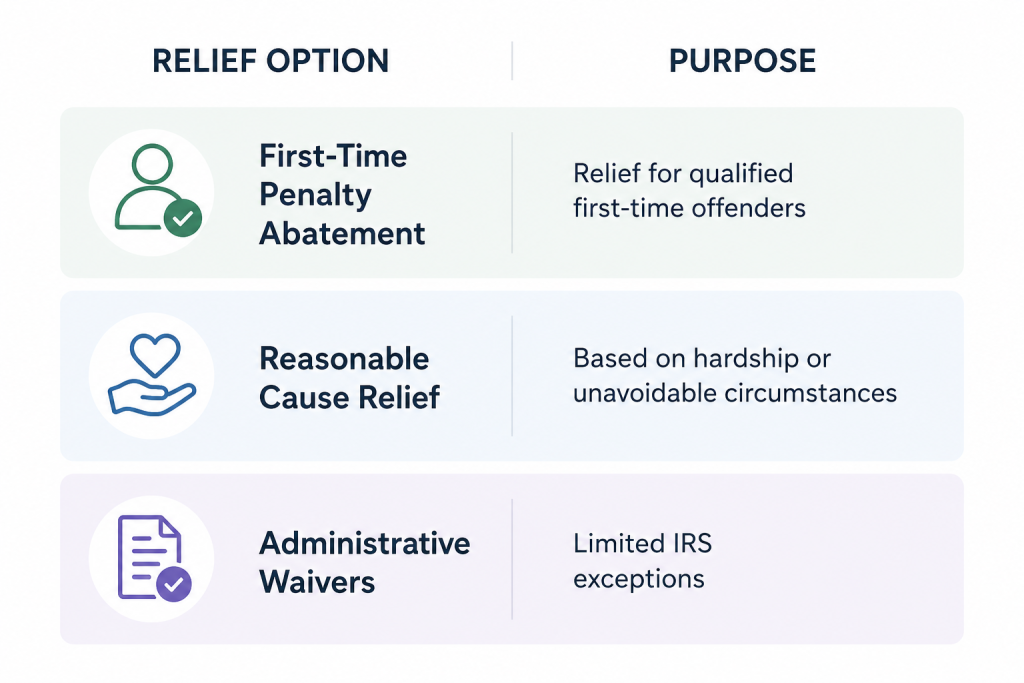
Tax professionals may help document circumstances such as:
- Serious illness
- Natural disasters
- Financial hardship
- Incorrect professional advice
- Record destruction
- Family emergencies
How Tax Law Advocates Helps Taxpayers With IRS Filing Problems
At Tax Law Advocates, the legal and tax resolution team helps individuals and businesses address:
- Unfiled tax returns
- IRS failure-to-file penalties
- Payroll tax issues
- Tax debt negotiations
- Wage garnishments
- IRS levy releases
- Penalty abatement requests
Yongho David Cho focuses on complex IRS negotiations and compliance strategies, while Jamie Roman and the broader tax resolution team work with taxpayers facing escalating IRS collection pressure.
Steps to Take If You Have Unfiled Tax Returns
Ignoring IRS problems usually increases financial risk over time. Taxpayers with missing returns should consider taking action before penalties and collections continue growing.
Recommended Initial Steps
- Determine which years are unfiled
- Gather IRS transcripts and income records
- File accurate returns as soon as possible
- Review potential penalty relief eligibility
- Evaluate payment or settlement options
- Respond promptly to IRS notices
Early action often creates more resolution opportunities and may reduce enforcement pressure.
Final Thoughts on Failure to File Penalties
The IRS treats filing compliance seriously, especially when taxes remain unpaid. The fine for not filing taxes can grow quickly due to monthly penalties and compounded interest. Business owners may face even larger risks, particularly involving payroll taxes and repeated noncompliance.
Taxpayers facing IRS filing issues should avoid ignoring notices or delaying action further. Addressing unfiled returns proactively may help reduce penalties, prevent escalating collections, and create more opportunities for structured resolution programs.
FAQs
Do you get penalized for not filing taxes if you cannot afford to pay?
Yes. The IRS may still assess a failure-to-file penalty even if you cannot pay the taxes owed. Filing the return on time is usually better than not filing at all because the failure-to-file penalty is generally much higher than the failure-to-pay penalty.
What is the penalty for filing business taxes late?
The penalty depends on the type of business return involved. Partnerships, S-corporations, payroll tax filings, and corporate returns may all have different penalty structures. In some cases, penalties can increase monthly and become substantial over time.
Can the IRS waive penalties for late filing?
Yes. The IRS may offer relief through programs such as First-Time Penalty Abatement or Reasonable Cause Relief if the taxpayer qualifies based on compliance history or documented hardship circumstances.
What happens if I never file my taxes?
The IRS may eventually file a Substitute for Return (SFR) on your behalf using income information from employers and financial institutions. These returns often result in higher tax balances because deductions and credits may not be fully included.
Can you go to jail for not filing taxes?
Most late filing situations remain civil matters involving penalties and collections. However, intentional tax evasion, repeated noncompliance, fraud, or concealment of income may trigger criminal investigation in severe cases.
Is there a difference between failure to file and failure to pay?
Yes. Failure to file penalties are usually more severe than failure to pay penalties. The IRS often charges approximately 5% per month for failure to file versus 0.5% per month for failure to pay.
How many years can you file taxes late?
Taxpayers can usually file prior-year returns, but delaying too long can increase penalties, interest, and enforcement risk. Additionally, refunds may expire if returns are not filed within the allowable refund claim period.
Can the IRS garnish wages for unfiled taxes?
Yes. Once the IRS assesses taxes and collections begin, the agency may garnish wages, levy bank accounts, or file federal tax liens if the debt remains unresolved.
Does filing late hurt my chances of getting penalty relief?
Not necessarily. Some taxpayers still qualify for penalty abatement even after filing late, especially if they can show reasonable cause or have a strong compliance history.
Should I hire a tax attorney for unfiled tax returns?
Complex situations involving multiple years of unfiled taxes, business liabilities, payroll tax problems, or aggressive IRS enforcement may benefit from professional representation by a tax attorney or enrolled agent.
What is the fine for not filing taxes if I am owed a refund?
If no taxes are owed, the IRS generally does not assess a failure-to-file penalty. However, taxpayers may lose refunds if returns are not filed within the allowable refund claim period.
Can the IRS forgive failure-to-file penalties?
In some situations, yes. First-Time Penalty Abatement and reasonable cause relief may reduce or remove penalties for qualifying taxpayers.
How long can you go without filing taxes?
There is no simple universal answer because IRS enforcement depends on income, balance owed, compliance history, and other factors. However, long periods of non-filing can significantly increase risk.
Is filing late better than not filing at all?
In most cases, yes. Filing late is usually less damaging than completely failing to file because it may reduce penalties and improve eligibility for IRS resolution programs.
This article is for educational purposes only and does not constitute legal or tax advice. Viewing this page does not create an attorney-client relationship. IRS outcomes depend on your specific financial situation, documentation, compliance status, and procedural posture. If you have received time-sensitive IRS notices, seek qualified professional advice promptly.