If you owe back taxes, you have likely come across the claim that the IRS simply forgives tax debt after 10 years. It is one of the most searched questions in tax resolution, and for good reason: the idea of a debt quietly disappearing is appealing. The short answer is that the IRS does have a 10-year collection window, but “forgiveness” is not quite the right word for what actually happens, and the rule comes with enough exceptions that relying on it without professional guidance can be risky. This article breaks down exactly how the rule works, what can pause or extend it, and what your realistic options are if you are carrying a tax balance.
Does the IRS Forgive Tax Debt After 10 Years, or Is It More Complicated?
The IRS is legally required to stop collection activity once the collection statute of limitations expires, which is generally 10 years from the date your tax was assessed. In that narrow sense, yes, unpaid tax debt can become legally uncollectible after a decade. But very few taxpayers make it to that date with a clean, untouched clock, because certain actions on your part or the IRS’s part can pause the countdown for months or even years at a time. (Time IRS Can Collect Tax)
Understanding this distinction matters because taxpayers who assume the clock is running cleanly often make decisions, like ignoring IRS notices or avoiding contact, that end up extending their debt rather than shortening it. A qualified tax professional can pull your account transcript and calculate your actual expiration date, which is often very different from a simple 10-year estimate based on when you filed.
The 10-Year Statute of Limitations on Tax Debt Collection, Explained
Internal Revenue Code Section 6502 sets the collection statute expiration date, commonly called the CSED, at 10 years from the date of assessment, not the date the return was filed or the date the tax was originally due. Assessment typically happens shortly after you file a return or after the IRS completes an audit adjustment, and this date is recorded on your account transcript.
Once the CSED passes, the IRS loses its legal authority to collect that specific tax debt through liens, levies, wage garnishment, or lawsuits, and the balance is written off. This applies debt by debt and year by year, so if you owe taxes for multiple years, each year has its own separate CSED running on its own timeline.
Why “Forgiveness” Is the Wrong Word for What Actually Happens
“Forgiveness” implies the IRS makes an affirmative decision to excuse your debt, similar to how a lender might approve a loan forgiveness application. What actually happens with the CSED is closer to an expiration: the IRS simply loses the legal right to pursue the debt once the statutory window closes, with no application, approval, or formal notice required on their part.
This distinction is more than semantic. Programs like an offer in compromise involve the IRS actively agreeing to accept less than you owe, which is genuine forgiveness of a portion of your debt. The 10-year rule, by contrast, is a procedural deadline, and taxpayers who confuse the two often miscalculate how much certainty they actually have.
How the IRS Collection Statute Expiration Date (CSED) Actually Works
Every taxpayer with a balance due has a CSED attached to each tax year they owe, and the IRS tracks these dates internally through its Integrated Data Retrieval System. Your CSED is not something you can find on your notices; it must be calculated from your account transcript or requested directly from the IRS or a tax professional.
Because the calculation depends on the exact assessment date and any tolling events that occurred afterward, two taxpayers who owe the same amount from the same tax year can have meaningfully different expiration dates. This is why generic online IRS calculators should be treated as rough estimates rather than reliable figures.
How to Calculate Your CSED From the Date of Assessment
To estimate your CSED, start with your assessment date, found on IRS transcript codes such as 150 (return filed and tax assessed), then add 10 years to that date as your baseline expiration. From there, you need to identify and add back any period during which the statute was paused, since these periods extend the CSED beyond the simple 10-year mark.
Requesting an account transcript through the IRS or a representative with power of attorney is the most reliable way to see the actual assessment date and any tolling codes on record, rather than guessing based on when a return was originally due.
Common Events That Pause or Extend the 10-Year Clock
Several routine taxpayer actions pause the collection clock, including filing for bankruptcy, submitting an offer in compromise, requesting a collection due process hearing, or applying for innocent spouse relief. Each of these actions suspends the CSED for the length of the process plus, in some cases, an additional statutory period afterward.
Living outside the United States for an extended period can also toll the statute, sometimes indefinitely until you return. Because these pauses are cumulative, a taxpayer who has gone through even two or three of these processes over the years may find their real CSED is several years later than a naive calculation would suggest.
What Can Suspend or Reset Your IRS 10-Year Collection Period
Beyond the general categories above, it helps to understand the specific mechanics of the most common tolling events, since each one behaves slightly differently and combining several of them can significantly extend your timeline. Taxpayers actively working through resolution options are often unaware that the very steps intended to help them are also extending the window the IRS has to collect.
This is not a reason to avoid these programs, since most of them offer real benefits, but it is a reason to go in with accurate expectations rather than assuming the clock is ticking down unaffected in the background.
Filing Bankruptcy, an Offer in Compromise, or a Collection Due Process Appeal
Bankruptcy suspends IRS collection activity under the automatic stay, and the CSED is tolled for the duration of the bankruptcy case plus six months afterward. An offer in compromise similarly pauses the clock while the IRS reviews your proposal, and if the offer is rejected, an additional 30-day window and any appeal period are added on top.
A collection due process appeal, typically filed after receiving a Notice of Intent to Levy, also suspends the statute for as long as the appeal is pending, which can take many months depending on the IRS’s current caseload.
Leaving the Country, Applying for an Installment Agreement, and Other Tolling Events
If you leave the United States for a continuous period of six months or more, the CSED stops running entirely until you return, which can catch taxpayers with international work assignments off guard. Requesting an installment agreement can also pause the clock while the IRS evaluates the request, and if it is denied, a similar 30-day plus appeal extension applies.
Other less common tolling events include filing for innocent spouse relief and certain military deferments under the Servicemembers Civil Relief Act, both of which suspend collection while the underlying request is being processed.
IRS Debt Forgiveness Programs You Can Apply for Right Now
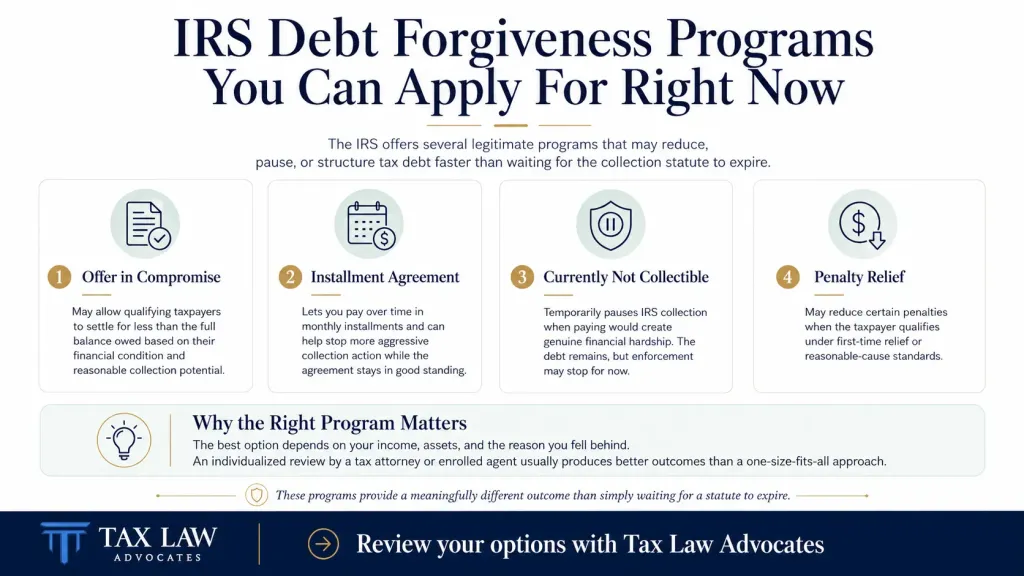
For taxpayers who do not want to wait out a decade of uncertainty, or who cannot afford to have liens and levies hanging over them in the meantime, the IRS offers several legitimate programs that provide faster, more predictable relief. These programs involve the IRS actively agreeing to reduce or pause your obligation, which is a meaningfully different outcome than waiting for a statute to expire.
Choosing the right program depends heavily on your income, asset picture, and the specific reason you fell behind, which is why an individualized review by a tax attorney or enrolled agent typically produces better outcomes than a one-size-fits-all approach.
Offer in Compromise: Settling Your Debt for Less Than You Owe
An offer in compromise allows qualifying taxpayers to settle their tax debt for less than the full amount owed, based on the IRS’s assessment of your reasonable collection potential, meaning what they could realistically collect from your income and assets before the CSED expires. The IRS evaluates your ability to pay, your income, your necessary living expenses, and your equity in assets to determine an acceptable settlement figure. (IRS Offer in Compromise)
Acceptance rates for offers in compromise are relatively low, and applications require detailed financial documentation, so working with a tax professional who understands how the IRS calculates reasonable collection potential can meaningfully improve your chances of approval.
Currently Not Collectible Status and IRS Hardship Programs
If you genuinely cannot afford to pay anything toward your tax debt without jeopardizing basic living expenses, the IRS can classify your account as currently not collectible, which halts active collection efforts such as levies and garnishments. This status does not erase the debt or stop the CSED clock, but it does provide breathing room while your financial situation is reassessed periodically.
The IRS reviews currently not collectible accounts periodically, and if your financial situation improves, they can resume collection, but if your CSED passes while you remain in this status, the debt is written off entirely without you ever having to make a payment. (IRS Collection)
Risks of Waiting Out the 10-Year IRS Statute of Limitations
Some taxpayers, upon learning about the CSED, decide their best strategy is simply to avoid the IRS and wait for the debt to expire. This approach carries meaningful risks, both financial and legal, that are important to understand before committing to it as a strategy rather than resolving the debt proactively.
Because the IRS retains aggressive collection tools throughout the entire pre-CSED period, “waiting it out” often means years of active liens, levies, and credit damage rather than a quiet countdown in the background.
Wage Garnishment, Tax Liens, and Levies While Your Clock Is Still Running
Until your CSED actually passes, the IRS retains full authority to file federal tax liens against your property, garnish your wages, and levy your bank accounts, and they frequently use these tools against taxpayers who are not engaging with them. A federal tax lien can also damage your ability to sell property, refinance a mortgage, or secure certain types of credit for as long as it remains attached.
Taxpayers who assume the debt will simply disappear often underestimate how disruptive a decade of potential enforcement action can be to their financial life in the meantime, particularly if the IRS escalates to a levy on wages or a bank account.
How the IRS Tracks and Verifies Your CSED Internally
The IRS maintains detailed internal records of assessment dates and every tolling event on an account, and their systems automatically recalculate the CSED whenever a qualifying event occurs. This means that even if a taxpayer believes their debt should have expired, the IRS’s internal figure may show a later date due to a tolling event the taxpayer forgot about or was unaware of.
Because these internal calculations control what the IRS actually does, and because errors sometimes occur, it is worth independently verifying your CSED rather than assuming the IRS’s assessment matches your own estimate.
How to Find Your Exact CSED and Verify Your IRS Account Status
Given how much cumulative tolling can shift your actual expiration date, guessing is not a reliable strategy. The only dependable way to know where you stand is to obtain your official IRS records and, ideally, have someone experienced in reading transcript codes confirm the calculation.
This step is also useful even if you are not planning to wait out your debt, since it gives you and your representative an accurate picture of how much time and leverage you have when negotiating a resolution option like an offer in compromise or installment agreement.
Requesting Your IRS Account Transcript to Confirm Your CSED
You can request your account transcript directly from the IRS through their online account portal, by mail, or through a representative with a valid power of attorney on file. The transcript lists transaction codes corresponding to assessments, payments, and any tolling events, which together determine your actual CSED. (IRS Transcript)
Reading these codes accurately requires familiarity with IRS transcript terminology, since assessment, adjustment, and suspension codes are not labeled in plain language and can be easy to misinterpret without experience.
Why a Tax Professional’s CSED Calculation Differs From a DIY Estimate
A tax attorney or enrolled agent calculating your CSED will cross-reference every transaction code against known tolling rules, request updated transcripts to confirm nothing has changed recently, and account for compounding suspensions that a simple online calculator cannot capture. This level of scrutiny is particularly important for taxpayers who have gone through bankruptcy, multiple offers in compromise, or extended time abroad.
Because an inaccurate CSED estimate can lead to poor decisions, such as prematurely stopping communication with the IRS or missing a genuine resolution opportunity, this is one area where professional verification consistently pays for itself.
What to Do Next if Your Tax Debt Is Nearing Its Expiration Date
If your research or a professional’s calculation suggests your CSED is approaching, there are specific steps you can take to protect that outcome and avoid inadvertently resetting the clock. There are also situations where waiting is not actually your best option, even if the math favors it on paper.
The right next step depends on your full financial picture, so this section should be treated as general guidance rather than a substitute for a personalized review of your account.
Steps to Avoid Restarting the 10-Year Clock by Accident
Avoid taking any action that could trigger a new tolling period unless it is genuinely necessary, such as filing an unnecessary offer in compromise or requesting a collection due process hearing you do not need, since both actions pause the clock even if ultimately unsuccessful. Continue filing all required tax returns on time, since failing to file can create new liabilities and complications even if your existing debt is close to expiring.
Keep a close eye on your mailing address and correspondence with the IRS, since missed notices can lead to default actions or misunderstandings about your account status that are harder to unwind later.
When to Consult a Tax Resolution Attorney Instead of Waiting It Out
If your CSED is more than a year or two away, if your transcript shows multiple past tolling events, or if the IRS has already filed liens or initiated levies against you, waiting passively is rarely the strongest option. A tax resolution attorney can evaluate whether an offer in compromise, installment agreement, or currently not collectible status would resolve your situation faster and with less financial disruption than continuing to wait.
Because tax debt cases are highly fact-specific, and because errors in calculating your CSED can have significant financial consequences, this is a decision best made with guidance from a licensed tax attorney or enrolled agent who can review your complete account history before you commit to a strategy.
Frequently Asked Questions
Does IRS Tax Debt Expire After 10 Years?
Generally, yes, but only after the official Collection Statute Expiration Date passes.
When Does the IRS 10-Year Period Begin?
It usually begins on the date the IRS officially assesses the tax debt.
What Can Pause the 10-Year IRS Collection Clock?
Bankruptcy, appeals, offers in compromise, and certain payment requests can pause it.
How Can I Find My Exact CSED?
Review your IRS account transcripts or ask a tax professional to calculate it.
Should I Wait for My IRS Debt to Expire?
Waiting can be risky because the IRS may use liens, levies, or wage garnishment.