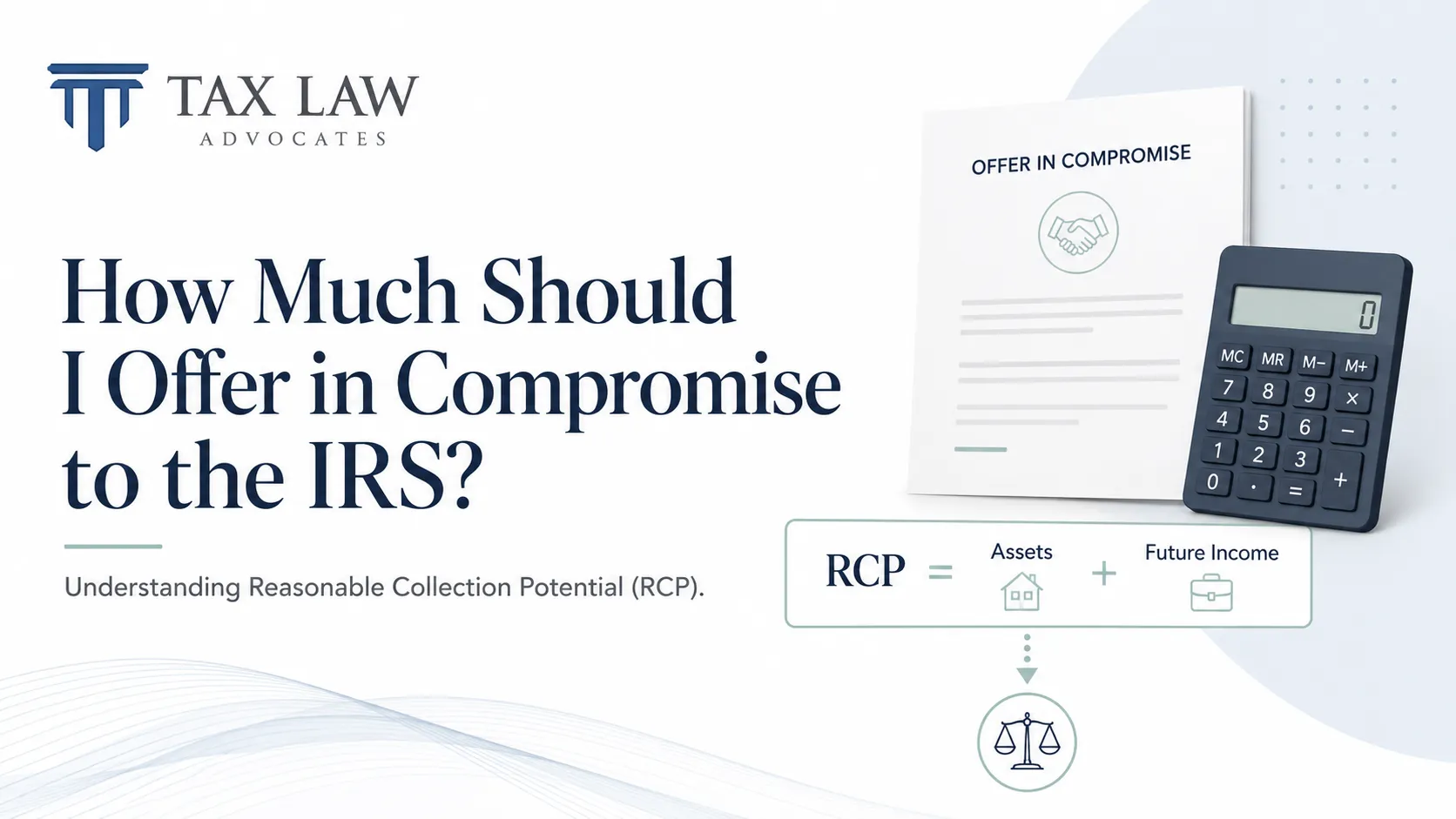
If you’ve searched “how much should I offer in compromise to the IRS,” you already know the frustrating answer most sources give: it depends. That’s true, but it’s also incomplete. The IRS doesn’t accept an Offer in Compromise (OIC) because a number sounds fair. It accepts an offer because a specific formula says the offer equals or exceeds what the agency could otherwise collect from you. That formula has a name, Reasonable Collection Potential (RCP), and once you understand how it’s built, “it depends” turns into a number you can actually calculate.
I’ve spent years preparing OIC submissions as a federally licensed Enrolled Agent, and the single most common reason a self-prepared offer gets rejected isn’t a weak financial story. It’s a miscalculated RCP. This guide walks through exactly how the IRS builds that number, so you can walk into the process with a realistic minimum offer instead of a guess.
Understanding the IRS Offer in Compromise Minimum Formula
Before you can calculate anything, you need to understand what the IRS is actually solving for. The agency isn’t negotiating in the way a debt collector negotiates, it’s running a formula against your finances and comparing the result to your proposed offer. According to the IRS’s own guidance on offers in compromise, the agency generally approves an offer when the amount represents the most it can expect to collect from you within a reasonable period of time. That single sentence is the entire philosophy behind every OIC decision the IRS makes.
What “Reasonable Collection Potential” Means to the IRS?
Reasonable Collection Potential is the IRS’s estimate of the maximum amount it could realistically collect from you before your Collection Statute Expiration Date (CSED) passes, the date the government’s legal window to collect a given tax year closes. RCP isn’t a subjective judgment call by an individual revenue officer. It’s a structured calculation built from two components: the equity you hold in your assets and the disposable income you could contribute over a defined period. Every OIC decision traces back to this single figure.
Why Your Minimum Offer Is Never a Random Negotiated Number?
Many taxpayers assume they can offer a low, round number and see what the IRS counters with. In practice, the IRS doesn’t counter-negotiate the way a used-car dealer might. If your offer falls below your calculated RCP, the case is generally closed as unprocessable or rejected outright, unless you can document special circumstances that justify an exception. That’s why your minimum offer isn’t a starting point for negotiation, it’s closer to a floor set by math you can calculate in advance.
How the IRS Calculates Your Reasonable Collection Potential (RCP)?
RCP is built from exactly two components added together: your net realizable equity in assets, and your future income. Once you know both numbers, you have your RCP, and your RCP is, in almost every case, the minimum amount the IRS will accept.
The RCP Formula: Asset Equity Plus Future Income
In its simplest form, the formula reads: RCP = Net Realizable Equity in Assets + Future Income. Net realizable equity captures what the IRS believes it could collect today by seizing and liquidating what you own. Future income captures what it could collect over time through wage garnishment or levies on future earnings. Neither component is optional, and neither can be negotiated away, they’re both grounded in the financial disclosures you provide during the application.
Where Form 433-A (OIC) Fits Into the Calculation
Every figure that feeds the RCP formula comes from Form 433-A (OIC), the Collection Information Statement for Wage Earners and Self-Employed Individuals, which is submitted alongside Form 656. This is the document the IRS uses to verify your assets, income, expenses, and household size. An incomplete or inaccurate 433-A doesn’t just slow down processing, it produces an inaccurate RCP, which is why the form deserves the same care as the offer amount itself.
Calculating Your Asset Equity for an Offer in Compromise
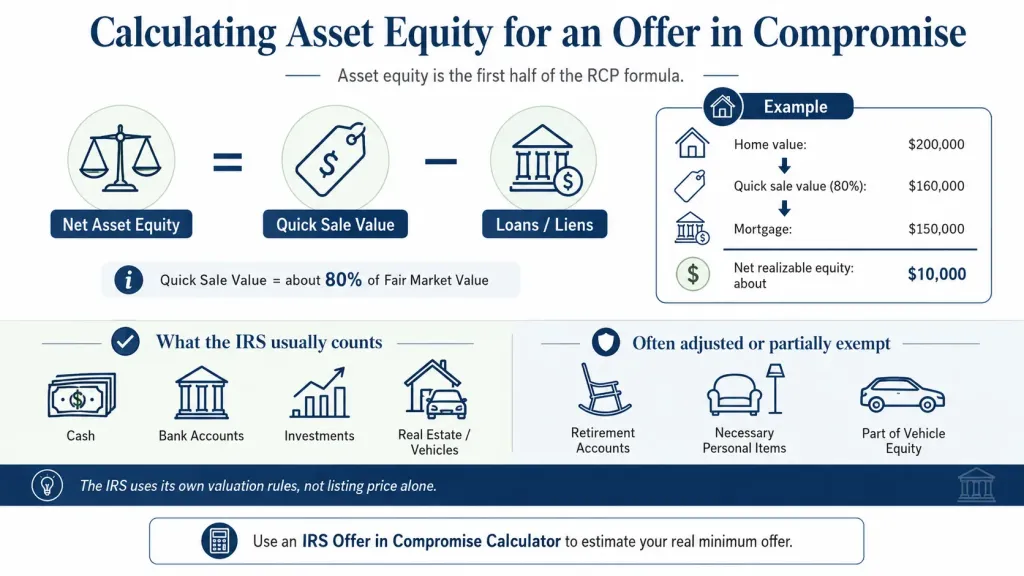
Asset equity is the first half of the RCP formula, and it’s often where taxpayers most overstate, or understate, their true minimum offer. The IRS doesn’t use market value the way a real estate listing would; it uses its own valuation standards designed to reflect what could realistically be recovered through a forced sale.
Quick Sale Value vs. Fair Market Value Explained
For most real property and vehicles, the IRS applies a “quick sale value”, generally 80% of fair market value, rather than full appraised value, to account for the discount typically required to sell an asset quickly. From that quick sale value, any outstanding loan balances or liens are subtracted to arrive at your net equity. A home appraised at $200,000 with a $150,000 mortgage, for example, produces a net realizable equity of roughly $10,000 once the 80% quick-sale discount and the mortgage balance are both applied.
Which Assets the IRS Counts and Which It Exempts
Cash, bank balances, and investment accounts are generally counted at close to full value, while retirement accounts are typically valued at a discount to account for early-withdrawal penalties and taxes. Real property, vehicles, and other personal property generally follow the quick-sale-value method described above. Certain necessary personal items and a portion of vehicle equity may be exempted depending on your circumstances, which is one of many reasons a professionally prepared 433-A tends to produce a more favorable, and more accurate, RCP than a self-prepared one.
IRS Offer in Compromise Calculator
Before you submit a single form to the IRS, you deserve to know your real number — not a guess, not a rough range, but the actual minimum offer your Reasonable Collection Potential requires. Our IRS Offer in Compromise Calculator walks you through the same asset equity and disposable income inputs the IRS itself uses, so you can see where you likely stand before you file. It’s built on current Collection Financial Standards and IRS valuation rules, not outdated formulas floating around the internet. Calculate your minimum offer now and find out exactly what you’re working with before you send anything to the IRS.
Determining Your Future Income Component
The second half of the formula is future income, and it’s calculated very differently from how most people budget their own finances. The IRS doesn’t ask what you spend, it asks what it allows you to spend, using its own nationwide and local standards.
How Allowable Living Expenses Reduce Your Monthly Disposable Income
Your monthly disposable income (MDI) is calculated by subtracting IRS-allowed expenses from your gross monthly income. Categories include housing and utilities, transportation, food, healthcare, and certain other necessary expenses, each capped according to IRS standards rather than your actual spending. If your real expenses exceed the IRS standard, the excess generally isn’t deducted from income for RCP purposes, a detail that surprises a lot of taxpayers preparing their own offer.
Why the IRS Uses National and Local Standards, Not Your Actual Budget?
The IRS publishes Collection Financial Standards that set allowable expense amounts by category, household size, and geographic location, rather than accepting itemized personal budgets. This standardization is intentional, it keeps the formula consistent across taxpayers and prevents discretionary spending from artificially lowering an offer. Knowing which standard applies to your county and household size before you file is one of the clearest ways to avoid a lowball, or an unrealistically high, RCP estimate.
Lump Sum vs. Periodic Payment Offers: Which Formula Fits You
Once you know your net asset equity and your monthly disposable income, the final variable is how you intend to pay. The IRS offers two payment structures, and each multiplies your MDI differently, meaning the same disposable income can produce two very different minimum offers.
The 12-Month Multiplier for Lump Sum Cash Offers
Under the lump sum option, generally payable in five or fewer installments after acceptance, your future income component is calculated as 12 months of MDI. This structure tends to produce the lowest total RCP for taxpayers with meaningful monthly disposable income, since fewer months of income are added into the formula.
The 24-Month Multiplier for Periodic Payment Offers
Under the periodic payment option, your future income component is instead calculated as 24 months of MDI, with payments continuing monthly while the IRS considers the offer and afterward. This structure spreads the total offer amount over a longer window but generally results in a higher overall RCP than the lump sum method, since twice the number of income months is factored into the equation.
Common Mistakes That Lower Your Chances of OIC Acceptance
Even a mathematically sound formula can produce a rejected offer if the inputs feeding it are wrong. Most rejections trace back to a small number of recurring, avoidable errors.
Underreporting Income or Assets on Form 433-A (OIC)
The IRS cross-references your 433-A against third-party data, including wage and bank reporting. Omitted accounts, undisclosed assets, or understated income don’t just risk rejection, they can trigger a more detailed review of the entire filing. Full, accurate disclosure is the foundation every other part of the formula depends on.
Offering Too Little Based on a Miscalculated RCP
The most common, and most preventable, mistake is submitting an offer below the true RCP because an asset was undervalued, an expense standard was misapplied, or the wrong payment multiplier was used. According to the IRS’s offer in compromise FAQs, a rejected offer can be appealed within 30 days of the rejection letter, but appealing a mathematically flawed initial submission almost always takes longer than getting the RCP right the first time.
What Your Minimum Offer Really Comes Down To
Your minimum offer to the IRS was never a matter of hope, generosity, or how good your written hardship story sounds, it’s a formula, built from your assets, your income, and the payment structure you choose. Get any one input wrong, and you risk either overpaying a debt you didn’t need to pay in full, or submitting an offer the IRS is required to reject.
That’s the gap between a self-prepared OIC and one prepared by someone who calculates Reasonable Collection Potential for a living. At Tax Law Advocates, we’re a partner, not a seller, from your first IRS notice to full resolution. Our team, led by attorneys and enrolled agents who work inside this formula every day, will calculate your true RCP, structure your offer around it, and file it correctly the first time.
Conclusion
Here’s the truth most people don’t want to hear: the IRS isn’t waiting for a compelling story, it’s waiting for the right number. Offer too much, and you hand over money you never had to pay. Offer too little, and the file gets closed before anyone even reads why you’re struggling. The difference between those two outcomes is a formula, one that rewards precision, not persuasion.
That’s exactly where we come in. At Tax Law Advocates, we don’t guess at your Reasonable Collection Potential, we calculate it, the same way the IRS does, before we ever put a number in front of them. From your first IRS notice to full resolution, we’re your partner, not a seller chasing a signature. If you’re ready to find out what your real minimum offer actually is, not a rough estimate, the actual number, talk to Tax Law Advocates today and stop guessing with money you don’t have to lose.
FAQ
How Much Should I Offer in Compromise to the IRS?
Your minimum offer equals your Reasonable Collection Potential (RCP) — the equity in your assets plus your future income, calculated over 12 months for a lump sum offer or 24 months for a periodic payment offer. Offering below this number generally results in rejection unless special circumstances apply.
What is Reasonable Collection Potential (RCP)?
RCP is the IRS’s formula for estimating the maximum amount it could realistically collect from you before your Collection Statute Expiration Date passes. It’s calculated by adding your net realizable equity in assets to your projected future income, and it forms the floor for any Offer in Compromise.
Does the IRS Use My Actual Monthly Expenses to Calculate My Offer?
No. The IRS uses its own Collection Financial Standards — national and local expense allowances based on household size and location — rather than your actual budget. If your real expenses exceed the IRS standard, the excess typically isn’t subtracted from your income for RCP purposes.
What’s the Difference Between a Lump Sum and Periodic Payment Offer?
A lump sum offer multiplies your monthly disposable income by 12 and is generally payable within five months of acceptance. A periodic payment offer multiplies your monthly disposable income by 24 and is paid over a longer schedule. The lump sum option usually produces a lower total offer for taxpayers with meaningful monthly income.
What Happens if My Offer Is Below My RCP?
The IRS will generally reject or return the offer as unprocessable, since an offer below RCP doesn’t meet the standard of representing the most the agency could otherwise collect. You have 30 days from a rejection letter to file an appeal.
Can a Tax Professional Lower My Reasonable Collection Potential?
A professional can’t lower the formula itself, but they can ensure every input — asset valuations, allowable expense standards, household size, and income figures — is calculated correctly. Since most self-prepared offers are rejected due to RCP miscalculation rather than ineligibility, accurate preparation often makes the difference between acceptance and denial.