
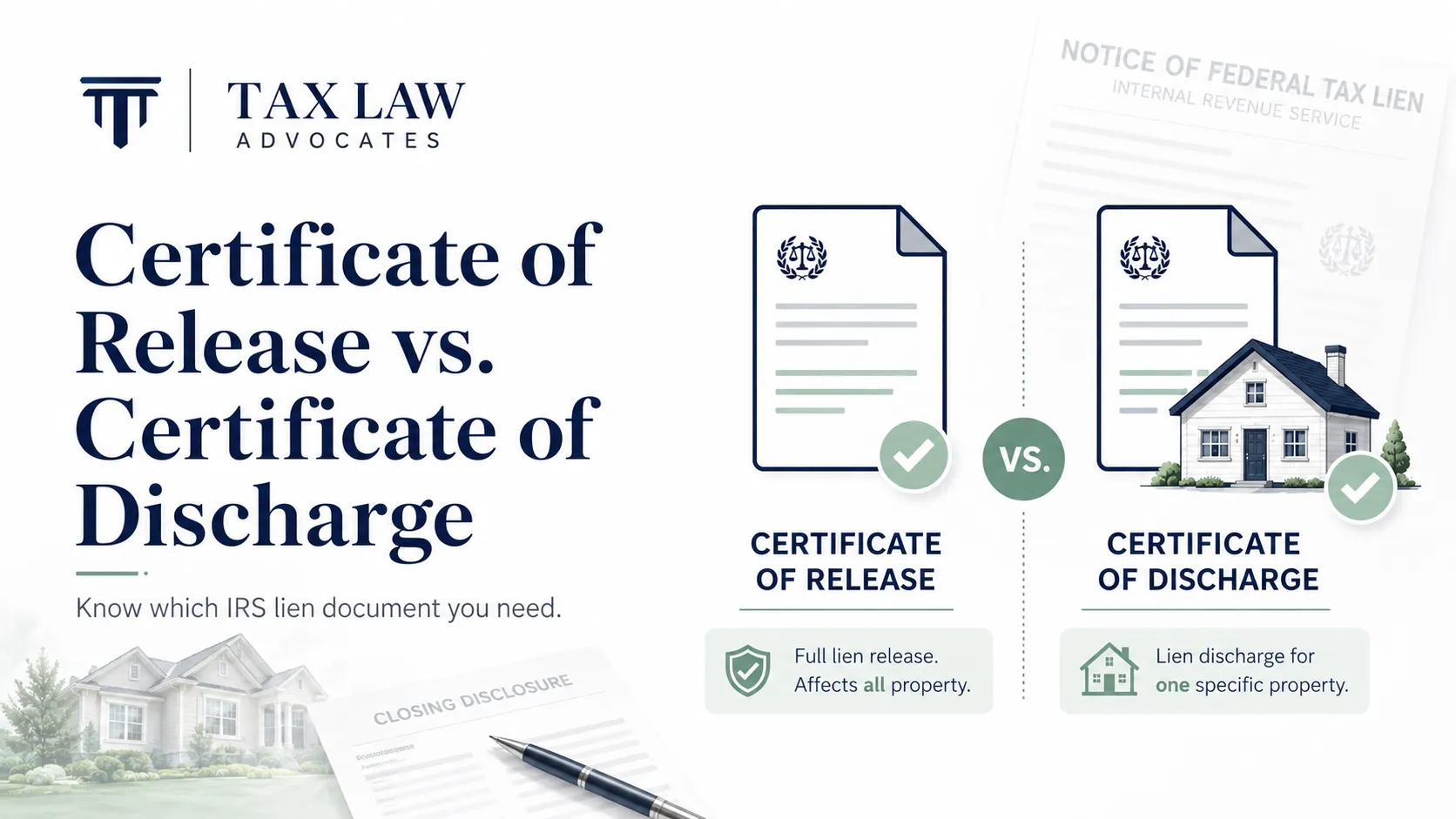
Two IRS documents get confused constantly, and the confusion causes real problems: a taxpayer preparing to sell a specific property assumes they need a certificate of release, when what actually applies to their situation is a certificate of discharge, or the reverse. These two documents solve entirely different problems, and requesting the wrong one wastes time a real estate closing or refinance often can’t afford to lose.
This guide draws a clear, practical line between a certificate of release and a certificate of discharge: what each one actually does, when the IRS issues it, and how to know which one your situation actually calls for.
What Is a Certificate of Release of Federal Tax Lien
A certificate of release is the document that ends a federal tax lien entirely. According to the IRS’s guidance on understanding a federal tax lien, paying a tax debt in full is the best way to get rid of a lien, and the IRS releases the lien within 30 days after the debt has been paid. Once issued, this certificate confirms that the government’s legal claim against all of a taxpayer’s property, not just one specific asset, has ended.
This is the document most taxpayers picture when they think of “getting rid of” a lien, because it represents full resolution rather than a workaround for a specific transaction.
When the IRS Issues a Certificate of Release Automatically
A federal tax lien is generally self-releasing once the underlying conditions for release are met, though a formal certificate is also filed to make that release part of the public record. According to the Taxpayer Advocate Service, the IRS is required to issue a release within 30 calendar days of the date the tax, including penalties and interest, is fully paid, the time to legally collect the debt has ended, or the IRS has accepted a bond covering the liability. Taxpayers should not assume this happens instantly; confirming that the certificate was actually filed with the appropriate county or state recording office is a reasonable step after a qualifying event occurs.
What a Tax Lien Release Actually Changes on Your Record
A tax lien release ends the lien’s effect on all of a taxpayer’s property going forward, but it does not erase the lien’s existence from historical credit or public records automatically. The certificate itself becomes the formal proof that the underlying debt has been satisfied, which is why taxpayers selling or refinancing property after a full payoff should keep a copy readily available, since a title company or lender may specifically request it as evidence the lien no longer applies.
What is a Certificate of Discharge and How it Differs
A certificate of discharge solves a narrower, more specific problem than a release. Per the IRS, a discharge removes the lien from one specific piece of property, with eligibility determined by several distinct provisions in the Internal Revenue Code. The IRS outlines the application process in Publication 783, Instructions on How to Apply for Certificate of Discharge From Federal Tax Lien.
Unlike a release, a discharge does not require the underlying tax debt to be resolved. It simply frees a specific asset, such as a home being sold, from the lien’s reach so that a transaction can move forward.
Which Specific Property a Discharge Removes the Lien From
A discharge application identifies the exact property, most commonly real estate, that a taxpayer needs freed from the lien, typically because they are selling it or transferring it and intend to apply some or all of the proceeds toward the tax debt. The lien continues to attach to any other property the taxpayer owns; only the specific asset named in the discharge application is affected.
Why a Discharge Does Not End the Underlying Tax Debt
Because a discharge addresses one piece of property rather than the taxpayer’s overall liability, the tax debt itself remains fully owed after a discharge is granted, and the lien continues to attach to any other assets the taxpayer holds. This is the most important distinction for taxpayers to understand: a discharge is a targeted tool for completing a specific transaction, not a form of debt resolution.
Certificate of Release vs. Certificate of Discharge
Once each document is understood individually, the practical distinction becomes straightforward: a release reflects that the entire debt is gone, while a discharge simply clears one asset so a transaction involving that asset can close, even while the broader debt and lien remain in place.
Taxpayers researching “certificate of release of federal tax lien” sometimes actually need a discharge instead, particularly when they are mid-transaction on a specific property rather than working from full payoff.
Full Satisfaction vs. Partial Property Removal
A release only becomes available once the underlying liability has been fully satisfied, through payment, an accepted bond, or expiration of the legal collection period. A discharge, by contrast, can be requested while a balance remains outstanding, specifically to accommodate a sale, transfer, or refinance involving one identified piece of property. This is the core functional difference that determines which document actually fits a given taxpayer’s circumstances.
Timing and Processing Differences Between the Two
A release tied to full payment carries the IRS’s 30-day issuance requirement described earlier, making it a relatively predictable timeline once the qualifying payment is made. A discharge application, because it requires the IRS to evaluate specific Internal Revenue Code eligibility provisions and the details of the underlying transaction, typically takes longer to process and should be initiated well ahead of any anticipated closing date to avoid disrupting the transaction’s timeline
When You Need a Certificate of Release of Federal Tax Lien
A certificate of release is the right document whenever the underlying tax debt itself has been, or is about to be, fully resolved. Taxpayers in this position are not trying to complete a specific transaction around an active lien; they are closing out the lien entirely because nothing remains for it to secure.
Confirming which scenario actually applies before requesting a document saves meaningful time, since a release request submitted before a debt is truly satisfied will simply be rejected.
Paying Your Balance in Full to Trigger a Lien Release
Paying the full outstanding balance, including any accrued penalties and interest, is the most direct and reliable way to trigger a release. Once that payment posts and is confirmed by the IRS, the 30-day release requirement begins running, giving taxpayers a clear, predictable path toward a fully cleared lien without needing to navigate the more involved discharge or subordination processes.
Confirming the Collection Statute Has Expired
A federal tax lien can also become subject to release when the IRS’s legal window to collect the debt, generally ten years from assessment, has run out. Taxpayers who believe this applies to their situation should still confirm the release was actually processed and recorded, since the IRS does not always automatically update county or state records the moment a collection statute expires, and following up directly is often necessary to get the public record corrected.
When You Need a Certificate of Discharge Instead
A certificate of discharge is the right tool whenever a taxpayer needs to complete a transaction involving one specific piece of property while the broader tax debt and lien remain unresolved. This scenario is common among homeowners and property owners who have an active lien but a pressing need to sell, transfer, or refinance.
Recognizing this distinction early, rather than assuming a discharge and a release are interchangeable, prevents a taxpayer from applying for the wrong document and losing valuable time before a closing date.
Selling or Transferring Specific Property Under a Lien
A taxpayer selling a home or other asset that’s subject to a federal tax lien, and planning to direct some or all of the sale proceeds toward the tax debt, is a textbook case for a discharge rather than a release. The discharge clears that specific property so the transaction can close, even though the taxpayer’s overall balance with the IRS may not be fully paid off at the moment of sale.
Refinancing a Home While a Tax Lien Remains Active
Refinancing presents a related but distinct challenge: the taxpayer isn’t selling the property, so a discharge may still apply depending on the lender’s requirements, though in some refinancing scenarios a certificate of subordination, which allows a new lender to move ahead of the IRS in priority without removing the lien at all, may be the more appropriate tool. Understanding which of these options a specific lender or transaction actually requires is essential before starting the application process, since applying for the wrong one wastes the lead time needed before closing.
How to Request the Right Lien Document for Your Situation
Both documents require a formal application process with the IRS, and both benefit significantly from being initiated as early as possible, particularly when a transaction closing date is already on the calendar. Waiting until the last minute to determine which document is needed is one of the most common and avoidable causes of delayed real estate transactions involving a federal tax lien.
Because the underlying legal standards differ between a release and a discharge, taxpayers should confirm which document actually fits their scenario before submitting anything to the IRS.
Forms and Documentation Required for Each Request
A release generally follows automatically from full payment confirmation, though taxpayers can also request written confirmation directly if they need documentation for a lender or title company. A discharge application requires more detailed documentation under Publication 783, including information about the specific property, the nature of the transaction, and how proceeds will be applied to the outstanding balance. Taxpayers unsure which document their situation calls for can also contact the IRS’s Centralized Lien Operation for basic release verification or the Collection Advisory Group for more complex discharge and subordination questions.
Common Mistakes That Delay a Tax Lien Release or Discharge
The most frequent delays come from submitting a discharge application without complete documentation on the property or transaction details, assuming a release applies when the debt hasn’t actually been fully satisfied yet, and waiting until a closing date is imminent to begin either process. Because discharge applications specifically can take significant processing time, starting well before any transaction deadline, and confirming which document actually applies to the situation before submitting anything, are the two most effective ways to avoid unnecessary delays.
Get the Right Lien Document Without Losing Your Closing Date
Confusing a certificate of release with a certificate of discharge can cost you exactly the kind of time you don’t have when a sale or refinance is already on the calendar. Knowing which document your situation actually calls for, and starting that application early, is the difference between a clean closing and a deal that stalls at the title company.
That’s exactly the kind of clarity a firm built to be a genuine partner, not just a paperwork processor, from your first IRS notice to full resolution can bring to your transaction. Talk to Tax Law Advocates about your tax lien today and get a clear answer on whether a release, a discharge, or another lien solution entirely is the right move for your specific situation, before your closing date puts you in a bind.
Frequently Asked Questions
What’s the Main Difference Between a Certificate of Release and a Certificate of Discharge?
A release ends a federal tax lien entirely because the debt is fully satisfied. A discharge removes the lien from one specific piece of property while the underlying debt and lien on other assets remain in place.
How Long Does It Take to Get a Certificate of Release After Paying My Tax Debt?
The IRS is generally required to issue a release within 30 calendar days after the full balance is paid, including penalties and interest.
Does a Certificate of Discharge Mean I No Longer Owe the IRS?
No. A discharge only removes the lien from the specific property named in the application. The overall tax debt remains fully owed, and the lien continues to attach to any other property you own.
Can I Sell My Home if I Have a Federal Tax Lien but Haven’t Paid Off My Full Tax Debt?
Yes, in many cases, by applying for a certificate of discharge on that specific property and directing the sale proceeds toward your tax debt as part of the transaction.
What Should I Do if My Lien Wasn’t Released Even Though I Paid My Debt in Full?
Confirm the payment was fully processed and posted, then follow up directly with the IRS’s Centralized Lien Operation to verify the release was issued and properly recorded with the county or state.
Is a Certificate of Discharge the Same as a Certificate of Subordination?
No. A discharge removes the lien from a specific property entirely. A subordination does not remove the lien at all; it simply allows another creditor to move ahead of the IRS in priority on that property.
How Far in Advance Should I Apply for a Discharge Before a Real Estate Closing?
As early as possible once a closing date is anticipated, since discharge applications require IRS review of specific documentation and can take significant time to process compared to a straightforward release.
