
Discovering that money in your bank account has been restricted can create immediate financial and emotional pressure. Taxpayers may first become aware of an IRS collection action through a bank notification, an unavailable balance, or a transaction associated with a federal tax levy.
In most cases, the IRS has not withdrawn the money without a legal process. A bank levy is an administrative collection action through which the IRS directs a financial institution to hold and surrender property belonging to a taxpayer with an unpaid federal tax liability. The action generally follows an assessment, a demand for payment, and required collection notices, although limited statutory exceptions apply.
Understanding the difference between a lien, a proposed levy, and an active bank levy is essential. A federal tax lien represents the government’s legal claim against a taxpayer’s property, while a levy is the actual legal seizure of property or rights to property. (IRS Levy)
Does the IRS Take Money From Your Bank Account?
When the IRS takes money from a bank account, it has generally served the financial institution with a Notice of Levy. The levy attaches to property or rights to property belonging to the taxpayer and held by the bank at the time the levy is received, up to the amount shown on the levy.
The levy may affect checking accounts, savings accounts, business deposit accounts, and jointly titled accounts when the taxpayer possesses an ownership interest or unrestricted withdrawal rights. Joint ownership does not automatically prevent collection; however, a non-liable account holder may be able to challenge the levy by documenting that some or all of the funds belong to that person.
Unlike a federal tax lien, which secures the government’s interest in property, a levy requires the financial institution to hold and potentially surrender the affected funds.
Can the IRS Freeze Your Bank Account?
The phrase “freeze your bank account” is commonly used, but it is not always technically precise. A standard IRS bank levy generally restricts the funds available in the affected account at the date and time the bank receives the levy. The bank must hold no more than the amount listed on the levy, although account restrictions and bank procedures may temporarily affect the taxpayer’s access to the account.
If the account balance is lower than the levy amount, the available funds may be held. If the balance exceeds the levy amount, the bank generally holds only the amount required to satisfy the levy. Money deposited after the levy is received is normally not included in that particular levy. (IRS Notice of levy)
Does the IRS Freeze Bank Accounts Immediately?
The financial institution generally restricts the affected funds when it receives the levy. Federal law then requires a 21-calendar-day holding period before the bank surrenders those funds to the IRS. The purpose of this period is to allow the taxpayer to contact the IRS, report an error, establish third-party ownership, request a levy release, or pursue an appropriate collection resolution.
The usual sequence is:
- The financial institution receives the levy.
- Funds available at that date and time are restricted.
- The 21-day holding period begins.
- The taxpayer or a third party may contact the IRS.
- Unless the levy is released or the holding period is extended, the bank sends the funds to the IRS after the period expires.
A standard bank levy is ordinarily a one-time seizure. It does not generally capture deposits made after the bank receives the levy, including deposits made during the holding period. A separate levy must normally be issued to reach those later funds.
Why Did the IRS Take Money From My Account Without Warning?
A bank levy can appear unexpected, particularly when the taxpayer has moved, has not opened IRS correspondence, or believed another person was handling the account. Legally, however, the IRS generally must send a Final Notice of Intent to Levy and Notice of the Right to a Hearing at least 30 days before the first levy covered by that notice.
The IRS may deliver the notice personally, leave it at the taxpayer’s home or usual place of business, or send it by certified or registered mail to the taxpayer’s last known address. Proper mailing to the last known address can be legally significant even when the taxpayer did not personally read or claim the correspondence.
Taxpayers who did not receive the notice should review their IRS account transcripts, address history, notice dates, and the tax periods included in the levy rather than assuming that nonreceipt automatically invalidates the collection action.
Bank Levy Without Notice
Before issuing an ordinary levy, the IRS generally must have assessed the tax, issued notice and demand for payment, allowed the balance to remain unpaid, and provided the taxpayer with a Final Notice of Intent to Levy and an opportunity to request a Collection Due Process hearing.
A taxpayer normally has 30 days from the date of the Collection Due Process notice to submit a written hearing request, commonly using Form 12153. Notices that may provide these rights include LT11, Letter 1058, and CP90. A timely hearing request can permit review of the proposed levy and consideration of collection alternatives, liability disputes in qualifying circumstances, and procedural objections.
Not every collection letter creates the same rights. The notice code, issue date, tax periods, and stated filing deadline should therefore be reviewed carefully.
Tax Levy Without Notice in Special Cases
Federal law recognizes four principal exceptions to the ordinary pre-levy Collection Due Process notice requirement. These involve:
- Collection that the IRS determines is in jeopardy
- Levies on state tax refunds
- Disqualified employment-tax levies
- Certain federal-contractor levies
In these cases, the taxpayer is generally given an opportunity for a hearing after the levy rather than before it. These exceptions are narrowly defined and should not be interpreted as allowing the IRS to disregard notice procedures in an ordinary bank-levy case. (IRS Liability Collection)
What Is a Tax Levy Fee on My Bank Account?
A transaction identified as a “tax levy fee” may refer either to the funds held under the IRS levy or to a separate administrative charge imposed by the financial institution for processing the levy.
The amount surrendered under the levy is applied to the federal tax liability. A bank’s processing fee is separate and does not reduce the taxpayer’s IRS balance. IRS procedures state that a financial institution may not deduct its processing charge from the levy proceeds that must be surrendered to the government. When sufficient non-levied funds remain, the bank may collect its fee from those funds under the account agreement.
When a levy was caused by an IRS error, limited reimbursement of directly related bank charges may be available if the taxpayer satisfies the applicable requirements and submits the appropriate claim.
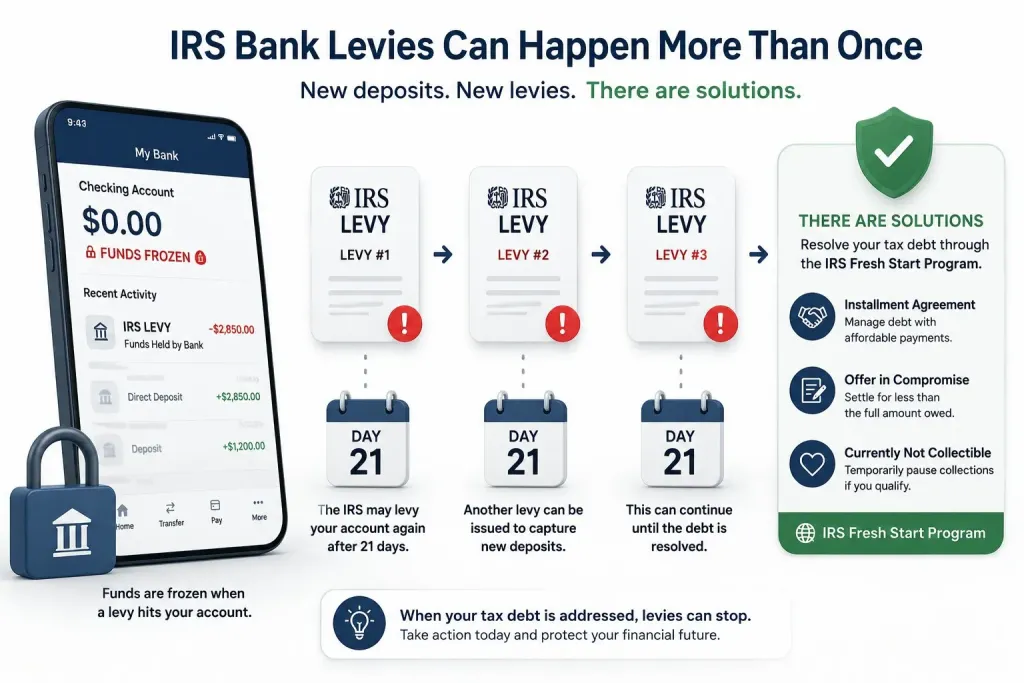
How Often Can the IRS Levy Your Bank Account?
There is no fixed statutory limit on the number of bank levies the IRS may issue while a federal tax liability remains legally collectible and no collection restriction prevents further enforcement.
Because a standard bank levy generally attaches only to funds held when the financial institution receives it, the IRS must ordinarily serve another levy to reach money deposited later. Repeated levies may therefore occur when the taxpayer continues to maintain funds in reachable accounts without resolving the underlying liability.
Resolving the account through an IRS Fresh Start Program option—such as a qualifying installment agreement, Offer in Compromise, or hardship-based collection delay—may restrict or reduce the risk of additional levies. “Fresh Start” is a general label for several IRS collection policies, not a single application or guaranteed relief program.
Repeated IRS Bank Levies
When collection remains appropriate, the IRS may serve levies on more than one financial institution, issue another levy at a later date, or pursue different forms of property in which the taxpayer has an interest.
A bank levy should be distinguished from a wage levy. A standard bank levy generally reaches funds available at one point in time, while a wage levy ordinarily continues to attach to future pay periods until the levy is released, the liability is resolved, or the applicable collection period ends.
What to Do When You Get a Notice of Levy
The appropriate response depends on whether the taxpayer has received a proposed levy notice or whether the bank has already restricted the funds.
A Final Notice of Intent to Levy may provide a 30-day period for requesting a Collection Due Process hearing. Once a bank receives an actual levy, a separate 21-day holding period generally applies before the funds are transferred. Confusing these two timelines can result in missed appeal or release opportunities.
Step 1 — Review the IRS Notice Carefully
Review the notice code, issue date, tax periods, assessed balance, response instructions, and the exact deadline shown on the document. Determine whether the notice proposes a future levy, confirms that a levy has already been served, or concerns another collection action.
When the bank has already restricted funds, confirm the date and time it received the levy because that event generally begins the 21-day holding period.
Step 2 — Verify Your Financial Situation
Collect records that establish both the liability and the effect of the levy, including:
- IRS notices and account transcripts
- Recent bank statements
- Proof of ownership and deposit sources
- Pay statements and income records
- Required living expenses
- Business financial records
- Filed and unfiled tax returns
- Evidence of an immediate hardship
For joint accounts, documentation identifying who earned, deposited, and controlled the funds can be particularly important because account title alone may not resolve the ownership question.
Step 3 — Contact a Tax Professional Quickly
Some taxpayers can address a straightforward levy by contacting the IRS directly and providing the requested information. Professional representation may be more valuable when the case involves multiple tax periods, business or payroll taxes, disputed ownership, missing returns, an assigned Revenue Officer, immediate economic hardship, or a possible wrongful levy.
A qualified representative may evaluate whether the facts support a Collection Due Process hearing, Collection Appeals Program request, hardship release, installment agreement, Currently Not Collectible status, Offer in Compromise, or third-party wrongful-levy claim. No representative can guarantee that the IRS will release or return funds.
Are Any Bank Accounts or Funds Protected From an IRS Levy?
There is no broad category of ordinary checking or savings accounts that the IRS can never reach. Federal law instead identifies particular types of property and payments that may be exempt or limited under specific circumstances.
For example, Supplemental Security Income is exempt from levy, while Social Security retirement and disability benefits are not universally protected and may be subject to levy under applicable procedures. Once wages or other income are deposited into a regular bank account, the exemptions that apply to a wage levy do not necessarily create an equivalent exempt amount in the bank account.
The source, ownership, and legal character of the funds should therefore be reviewed rather than relying on the name or type of account.
Potentially Protected or Limited Funds
Certain property may require additional analysis, including:
- Supplemental Security Income
- Certain public-assistance payments
- Funds belonging entirely to a non-liable third party
- Property covered by a superior legal interest
- Funds required for necessary living expenses when the levy creates economic hardship
- Mortgage escrow funds the taxpayer has no right to withdraw
Protection is not automatic in every deposited-funds case. Documentation, tracing, account-control rights, and applicable federal or state property law may determine whether the levy attaches.
Can You Get an IRS Bank Levy Released?
A bank levy may be released when statutory or administrative requirements are satisfied. According to the IRS, release is required when it determines that:
- The liability has been paid
- The collection period expired before the levy was issued
- Releasing the levy will facilitate collection
- The taxpayer enters an installment agreement that does not permit the levy to continue
- The levy creates an immediate economic hardship
- The value of the property exceeds the balance and a partial release will not impair collection
The IRS may also release or correct a levy that improperly attached property belonging to a third party. A levy release does not eliminate the underlying tax debt, and another levy may be issued if the liability remains unresolved.
After the bank has transferred the funds, the issue is generally no longer only a levy-release request. The taxpayer may need to pursue a return-of-property or wrongful-levy procedure, depending on the circumstances. (IRS levy released)
Common IRS Resolution Options
Depending on filing compliance, income, expenses, assets, and collection status, possible options may include:
Check Your IRS Resolution Options Before the Bank Levy Proceeds
Tax Law Advocates’ free IRS Fresh Start Program Calculator provides a preliminary financial estimate based on the information entered by the user, including tax debt, income, expenses, and asset equity.
For an Offer in Compromise based on doubt as to collectibility, the IRS generally evaluates the taxpayer’s income, allowable expenses, assets, and collection potential. However, Offers in Compromise may also be based on doubt as to liability or exceptional circumstances. The calculator is therefore a screening and educational tool—not an official IRS determination, legal opinion, or guarantee of acceptance.
The result may help a taxpayer determine whether further review is worthwhile before committing time or money to a particular strategy. Final eligibility depends on filing compliance, payment compliance, complete financial disclosure, supporting documentation, and IRS review. (IRS Collection Process)
How Tax Law Advocates Helps With IRS Bank Levy Cases
Tax Law Advocates begin by reviewing the levy document, account transcripts, notice history, filing compliance, ownership issues, financial condition, and applicable deadlines. That review helps determine whether the facts support a levy-release request, administrative appeal, hardship analysis, installment agreement, Currently Not Collectible status, Offer in Compromise, or another collection strategy.
The firm assists taxpayers facing matters such as frozen personal or business accounts, Final Notices of Intent to Levy, wage levies, payroll-tax liabilities, Revenue Officer assignments, disputed joint-account ownership, unfiled returns, and repeated collection enforcement.
The objective is not to place every taxpayer into the same advertised relief program. When a matter can reasonably be handled directly with the IRS, the taxpayer should understand that option. When the case involves disputed ownership, business liabilities, procedural defects, active enforcement, or documented hardship, attorney-led representation may provide greater continuity and structured case management.
No levy release or settlement result can be guaranteed. The purpose of representation is to identify a legally and financially supportable strategy, communicate with the IRS, submit the required evidence, and address the underlying liability rather than focusing only on the temporary account restriction.
FAQs
Why Did the IRS Take Money From My Account?
The IRS may have issued a bank levy due to unpaid federal tax debt after sending collection notices and demands for payment.
Can the IRS Freeze Your Bank Account?
Yes. The IRS can instruct your bank to freeze available funds before transferring them to satisfy tax debt.
Does the IRS Freeze Bank Accounts Permanently?
Usually no. Most levies affect the funds available at the time the levy is processed, though repeated levies may occur later.
What Should I Do When I Get a Notice of Levy?
Review the notice immediately, gather financial records, verify the debt, and consider speaking with a qualified tax professional before deadlines expire.
How Often Can the IRS Levy Your Bank Account?
The IRS can issue multiple levies if the tax debt remains unresolved and collection authority continues.
Can the IRS Levy a Joint Bank Account?
In some situations, yes. However, ownership rights and contribution tracing may affect how much can legally be seized.
Are There Bank Accounts the IRS Can’t Touch?
The IRS has broad authority, but certain protected federal benefits and exempt funds may receive limited legal protections depending on the circumstances.
Can a Bank Levy Be Released?
Sometimes. Levy releases may occur through hardship relief, payment arrangements, successful negotiations, or correction of IRS errors.