Owing money to the IRS is stressful enough without wondering whether the debt is also damaging your credit score.
The honest answer surprises most people. Owing the IRS, on its own, does not touch your credit score. But that doesn’t mean tax debt is harmless to your finances — it just causes damage in places your credit score can’t see.
Understanding the difference between your credit score, credit report, and broader financial profile is essential when you owe back taxes.
The Direct Answer
No. A tax balance, by itself, does not lower your credit score. Your score is built from your credit accounts — cards, loans, mortgages — not from what you owe the federal government.
Consumer credit scores are generally calculated using information contained in your credit reports, including payment history, credit utilization, account balances, length of credit history, and recent credit activity. Because ordinary IRS balances do not appear as credit accounts or collection accounts on standard consumer credit reports, they are generally not factored directly into the score. Experian confirms that the IRS does not report tax payments or unpaid tax balances to the credit bureaus.
However, unresolved tax debt can still affect your finances indirectly. For example, an IRS installment payment may become part of a lender’s debt analysis, while a levy that removes funds from your bank account may make it harder to pay mortgages, credit cards, or other obligations on time.
In that situation, the IRS debt itself is not directly lowering the score. The missed payments or increased account balances resulting from financial pressure may affect it.
At Tax Law Advocates, our tax attorneys and enrolled agents help taxpayers nationwide understand IRS collection procedures and available tax resolution options.
How Many Points Does a Lien Affect Your Credit Score?
Historically, a federal tax lien could drop a credit score by 100 points or more, since it was treated as a serious derogatory mark on a credit report. That changed in April 2018, when Equifax, Experian, and TransUnion, the three major credit bureaus, removed tax liens from credit reports entirely as part of the National Consumer Assistance Plan. This means a federal tax lien no longer appears on your credit report and does not directly lower your credit score today. However, the lien is still a matter of public record, and lenders, especially mortgage underwriters, often check county or state filings separately during the loan approval process. So while your score itself may stay untouched, an unresolved lien can still complicate refinancing or getting approved for new credit.
Does Not Filing Taxes Affect Credit Score?
Not filing your tax return doesn’t directly affect your credit score, since the IRS doesn’t report filing status, or unpaid balances, to Experian, Equifax, or TransUnion. But failing to file carries its own consequences that can spill into your finances indirectly. The IRS charges a failure-to-file penalty, which is typically steeper than the failure-to-pay penalty, and interest keeps accruing on whatever you owe. If the unfiled balance goes unresolved long enough, the IRS can pursue enforced collection, including a federal tax lien or a levy on wages or bank accounts. A tax lien itself won’t show up on your credit report today, but a levy that causes you to miss other bills, like a mortgage or credit card payment, can absolutely damage your score. In short: not filing doesn’t hit your credit directly, but it starts a chain of penalties and IRS actions that can end up hurting your credit indirectly.
Removing Tax Lien From Credit Report
Since 2018, tax liens no longer appear on credit reports at all, so there’s technically nothing to “remove” through the credit bureaus. If you spot an old tax lien listed on your Experian, Equifax, or TransUnion report today, it’s likely a clerical error or an outdated entry that should be disputed directly with the bureau. What still matters is the public record itself, since county recorder offices and title companies keep their own filings separate from credit reports. To clear the lien from those public records, you’ll need either a Certificate of Release, issued once your tax debt is fully paid, or a Certificate of Withdrawal, which removes the Notice of Federal Tax Lien entirely and is generally the stronger option since it treats the lien as though it was never filed. To request a withdrawal, you’ll need to submit IRS Form 12277, the Application for Withdrawal of Filed Notice of Federal Tax Lien. Once approved, sending a copy to your county clerk’s office ensures the public record reflects the change as well.
Does the IRS Report Your Tax Debt to Experian, Equifax, or TransUnion?
No, and this one is worth remembering. Federal law actually prohibits the IRS from sharing your tax return information with credit bureaus. There’s no data feed, no automatic report, no exception.
Your income, tax-return details, IRS payment history, and outstanding federal tax balance are not ordinarily included in your consumer credit report. Federal tax liens also no longer appear in standard credit files maintained by the three national credit bureaus.
There is an important distinction, however: not appearing on a credit report does not make the tax debt private from every financial review.
With your authorization, mortgage lenders, banks, and other participating institutions may request IRS tax transcripts through the Income Verification Express Service and Form 4506-C. These records may be used to verify income and tax information during a mortgage, loan, or other application.
Do IRS Collections Show Up on Your Credit Report?
IRS collection activity generally does not appear as a traditional collection account on a standard consumer credit report.
An IRS balance, payment demand, bank levy, or wage levy is different from a consumer debt transferred to a collection agency. The IRS does not normally create a tradeline similar to a credit card, auto loan, or private collection account.
Nevertheless, IRS collection activity may create serious indirect consequences:
- A wage levy may reduce your available monthly income.
- A bank levy may remove money needed for other obligations.
- An IRS payment plan may be considered during loan underwriting.
- A federal tax lien may be discovered through public or property records.
- A lender may require documentation showing that the tax debt is being resolved.
These effects concern your broader financial capacity and lending risk—not necessarily the numerical credit score itself.
Does the IRS Report to Credit Agencies?
Taxpayers frequently search: “Does the IRS report to credit agencies?”
Currently, the IRS generally does not furnish routine tax debt information directly to consumer credit agencies.
That said, lenders may still review:
- Public records
- Tax transcripts
- Outstanding federal liabilities
- Payment history
- Financial disclosures
This is especially common during:
- Mortgage underwriting
- Business financing reviews
- Large loan applications
- Government contracting reviews
Tax Lien on Credit Report
A federal tax lien and a credit-report entry are not the same thing.
A federal tax lien is the government’s legal claim against your property and rights to property after you fail to pay an assessed tax debt following notice and demand for payment. The lien may attach to assets you currently own and certain property acquired while the lien remains in effect.
Since 2018, federal tax liens have not been included on standard consumer credit reports maintained by the three major credit bureaus. As a result, the lien itself generally does not directly reduce a conventional consumer credit score.
However, the Notice of Federal Tax Lien remains a public filing. The IRS expressly acknowledges that the filing may affect your ability to obtain credit even though it no longer appears on major credit reports.
What a Lien Can Still Affect, Even Off Your Credit Report
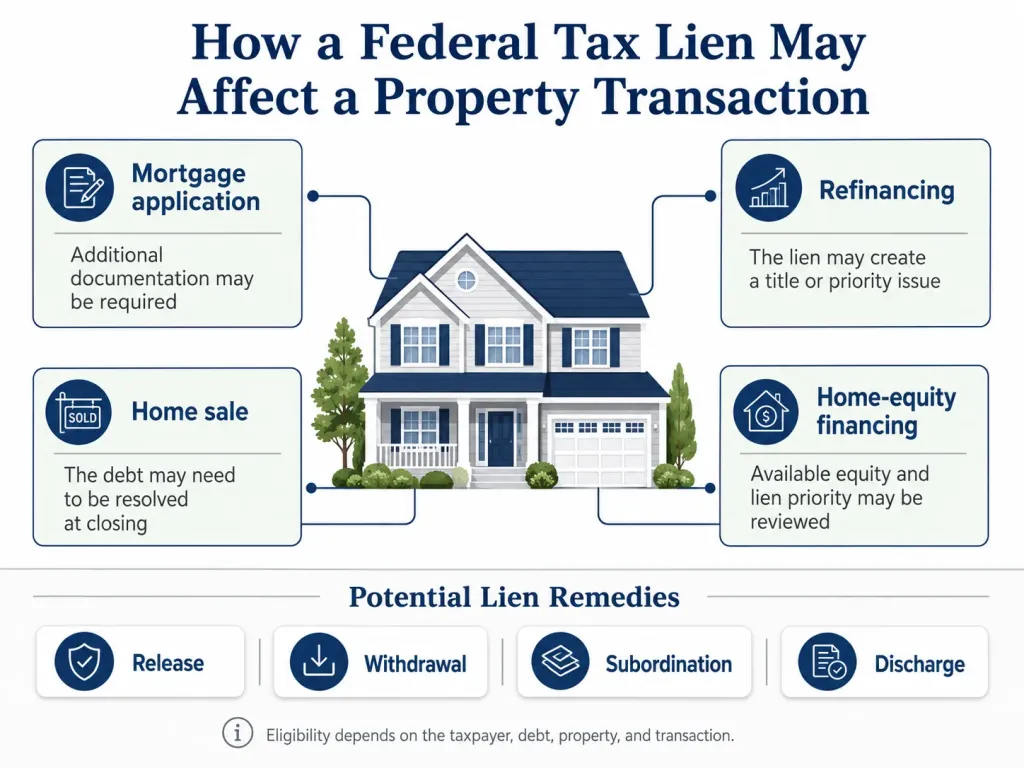
- Mortgage approval
- Mortgage refinancing
- Home-equity financing
- Business loans
- Property sales
- Asset transfers
- Commercial underwriting
The practical question is therefore not only, “Will the lien lower my credit score?” It is also, “Will the lien interfere with the financial transaction I need to complete?”
If Liens Don’t Hurt Your Score, Why Do They Still Hurt Your Ability to Borrow?
A federal tax lien generally does not hurt your credit score directly under current consumer credit-reporting practices. It can, however, make borrowing more difficult.
Lenders are not limited to reviewing the number shown as your credit score. They may also examine income, existing liabilities, monthly payment obligations, title records, public filings, tax transcripts, and the property securing the proposed loan.
For example, current Fannie Mae guidance requires lenders to obtain documentation when a borrower is repaying delinquent federal income taxes through an IRS installment agreement and no federal tax lien has been filed against the relevant property. If a recorded tax lien could affect the lender’s position, payoff or other resolution may be required in certain transactions.
Requirements vary by lender, loan program, lien status, and borrower circumstances. A tax lien does not automatically make every loan impossible, but it may create additional conditions that must be addressed before closing.
Tax Lien vs. Tax Levy: Why Lenders and Taxpayers Confuse Them
A tax lien secures the government’s interest in your property. A tax levy actually takes property or rights to property to satisfy the debt.
| IRS action | What it means | Appears on a standard credit report? | Possible financial effect |
| Unpaid IRS balance | Federal tax debt remains outstanding | Generally no | May affect cash flow and underwriting |
| Federal tax lien | Legal claim against property | No, under current bureau practices | May affect loans, sales, and refinancing |
| Wage levy | IRS takes part of ongoing income | Generally no | Reduces available monthly income |
| Bank levy | IRS takes funds from an account | Generally no | May disrupt payments and financial stability |
| IRS installment agreement | Monthly repayment arrangement | Generally no | Payment may be considered by lenders |
The absence of these items from a consumer credit report should not be mistaken for an absence of financial risk.
Can a Tax Lien Block a Mortgage or Refinance Even If Your Credit Score Looks Fine?
Yes. A federal tax lien may affect a home purchase, sale, or refinance even when it does not appear on your credit report.
A mortgage lender is concerned about both your ability to make the monthly payment and the priority of its lien against the property. A recorded federal tax lien can create title and priority issues that must be resolved before some transactions can close.
Depending on the facts, possible lien-related procedures may include:
- Lien release: Generally available after the tax liability is fully satisfied or becomes legally unenforceable.
- Lien withdrawal: Removes the public Notice of Federal Tax Lien in qualifying situations but does not necessarily erase the underlying debt.
- Lien subordination: May allow another creditor to move ahead of the IRS lien when doing so helps facilitate collection.
- Discharge of specific property: May remove the lien from a particular property while leaving it attached to other assets.
The IRS states that it generally releases a federal tax lien within 30 days after the tax debt is fully paid. It may also withdraw a Notice of Federal Tax Lien in certain qualifying circumstances.
What Happens If You Ignore IRS Tax Debt?
Ignoring IRS notices does not immediately place an item on your credit report, but it can allow the case to progress toward more serious collection action.
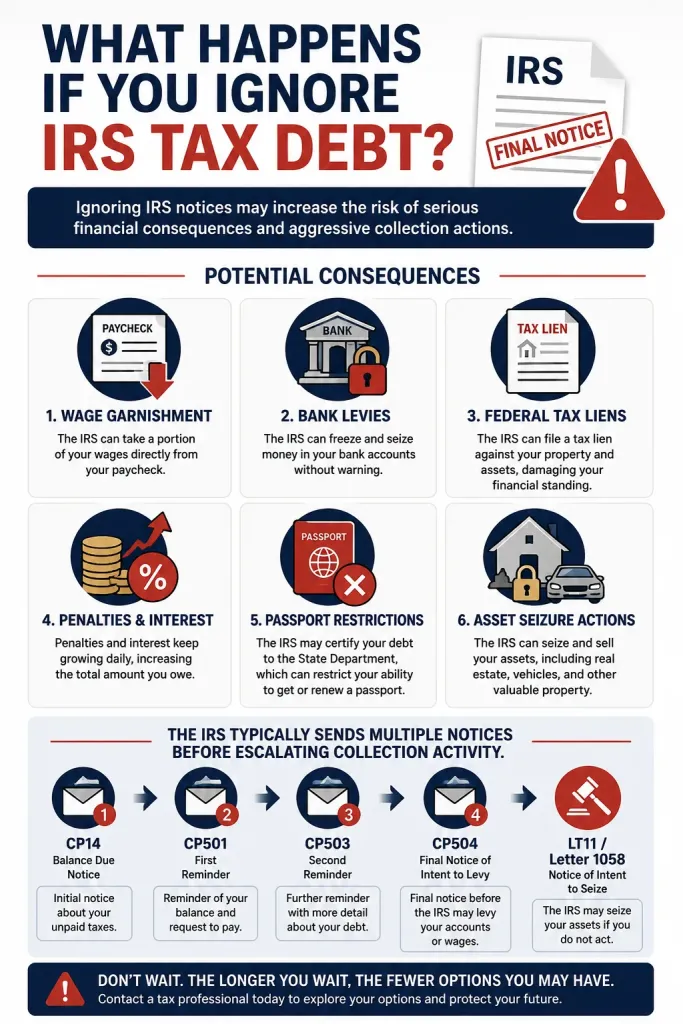
The IRS generally begins with a balance-due notice. CP14 is commonly the first bill informing a taxpayer of the unpaid balance, penalties, interest, and payment deadline. If the debt remains unresolved, additional notices such as CP501, CP503, and CP504 may follow.
Later notices, including LT11 or Letter 1058, may warn of intended levy action and provide Collection Due Process hearing rights. Taxpayers generally have 30 days to request a CDP hearing after receiving an LT11 or Letter 1058.
Ignoring the debt may increase the risk of:
- Additional penalties and interest
- A Notice of Federal Tax Lien
- Wage levies
- Bank-account levies
- Seizure of certain assets
- Loss of appeal opportunities
- Passport denial or revocation in qualifying seriously delinquent tax-debt cases
Passport certification applies only when statutory requirements are met, including an annually adjusted debt threshold and specified lien or levy conditions.
How to Protect Your Financial Profile While You Owe the IRS
The best way to reduce the broader financial impact of tax debt is to act before enforcement interferes with your income, accounts, property, or planned financing.
- Start by Reading Your Notice Line by Line
- Confirm Every Required Return Has Actually Been Filed
- Pull Your Consumer Credit Reports Before a Lender Does
- Resolve Tax Debt Before You Apply for Major Financing
- Don’t Let a Second Problem Start While You’re Fixing the First
The IRS Resolution Options That Can Actually Change This Outcome
Depending on the taxpayer’s circumstances, available IRS fresh start programs and tax resolution options may include:
- IRS installment agreements
- Offer in Compromise
- Penalty abatement
- Tax lien withdrawal requests
- Collection appeals
Every case is different, and eligibility depends on financial condition, filing compliance, and overall tax liability.
Before You Choose a Resolution Option, Know What You Actually Qualify For
Our free IRS Fresh Start Program calculator lets you enter basic details about your income, expenses, assets, and tax debt to estimate which relief options may fit your situation. In just a few minutes, you can calculate your potential eligibility yourself and get a clearer idea of whether an installment agreement, Offer in Compromise, or another IRS resolution may be worth exploring. The result is only a preliminary estimate and does not guarantee IRS approval, but it gives you a practical starting point before you spend time or money on the wrong option.
Tax Attorneys Can Help Evaluate IRS Collection Risks
Tax debt can create stress far beyond monthly payments.
IRS collection activity may affect:
- Financial planning
- Lending opportunities
- Business operations
- Employment-related financial reviews
- Personal financial stability
Conclusion
At Tax Law Advocates, our role is not to sell you a generic tax relief service and move on. We begin by understanding your notices, finances, deadlines, and goals, then stay with you through every stage of the process—from the first review and IRS communication to negotiations, documentation, and final resolution. You should always know what is happening, why a strategy is being recommended, and what comes next. Our commitment is to remain beside you until your tax problem is genuinely resolved and you can move forward with clarity and confidence.
Frequently Asked Questions
Does Taxes Affect Your Credit Score?
Generally, owing taxes alone does not directly lower a credit score because the IRS typically does not report tax debt directly to major credit bureaus.
Does Owing the IRS Affect Your Credit Score?
While unpaid IRS debt may not directly appear on a standard credit report, it may still affect lending decisions and overall financial evaluations.
Does the IRS Report to Credit Bureaus?
The IRS generally does not directly report tax debt balances to Equifax, Experian, or TransUnion.
Do IRS Collections Go on Credit Reports?
IRS balances themselves are generally not directly listed on consumer credit reports, though related financial issues may still impact lending reviews.
Does a Tax Lien Affect Your Credit?
Although many federal tax liens no longer appear directly on standard credit reports, lenders may still identify liens through public records searches.
Does a Tax Lien Hurt Your Credit?
Tax liens may still negatively affect financing opportunities, underwriting reviews, and overall financial risk assessments.