
Tax Lien Removal Lawyer
Stop IRS Tax Liens, Protect Your Property & Regain Financial Control
$0M+


Discover how much tax debt forgiveness you qualify for.

IRS Filed a Tax Lien? Take Action Before It Escalates
When the IRS files a Notice of Federal Tax Lien, it’s no longer just a tax issue, it becomes a legal claim against everything you own.
Your home, your business, your bank accounts, even your future assets can be affected. Credit damage follows quickly. Opportunities disappear. And if left unresolved, the situation can escalate into levies, wage garnishments, or property seizure.
At Tax Law Advocates, our tax attorneys intervene at the legal level, not just the administrative level, to remove tax liens, stop IRS enforcement, and protect your financial future.
We handle complex lien cases nationwide and negotiate directly with IRS officers to achieve the most favorable resolution possible.
Why Clients Nationwide Trust Tax Law Advocates
We are not a call center or a volume-based tax relief company. Every case is handled with legal strategy, precision, and accountability.
- Lien Subordination & Discharge Specialists
- Direct Negotiation with IRS Revenue Officers
- Administrative Appeals & Legal Defense
- Flat-Fee Transparency with No Hidden Costs
Speak directly with a tax attorney about IRS Penalty Abatement. No pressure. No obligation. Just clear, experienced guidance and real answers for your tax situation. Speak directly with a tax professional and understand your options today.
What Does a Tax Lien Removal Lawyer Do?
A tax lien lawyer is a licensed legal professional who represents individuals and businesses when the IRS places a claim against their property due to unpaid taxes.
Unlike general tax preparers or resolution firms, a tax attorney operates with legal authority, meaning they can challenge IRS actions, file formal appeals, and develop advanced strategies to resolve liens efficiently.
When a lien is filed, the IRS gains priority over your assets. A tax lien attorney works to:
- Remove the lien entirely when possible
- Reduce its impact through legal restructuring
- Protect assets from seizure or forced liquidation
- Negotiate directly with IRS officers on your behalf
Most importantly, your attorney becomes your legal buffer, ensuring the IRS communicates through us, not directly with you.
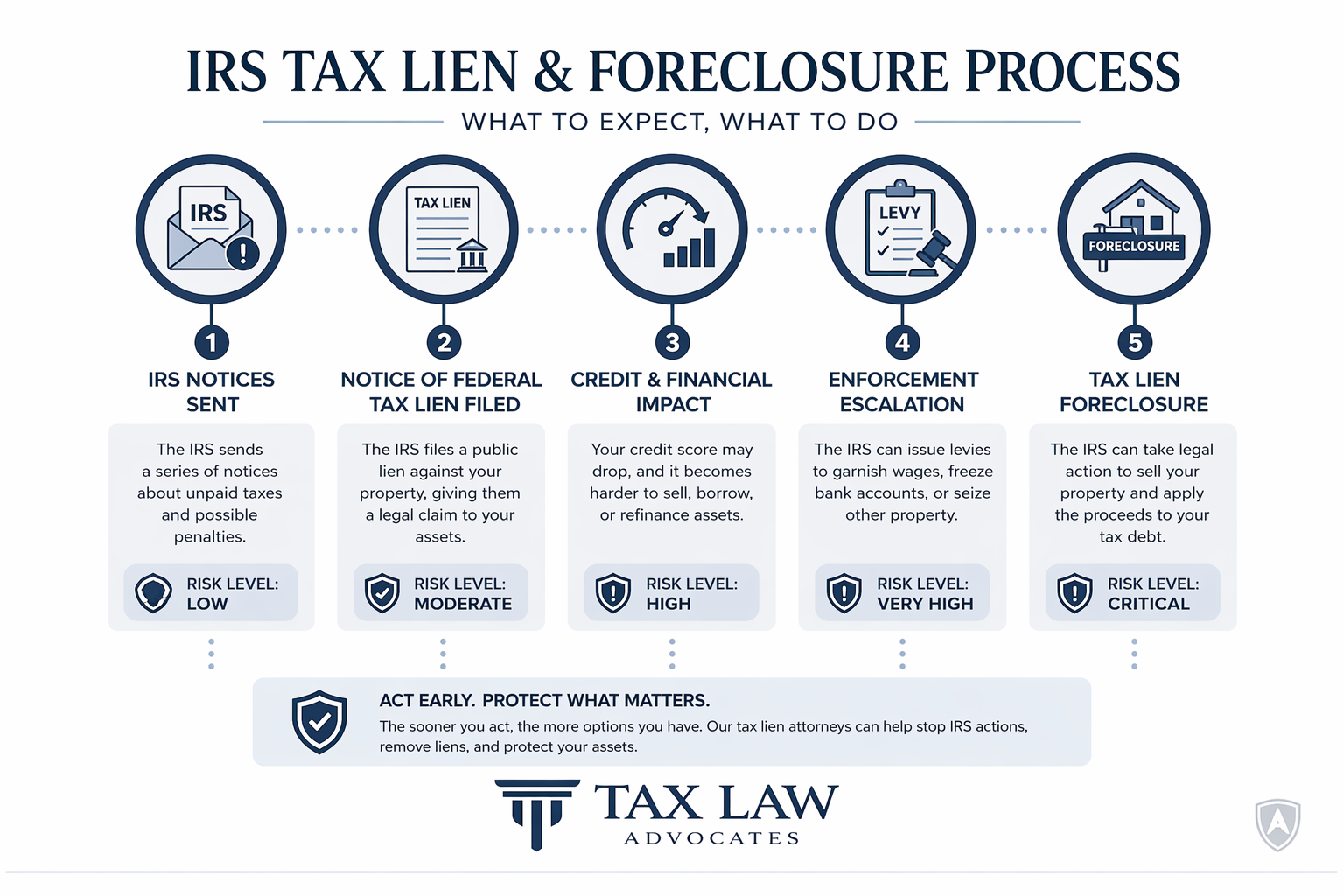
IRS Tax Lien & Foreclosure Process (What You’re Really Facing)
Tax Lien Stages
- IRS Notices Issued
- Notice of Federal Tax Lien Filed
- Financial Restrictions
- Enforcement Escalation
- ax Lien Foreclosure
What Happens in IRS Foreclosure
- Balance due notices and warnings
- Public record filed against you
- Difficulty refinancing or selling assets
- Levies or garnishments initiated
- Legal action to seize property
IRS Tax Lien Impact
- Opportunity to resolve early
- Credit damage begins
- Cash flow limitations
- Income disruption
- Loss of assets
The Hidden Risk Most Taxpayers Miss
Many taxpayers believe they still have time after a lien is filed. In reality, once the IRS records a lien, they are positioning themselves for enforcement. The sooner you act, the more leverage your attorney has to negotiate removal or restructure the lien before it escalates.
What is a tax lien?
A tax lien is the government’s legal claim against your property when you have unpaid tax debt, most commonly filed by the IRS after a tax bill goes unpaid following notice and demand for payment, such as a CP504 notice or LT11 notice. Once the IRS files a Notice of Federal Tax Lien, it becomes a matter of public record and can attach to real estate, vehicles, and other assets you own, as well as those you acquire in the future. A tax lien is different from a tax levy: a lien secures the government’s interest in your property, while a levy, such as a bank levy or wage garnishment, is the actual seizure of assets. Understanding this distinction matters because it changes what options are realistically available to you. If you’ve received lien notices from the IRS, an experienced tax attorney like David Cho can review your account, confirm what’s been filed, and walk you through steps toward resolution; Tax Law Advocates’ attorneys handle these cases directly, not through a call center.
What is a lien on a house?
A lien on a house is a legal claim placed against your property by a creditor to secure payment of a debt. It doesn’t mean you no longer own your home, but it does mean the creditor has a legal right to your property’s equity until the debt is resolved, which can affect your ability to sell, refinance, or transfer ownership. Liens can come from several sources, including mortgage lenders, contractors, homeowners’ associations, and government agencies like the IRS. If you’re seeing an unfamiliar lien on your property records, it’s worth understanding what kind it is and why it was filed before deciding on next steps. Tax Law Advocates works with property owners to identify tax-related liens, explain what they mean for your situation, and outline the paths available to address them.
Is there a lien on my house?
If you’re unsure whether a lien has been filed against your house, you’re not alone; many homeowners only discover a lien when they try to sell or refinance. The most reliable way to check is by searching public records with your county recorder or assessor’s office, where liens are officially filed. You can also request a title search, which many title companies perform for a fee, or review your credit report, since certain liens may appear there as well. If you already know you have unpaid federal or state tax debt, it’s reasonable to assume a lien may follow if the balance remains unresolved. Rather than guessing, Tax Law Advocates can help you determine your current lien status with the IRS and explain what it means for your specific circumstances.
How to Find Out if a Property Has a Lien
To find out if a property has a lien, start with a title search or a records search at the county recorder’s office, which maintains the official filings for mortgages, judgment liens, mechanic’s liens, and tax liens. Buyers and sellers typically use a title company to run this search as part of a real estate transaction, since it also verifies clear ownership. This is especially relevant for real estate investors and property wholesalers evaluating a property before purchase. If you’re checking your own property specifically for tax-related liens, requesting your IRS account transcript or contacting the IRS directly will confirm whether a federal tax lien has been filed. Tax Law Advocates can specifically verify IRS lien status on your account and explain what documentation supports your next move.
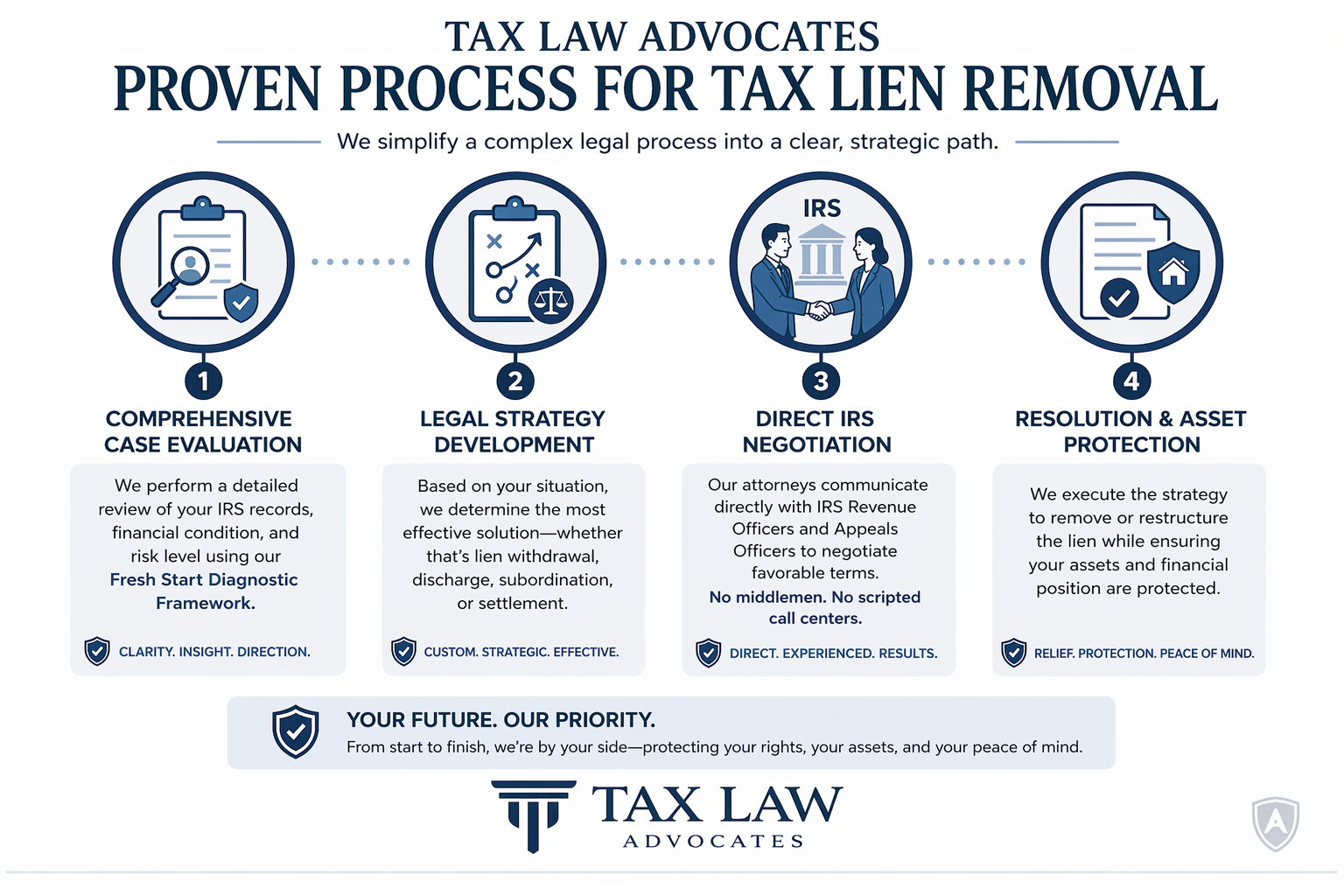
Our Proven Process for Tax Lien Removal
We simplify a complex legal process into a clear, strategic path.
01
Comprehensive Case Evaluation
02
Legal Strategy Development
03
Direct IRS Negotiation
04
Resolution & Asset Protection
How We Stop IRS Tax Liens and Prevent Levies
A tax lien is often the IRS’s first aggressive move. A levy is the next. Stopping both requires timely legal intervention and the right resolution strategy. At Tax Law Advocates, we approach every case with the goal of:
- Eliminating the lien when possible
- Preventing escalation into levies
- Protecting your income and property
- Restoring your financial flexibility
Tax Lien Solutions We Offer
Tax Lien Withdrawal (Full Removal of Public Record)
We work to remove the lien from public records entirely, which can significantly improve your credit profile and financial standing.
Tax Lien Discharge (Sell Property Without the Lien)
We allow specific assets, such as real estate, to be transferred or sold without the lien blocking the transaction.
Tax Lien Subordination (Unlock Financing Opportunities)
We reposition the IRS lien behind other creditors so you can refinance or obtain loans.
Contesting Liens & IRS Errors
If the IRS made procedural mistakes or filed improperly, we challenge the lien through formal legal channels.
Property Seizure & Foreclosure Defense
We act immediately to stop enforcement actions and protect your assets from forced liquidation.
Immediate Warning Signs You Should Not Ignore
- IRS has already filed a tax lien
- You received a Final Notice or Intent to Levy
- You cannot refinance or sell your property
- Your wages or accounts are at risk
- You owe over $10,000 in back taxes
How to check for liens on a property for free?
There are a few no-cost ways to check for liens on a property before paying for a professional search. Most county recorder or clerk offices maintain free online databases where you can search property records by address or owner name. Some states also offer centralized property record portals. Additionally, requesting a free IRS account transcript (via Form 4506-T or your IRS online account) will show whether a federal tax lien has been filed against you. Keep in mind that free searches can miss liens that haven’t been indexed yet or that exist in overlapping jurisdictions, so a paid title search is still the most thorough option before a major transaction like a sale. If your concern is specifically an IRS tax lien, Tax Law Advocates can pull your IRS records and confirm your lien status without you having to navigate the process alone.
Can the IRS take your house?
It’s a common fear, and a valid one to ask about: can the IRS actually take your house? In practice, the IRS rarely seizes and sells a primary residence, and doing so requires a formal process with significant legal safeguards, including court approval in many cases. What’s far more common is the IRS filing a tax lien against your property, which doesn’t remove your ownership but does attach to your equity and can complicate a future sale or refinance. Seizure (levy) of a home is typically reserved for cases involving large tax debts where other collection efforts, including notices like a CP90 or LT1058, have failed. If you’re worried about how far the IRS could go in your situation, it’s worth getting a clear picture of where your case actually stands. Tax Law Advocates’ attorneys can review your IRS collection status and explain realistically what is, and isn’t, likely to happen next.
What is a tax lien certificate?
A tax lien certificate is a different concept from an IRS tax lien, it’s typically issued by a local government (county or municipality) when a property owner fails to pay property taxes. The local authority sells the certificate to investors, who pay the outstanding tax bill in exchange for the right to collect that debt, plus interest, from the property owner, and potentially to foreclose if it remains unpaid within a statutory redemption period. This is separate from a federal IRS tax lien, which arises from unpaid income or business taxes rather than local property taxes. If you’re dealing with a property tax lien certificate as a homeowner, your local tax authority’s redemption process applies, not IRS procedures. If your concern involves federal tax debt instead, Tax Law Advocates’ attorneys can clarify which type of lien you’re actually facing and what resolution options apply.
Can I sell my house with a tax lien?
Selling a house with a tax lien is possible, but the lien generally needs to be addressed as part of the closing process. In most transactions, the lien is paid off directly from the sale proceeds at closing, which the title company coordinates so that clear title can be transferred to the buyer. If the lien amount exceeds your available equity, or if the sale needs to move forward before the debt is resolved, options like a partial payment agreement, an Offer in Compromise, or lien subordination with the IRS may be worth exploring, depending on your circumstances. This comes up frequently among real estate agents and mortgage brokers working with sellers facing tax debt. Tax Law Advocates can help you understand what’s realistically possible for your sale and work directly with the IRS on lien-related requests when appropriate.
Why Hiring a Tax Attorney Changes the Outcome
Legal Authority to Act on Your Behalf
A tax attorney has the authority to represent you in IRS disputes, file appeals, and protect your rights under federal law.
Strategic Negotiation at the Officer Level
We communicate directly with IRS decision-makers—not entry-level agents—allowing for faster and more effective resolutions.
Protection From IRS Pressure
Once we represent you, the IRS must go through us. This immediately reduces stress and stops aggressive communication.
The Difference Between Attorneys and Tax Relief Companies
Most tax relief companies rely on standardized processes. We provide legal strategy, case-specific solutions, and enforceable representation.
What is a tax lien investment?
A tax lien investment refers to purchasing a tax lien certificate from a local government, typically at a public auction, when a property owner has unpaid property taxes. Investors pay the delinquent tax bill and, in return, receive the right to collect that amount plus interest from the property owner, with the potential to initiate foreclosure if the debt isn’t repaid within the redemption period set by local law. This is a niche investment strategy that carries real risk, including the possibility the debt is never repaid or that redemption periods and procedures vary significantly by state and county. It’s important to note this is distinct from federal IRS tax liens, which aren’t sold to private investors. If you’re on the other side of this equation, as a property owner facing a lien, tax or otherwise, Tax Law Advocates can help you understand your specific situation and available options.
How do you put a lien on a business?
Placing a lien on a business typically happens when a creditor, including the IRS, has a legal claim against the business due to unpaid debt. For federal tax debt, the IRS files a Notice of Federal Tax Lien after assessing the tax, sending notice and demand for payment, and the balance remaining unpaid. This lien can attach to business assets, accounts receivable, and property, and it becomes part of the public record. Business owners are often surprised to learn that payroll tax debt (unpaid 941 trust fund taxes) is one of the most common triggers for IRS liens against a company, and it can carry Trust Fund Recovery Penalty exposure for responsible parties as well. If your business has received lien notices or you’re concerned about payroll tax exposure, Tax Law Advocates’ attorneys regularly work with business owners, including contractors and construction companies and restaurant owners, to assess the situation and outline a path forward.
How do you remove a lien on a property?
Removing a lien on a property generally requires resolving the underlying debt or reaching an agreement with the creditor that filed it. For an IRS tax lien specifically, common paths include paying the tax debt in full, entering into a qualifying installment agreement, or completing an Offer in Compromise, after which the IRS issues a Certificate of Release. In certain situations, taxpayers may also qualify for lien withdrawal, subordination, or discharge of specific property, each of which serves a different purpose depending on your goals, such as enabling a sale or refinance. Because eligibility depends heavily on your financial situation and IRS account history, it’s not a one-size-fits-all process. Tax Law Advocates’ attorneys can review your case, determine which lien relief options you may qualify for, and handle communication with the IRS on your behalf — contact us to discuss your specific lien.
Why Tax Law Advocates
Choosing the right firm is the difference between ongoing IRS pressure and real resolution.
Real Tax Attorneys Handling Your Case
Your case is handled by experienced professionals trained in IRS procedures and tax law—not sales representatives.
Nationwide Representation
Customized Resolution Strategy
Complete IRS Resolution Services
From payment plans to settlements and hardship programs, we handle every aspect of your case.
Transparent Flat-Fee Structure
You know exactly what you’re paying—no hidden fees, no surprises.
Proven Track Record
We have successfully helped clients remove liens, prevent levies, and regain control of their financial lives.
Real Client Scenarios
Business Owner Avoids Shutdown
A client facing a tax lien that blocked financing was able to secure funding after we obtained lien subordination, keeping operations running.
Homeowner Restores Financial Flexibility
We removed a lien that was preventing refinancing, allowing the client to restructure their mortgage.
Property Sale Saved at the Last Minute
A pending home sale was at risk due to a lien. We negotiated a lien discharge, allowing the transaction to close successfully.
Meet Your Lead Tax Attorney and Enrolled Agent for IRS Debt Relief & Tax Resolution You Can Trust

David Cho
David Cho
Scott Mullerleile
EA with 12+ years in tax resolution and a background in collections. Scott has successfully handled hundreds of cases, including accepted Offers in Compromise and representation before Revenue Officers, audits, and appeals.

Our IRS Tax Relief Results by the Numbers
Proven results helping clients resolve IRS and state tax debt nationwide.
$0M+
Tax Debt Resolved for Clients
0K+
Clients served
0%
Handled by Tax Attorneys
0%
Cases Successfully Resolved
24hr
Average Case Action Time
0
Years of experience
Tax Law Advocates Client Success Stories
Jonnel Bolotano with Tax Law Advocates was amazing to work with. Even though I didn’t initially start my case with him, he stepped in, took charge, and stayed on top of everything from that point forward.

ItzMiBaebii
If I could give Tax Law Advocates more than 5 stars, I absolutely would. Jamie and Scott were my dream team, steady, sharp, and on top of every detail. I came in with a heavy tax burden that felt like it would follow me forever...

Rebecca Ingram
Jesse Moreno my tax lawyer did a wonderful job on my case. She was very patient kind and professional, and resolution that I received was better than I expected! Thank you Jesse for representing me!

Debbie Kern
Frequently Asked Questions About Tax Lien Removal
What is an IRS tax lien?
A legal claim the IRS places on your property when you fail to pay tax debt.
Can a tax lien be removed completely?
Yes, through withdrawal, discharge, or resolution of the underlying tax debt.
How long does a lien stay active?
Until the debt is resolved or the IRS releases the lien.
Will it impact my credit?
Yes, liens can affect lending and financial opportunities.
What’s the difference between a lien and a levy?
A lien is a claim; a levy is the actual seizure of assets.
Can the IRS take my home?
In extreme cases, yes—but legal intervention can prevent this.
Do I need a tax lien lawyer?
While optional, legal representation significantly improves outcomes
How fast can this be resolved?
Depends on complexity, but early action speeds up resolution.
What is lien subordination?
It allows lenders to take priority over the IRS lien.
What if I can’t afford to pay my taxes?
We can explore hardship programs and settlement options.